|
|||
 |
|||
|
|||
|
|||
|
|||
|
|
||||||||||||||||||
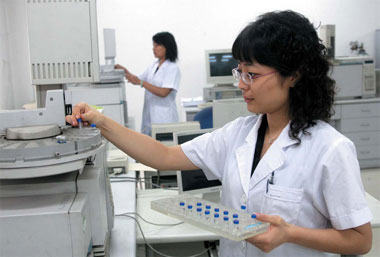
Beijing to ramp up Olympic doping testsBy Lei Lei (China Daily)Updated: 2007-07-06 10:57 Doping stained the Athens Games. In a bid to avoid a re-run in 2008, Beijing plans to subject athletes to a level of scrutiny and testing never before seen at the Olympics. "As announced by the International Olympic Committee (IOC), the number of doping tests will increase to 4,500 during the Beijing Games," said Zhao Jian, head of the Anti-Doping Commission of the Chinese Olympic Committee.
In December 2005, the Chinese agency signed a contract with organizing committee BOCOG to take the role of official drug tester at next year's Games. Most of the team have worked in the field for about 10 years. Some 200 more staff will be recruited from local hospitals to plug the gaps. "The heads of all the doping control centers at the competition venues are very experienced," Zhao told China Daily. "Meanwhile, those plucked from local hospitals will get to practice at this year's test events." A further 800 college volunteers will be recruited to help out, he added. Doping tests have risen steadily in recent years, from 2,800 at the Sydney Games in 2000 to 3,700 in Athens. Between the two Games, the number of positive results more than doubled. BOCOG is now in discussions with each of the 28 international sports federations to determine how many doping tests will be needed for each Olympic sport next year. "The number is usually decided by the host country based on what it is capable of and the IOC's approval," Zhao said. "Although the scale of the tests will be a challenge, we are confident we can manage it." Zhao's confidence is based on China's anti-doping management system, which won ISO 9001:2000 certification, an international quality standard, in April 2004. The country's drug-testing laboratory, which was set up in 1989 for the 1990 Asian Games, has passed the IOC's level-A examination for 17 straight years. Beijing has almost finished building a new laboratory to meet demand. Located in the Olympic Sports Center, at the southern end of the central cluster of Olympic venues, the new lab covers 5,000 sqm and has cost the city over 70 million yuan ($10 million). "Apart from those for the horses (equestrian events will be staged in Hong Kong), all tests will be conducted in the new lab," said Zhao. "At its peak, there will be over 200 tests a day," he said These will be overseen by 150 staff. "Most of the employees will come from affiliated institutions and universities," said Wu Moutian, head of the Chinese doping-test laboratory. "Half will be on the payroll and half will be volunteers." According to Wu, besides the current 21 staff, 60 will come from professional drug analysis institutions, 50 will be medical students from universities and 20 will be foreign experts. "Inviting foreign experts is international practice. It is a guarantor of impartiality and transparency," he said. The new lab will be put into use at the end of August for some of the Olympic warm-up events. Wu said it was too early to predict whether new drugs would be added to the test list next year. "IOC and the World Anti-Doping Agency usually announce any new items close to the opening of the Games so athletes have less chance of escaping detection," he said. Surprising athletes in this way is not unusual - it happened at the last two Summer Games. Two months before Sydney got under way, erythropoietin (EPO) tests were first carried out. Three months before Athens, the same thing happened with human growth hormone (HGH). EPO, a blood booster that facilitates the delivery of oxygen, is commonly used to give athletes an advantage in endurance sports like cycling and marathon running. HGH makes it easier for athletes to strip away fat and replace it with muscle by boosting the body's natural supplies. With such an array of threats on offer, and doping becoming ever more elaborate, the new laboratory will be granted maximum security protection to minimize the risk of tampering. "According to IOC rules, the Olympic doping test lab should be secured by armed guards 24 hours a day, while the vehicles responsible for transporting samples must be accompanied by armed guards," said doping official Chen Zhiyu. Chen said that despite the strict doping environment, Beijing will carry out the tests in a manner conducive to making the athletes feel comfortable rather than victimized. "There are two principles for the Beijing 2008 doping tests: one is not to let any drug taker get way with it, the other is athlete-oriented, as we aim to offer a good service." |