Comments
  Print
Print  Mail
Mail  Large Medium Small
River's deteriorating ecological environment hastening demise of finless porpoises. Li Jing reports in Hunan.
 A finless porpoise at Miyajima Public Aquarium in Japan. [Photo/Agencies]
Conservationist Zhao Jianguo still remembers the pain when Qi Qi, the world's last known living Yangtze River dolphin, died in 2002.
| ||||
"It really hurts to learn that Baiji (the Chinese name for the species) was extinguished in our generation," recalled Zhao, a veteran program officer with the World Wildlife Fund (WWF).
Now he fears the fate of the Baiji may recur with the Yangtze finless porpoise, a freshwater toothed cetacean whose population has plummeted in the past 20 years as a result of water pollution, illegal fishing and excessive dredging.
A 2006 study conducted by the Institute of Hydrobiology under the Chinese Academy of Sciences estimated that fewer than 1,800 Yangtze finless porpoises remain.
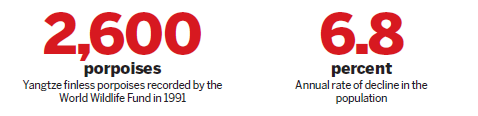
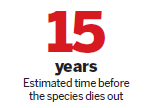
And the number is still dropping, at an annual rate of 6.8 percent, scientists from the institute said. They fear that the species will die out in less than 15 years.
Dredgers in the way
On a chilly morning in January, a group of scientists from the institute set out on a three-day survey cruise on Dongting Lake in Central China's Hunan province, one of the major habitats of the Yangtze finless porpoise.
The freshwater porpoise has lived in the main stream of the Yangtze River for more than 20 million years. An average mature dolphin can grow to 1.2-1.9 meters long.
As a member of the whale family, the Yangtze finless porpoise uses lungs to breathe, so it has to surface every eight to 10 minutes to take in fresh air. That makes it easily visible to observers. However, the first two hours of the cruise were a disappointment.
The surface was crowded with dredging vessels that are scraping sand from the lakebed so it can be shipped to downstream cities as construction material. Within a lake section less than 10 km long, researchers counted 499 large-scale dredging vessels and found no trace of the Yangtze finless porpoise.
Such findings worried Wang Kexiong, a researcher from the institute who fears that the intensive and chaotic dredging may disrupt the porpoise's once stable ecological condition.
Yangtze finless porpoises rely on a sonar system, using sound and echo to navigate and to catch fish. Noise from the dredging can severely disturb this function and even deafen the porpoises. Sometimes they bump into the boats or hit the propellers.
The heavy ship traffic along the Yangtze in recent decades has become one of the major causes of unnatural deaths among the porpoises, according to death reports collected by the researchers.
"And what's worse, this section is a crucial passage linking Dongting Lake with the Yangtze River," Wang said. "Today's findings show that the only channel through which Yangtze finless porpoises can travel between the lake and the river has been cut off because of the intensive dredging work, disrupting any possible genetic exchanges among different groups of the species."
|
 Wang Kexiong and his colleagues from the Institute of Hydrobiology, Chinese Academy of Sciences, set out on a three-day survey cruise on Dongting Lake in Hunan province, one of the major habitats of the Yangtze finless porpoise. [Photo/for China Daily]
|
Twos and threes
It took about three hours for the survey team to record the first two porpoises when the boat entered Meitan Bay, a relatively quiet area with less dredging. A hurrah burst from the volunteers and reporters who were on board. For most, it was the first time they had seen a Yangtze finless porpoise.
But the presence of the animal did not cheer Wang as much.
"They were so common to see in the river about one or two decades ago, when we carried out similar research on Baiji. Nobody thought they would diminish so quickly," Wang said.
In 1991, Yangtze finless porpoises totaled around 2,600, according to the WWF. In 2006, the figure was 1,800.
"It was quite normal to see a group of more than 10 porpoises hanging out together about 10 years ago, but now they only appear in twos or threes - another sign the species is degrading," Wang said.
In 2008, Wang and his colleagues received 21 death reports for the porpoises. But the actual deaths could be much greater. "Our estimation is around 100 every year," he said.
Besides the dredging, the local fishing industry has also become a major threat to Yangtze finless porpoises. Widespread illegal fishing and overfishing are now quite common, which not only dramatically reduces the porpoises' food sources, but also directly causes deaths.
The Yangtze's water quality has deteriorated because of damming, excessive water extraction, industrial pollution and heavy ship traffic. WWF listed the Yangtze among the 10 most endangered rivers in the world.
A subsequent impact is the dwindling of fish resources in the river. For instance, monitoring by the Yangtze River Fishery Resources Management Committee under the Ministry of Agriculture shows that from 2004 and 2006, the natural production of carp fry dropped 90 percent compared with the level in 2003, when filling began behind the Three Gorges Dam, Ma Yi, deputy director of the committee, said at a seminar in 2009.
Sustainability
Local fishermen are among the first to suffer from such changes. "Fishermen used to live quite harmoniously with the river," Wang said. "They only caught grown-up carps, and left the young fry untouched. In this way, they also saved food sources for the porpoises."
But now they are resorting to unsustainable ways of fishing, such as an extreme level of electrofishing, which is generally used only to stun fish briefly for scientific research. But fishermen use storage batteries to fire strong electric charges into the river, and then they collect the dead fish that float to the surface.
A lethal electric charge can kill anything within 20 meters, and the charge is left running continuously in the water as the fishing boat drifts along.
"Such an operation not only kills fishes at all sizes, leaving less food for porpoises, but it sometimes also kills nearby porpoises," Wang said. "Some bodies we found don't have obvious trauma, nor were they lacking food We thought electric shock might be the cause."
Although electrofishing is banned by fishery administration authorities, such practices are quite common in the Yangtze region nowadays because "otherwise you can't catch much fish," Wang said.
Intensive fishing nets set up by fishermen also trap porpoises occasionally.
"It is difficult to persuade local fishermen to give up such practices. Even fines cannot stop them," said Wei Baoyu, a program officer from the WWF. "The logic is that everybody is doing that; why should I stop?"
Wei's organization is trying to work with local fishermen "to let them understand such unsustainable ways of fishing will hurt themselves economically in the long run, so that they may work together to boycott such activities."
Meanwhile, less known impacts of climate change and extreme weather pose threats to the already vulnerable species.
In 2008, for example, some parts of the Yangtze iced up during fierce winter snowstorms in Central and South China. The finless porpoises had to crash through the ice to breathe, and some were scratched by the ice in the process. Days later, several of them died of skin infections.
|
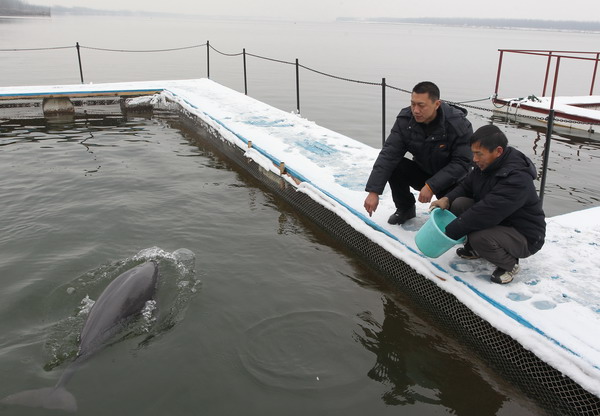 Yangtze finless porpoises are protected in a State-level semi-natural preservation area in Shishou, Hubei province. [Photo/for China Daily]
|
Will it hurt us?
There isn't much time left. And what worries conservationists and scientists is that the Yangtze finless porpoise is not catching enough attention.
Its population is already smaller than that of the highly protected giant panda (about 1,600 in the wild and 300 in captivity), yet the porpoise is still categorized at the Grade II conservation level.
"Officials from the Ministry of Agriculture have vowed to lift the conservation level to Grade I, which can ensure better protection of the species," Wang said, but he suspects that "they've met strong opposition from other related sectors."
If Grade I status were granted, protection of Yangtze finless porpoises would take priority over some economic activities along the river, such as transportation, he explained.
"Of course this would sound unacceptable to some people, giving up economic benefits for the sake of an animal that has nothing to do with their daily life," he said. "What we can do at the moment is to make recommendations for policymakers - for instance, better regulation on dredging and fishing activities. But the decisions are not up to us."
Like Zhao Jianguo from WWF, Wang fears he may have to witness the disappearance of another species.
"People always ask me about the consequences on human beings of losing these dolphins," Wang said. "No, losing them won't do us any harm.
"But if we're making the Yangtze River no longer inhabitable for these creatures, one day we may find ourselves not able to get along with the river, and that is very dangerous."


 Looted cultural relics displayed back in China
 Zhengzhou starts rail cargo service to Hamburg
 Jobless graduates swarm to grad school
 Fu becomes oldest living person at 116
 Peking University a hot tourist spot
 Building stands alone in East China
 Rain leads to bigger waterfall in C China
 Bruce Lee exhibition to open in Hong Kong
Copyright 1995 - . All rights reserved. The content (including but not limited to text, photo, multimedia information, etc) published in this site belongs to China Daily Information Co (CDIC). Without written authorization from CDIC, such content shall not be republished or used in any form. Note: Browsers with 1024*768 or higher resolution are suggested for this site.
Registration Number: 20100000002731