Comments
  Print
Print  Mail
Mail  Large Medium Small
|
 |
But something just as powerful has already arrived: rumors.
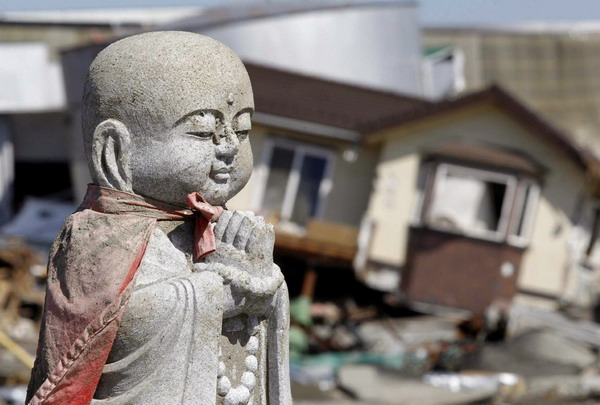
They dented the world's second largest economy in a heartbeat, just as the triple disaster ravaged the third largest, Japan, to its east.
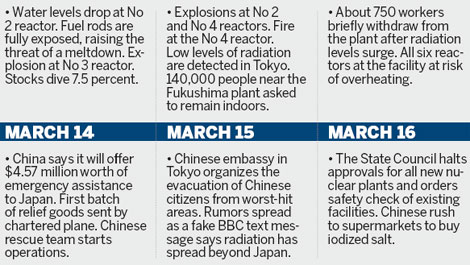
Midweek, rumors created panic and drove millions to supermarkets and stores, stocking up iodized salt, soy sauce and anything salty because they believed these products will help diffuse radiation should it reach China's shores.
It took the immediate and direct intervention by the government to stabilize salt supply and prices, although a buying quota was still imposed in many cities on Saturday, an indication that panic buying was still going on.
The common folk were responding to rumors that radiation had leaked into the sea from the Fukushima complex and would therefore compromise the safety of salt harvested from the sea.
What they did not realize was that only 20 percent of China's salt comes from the ocean, and most salt on sale is mined rock salt. Rumors also said the consumption of iodized salt would help safeguard against the effect of radiation.
As the Ministry of Health clarified, an adult would probably need to eat up 3 kilograms of salt at one sitting if it is to have any effect against radiation - meaning that they would likely die quicker from consuming that much salt than from any minimal exposure to radiation.
It all stems from the fear of the unknown, a failing which is not uniquely Chinese.
Human beings are naturally both curious and fearful about the unknown, according to James Gillies, spokesman for the European Organization for Nuclear Research. We tend to be calm about the unknown from a distance, but the minute it comes any closer, fear drives out reason.
In this case, nuclear radiation is the big unknown.
To the average Joe or Jane, the term implies two things people are most afraid of - death and complexity, both of which are enough to start the tide of fear.
Out of this same fear, Russians on Sakhalin Island have stocked up vodka and red wine. Those in Vladivostok brought home seaweed and dosimeters, a radiation-measuring device. Ukrainians in Bulgaria recommended chili peppers to block radiation.
On the other side of the Pacific, sales of gas masks soared in the United States. Some people in Los Angeles hoarded stores of drinking water and rice, while residents from the Republic of Korea to Canada desperately sought potassium iodide tablets, to the point that a pack of 14 pills attracted bids of up to $459 on Amazon.com and $300 on eBay.
In China, certain grassroots quirks have helped contribute to the profiteers' party.
To begin with, people here are afraid of missing out, so much so that some would rush to the end of a queue whenever they see a long line.
It may take them hours before realizing that the queue was for the washroom. But a few, undeterred, would still be in line the next time - "just in case", they'll say, "in case it's something good."
Apart from the mentality of not wanting to miss out on the good stuff, some are habitually wired to "swim with the tide" - whichever tide that may be and wherever it may sweep.
Those who pooh-pooh the rumors but still storm stores for salt anyway are no different from those people, who in 2003, didn't believe that smoking was a cure for SARS, but became habitual smokers anyway.
They are no different from those who, between the 1960s and 1980s, didn't believe that swinging one's arms vigorously was the panacea of all ills, but joined the arm-swinging parades in parks anyway, or from those who in the same period didn't believe that injecting chicken blood could boost one's health, but still copied by hand the book that contained all the "secret formulas".
The blind following of trends reflects a widespread lack of basic scientific knowledge.
Knowledge, unlike literacy, is hard to measure. At least some of the public panic was triggered by reporters and online writers with too much opinion but little or no understanding of science.
On microblogs, the Chinese equivalent of Twitter, some writers confused nuclear plants with nuclear reactors and others cannot tell the difference between a nuclear explosion (i.e., what happened in Hiroshima and Nagasaki in 1945) and blasts at a nuclear reactor.
After some of them wrote that there was a "nuclear blast" at Chernobyl, and that Fukushima now faces the same danger, netizens who counted on their expertise reacted furiously. Out of fear and distrust of official advice, some started new rumors. Others helped spread them.
It came to a head on Thursday, when Sheng Zhengmao, a nuclear scientist at Zhejiang University, was quoted as saying by the Qianjiang Evening News in Zhejiang province that the worst that could happen at the Japanese plant is a "nuclear explosion".
It took Fang Zhouzi, a well-known science writer dedicated to fighting pseudoscience, several tweets to explain to his 560,000 microblog followers that a nuclear explosion is impossible at any nuclear plant.
He also had to explain the very basics in an effort to convince people that, contrary to what Sheng was quoted as saying, wearing scarves would hardly help fend off nuclear radiation.
But there are still some who chose to remain unconvinced.
The inconsistent and recalcitrant flow of information from Japan after the disasters also contributed to the chaos.
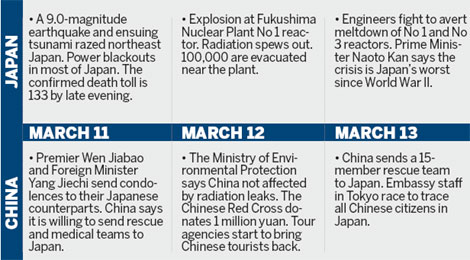
We now know that the March 11 tragedy left at least 17,000 people dead or missing. But when Japanese Prime Minister Naoto Kan called it the country's "worst crisis since World War II" two days after the earthquake and tsunami, the official death toll stood at only 1,596 - a small number compared to the Sichuan earthquake of 2008, which left 69,227 dead and 17,923 missing.
Misinformation and what the Associated Press calls the slow releasing of information on the crisis "in a country where the nuclear industry has a long history of hiding safety problems", added to the confusion.
In the first few days, some Chinese bloggers toned down the scale of the Japanese crisis and complimented the country on its excellent emergency response mechanisms. Shivering survivors near the epicenter who suffered the worst of the crisis must have no idea that they were described in China as being calm, orderly and optimistic.
That soon changed with the dramatic escalation of the severity of the crisis and subsequent footage of panic buying in Tokyo and survivors without food, water and power - all understandable events in the wake of such tragedy - left many in China confused and anxious. This, in turn, tilled the ground for rumors.
Rumors are sometimes more catastrophic than the disasters themselves.
The Chinese way of looking at this was best described by Confucian philosopher Xun Zi, who said more than 2,200 years ago: "Rumors stop at the wise." And anyone can be wise, for as Mencius put it, all men can become a sage.

 Looted cultural relics displayed back in China
 Zhengzhou starts rail cargo service to Hamburg
 Jobless graduates swarm to grad school
 Fu becomes oldest living person at 116
 Peking University a hot tourist spot
 Building stands alone in East China
 Rain leads to bigger waterfall in C China
 Bruce Lee exhibition to open in Hong Kong
Copyright 1995 - . All rights reserved. The content (including but not limited to text, photo, multimedia information, etc) published in this site belongs to China Daily Information Co (CDIC). Without written authorization from CDIC, such content shall not be republished or used in any form. Note: Browsers with 1024*768 or higher resolution are suggested for this site.
Registration Number: 20100000002731