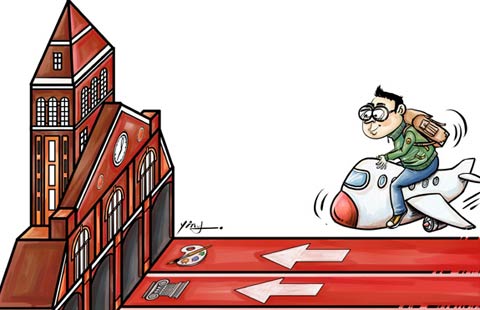
Learning a new language helps students expand horizons, report Li Xing and Tan Yingzi in Washington.
Discussions about where to go and which route to take were quite lively recently in a class at Phelps High School in Washington.
Grouped in pairs, the 16 students pointed at different spots on a map and talked about going to a restaurant, a library or a park.
The topics seemed easy, but discussing them was not. In this Chinese class, expanded for a press visit, the students had to fumble for the right vocabulary, sounds and tones.
"Ni qu tu shu guan gan shen me? (What are you going to do in a library?)" B. Rose Hansen, their Chinese language teacher, asked one student.
He paused, then answered. "Du shu (Read a book)."
Sometimes a pair started in English and turned to Chinese once they felt more comfortable with the sentences they needed to practice.
 |
|
Delmar Evans-Thomas (left), a 10th grade engineering major, and Chanel Sarter, a 12th grade architecture major, practice Chinese in a class at Phelps High School in Washington. Sarter is now in Beijing on a six-week program of language study and cultural immersion. It is sponsored by Americans Promoting Study Abroad China Scholars, which is funded by the US State Department. Photos by Li Xing / China Daily |
Phelps High School added Chinese three years ago to its curriculum of academic courses and vocational training in carpentry, plumbing, electrical and civil engineering, interior and architectural design.
Three students from Phelps High are now in Beijing, immersing themselves with dozens of other American high school students in the Chinese language for six weeks. Before she left for Beijing, Chanel Sarter, 16, said she wanted to find out how China is different from the United States.
Ready to travel
 |
|
Maps like this one help the Chinese language students learn the names of places such as park, theater and restaurant; what is done there; and how to get there. [Photo/China Daily] |
Sarter is likely to rub shoulders with other American students who are traveling in China under other programs.
George Mason University alone will take about 120 students, from high school to university postgraduates, in different programs. Among them, 15 high school students from Virginia, West Virginia and the District of Columbia will spend two weeks under the Chinese Bridge program, according to Lucia Sedwick Claster, deputy director of the Confucius Institute at George Mason.
Bridge is a two-week intensive Mandarin language and Chinese culture training program for high school students. It is organized by Hanban, the Office of Chinese Language Council International in China.
On Monday, 23 students from Howard University will leave for a one-week stay in China, visiting several university campuses in Beijing and discussing youth leadership with their Chinese peers at Peking University.
"I am interested in the unique culture of China - and we will take tai chi lessons," Howard sophomore Dominique Perkins said.
Educators are traveling to China, too. Claster is leading a group of nine from Virginia and DC on a 10-day trip that began Monday.
'100,000 Strong'
These and similar projects at many other US campuses go beyond helping fulfill US President Barack Obama's call two years ago to send 100,000 American students to China over four years.
Called the "100,000 Strong" initiative, it "seeks to prepare the next generation of American experts on China who will be charged with managing the growing political, economic and cultural ties between the United States and China," according to a news release by the US State Department.
Whenever "100,000 Strong" is discussed, officials from the State Department and schools often cite Obama's comments that far fewer Americans study in China than Chinese in the United States. These days, the numbers are about 20,000 versus more than 127,000.
"Many citizens of China have a strong knowledge of the English language and American culture, but in the US, there are many fewer citizens with a strong knowledge of the Chinese language, history and culture," Michael A. Johnson, the principal of Phelps High, told China Daily.
China is important because it is "a major economic and cultural power in our world, and it is our belief that China is playing, and will continue to play, a major influential role in shaping the future path of our global community," Johnson said.
"Our students must gain a better knowledge of Chinese language and culture so that there can be better opportunities for communication between our two countries and the people who live in these two great nations."


Copyright 1995 - . All rights reserved. The content (including but not limited to text, photo, multimedia information, etc) published in this site belongs to China Daily Information Co (CDIC). Without written authorization from CDIC, such content shall not be republished or used in any form. Note: Browsers with 1024*768 or higher resolution are suggested for this site.
License for publishing multimedia online 0108263 Registration Number: 130349