Mining project shows way to peace and prosperity, as a China Daily reporter observes in Kabul.

For more than 50 years, China has been sending workers to help Afghanistan build roads, dams, hospitals and other public projects.
By the end of 2006, China and Afghanistan had signed contracts worth $141.82 million. The pace of that investment has accelerated in recent years.
In 2007, ZTE and Huawei, both Chinese telecom companies, signed contracts for technology upgrades and mobile devices worth $10 million with an Afghan telecom company.
| ||||
Work on the mine has not begun yet. Even so, the project has been listed in the Afghanistan Ministry of Finance's draft budget statement for 2011 as one of three sources of revenue for national development, alongside "domestic revenue" and "donor grants".
The mine lies in central Afghanistan's Logar province, 35 km southeast of Kabul.
As early as 1979, when the Soviet Union invaded Afghanistan, geologists began retrieving copper samples from the mine, located in a place called Aynak, meaning "eyes" in the Pashto language.
Officials said the Taliban had established bases in the area, which is 2,300 meters above sea level.
Recently, sweepers hired by the Metallurgical Corporation of China placed white stones to mark off an area made safe from explosives.
|
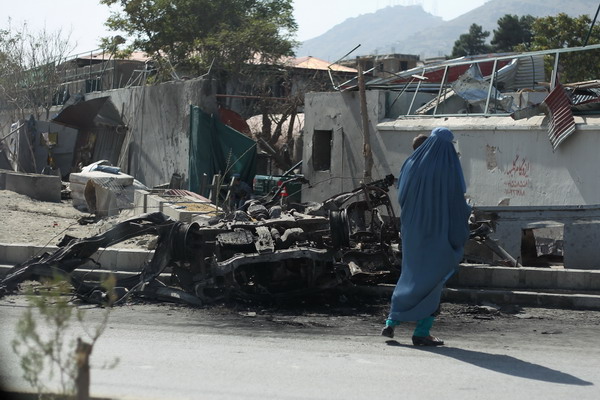 The wreckage of a car that was exploded on Aug 18, during an attack on the British Council in Kabul. [Photo by Wang Jing/China Daily]
|
In 2007, in a contest supervised by the World Bank, the joint venture outbid more than eight competitors hailing from the United States, Canada, Russia and Europe to win the Afghan government's contract for the project.
Analysts said the project will also be lucrative to the Afghan state. In return for the right to extract the metal from the ground, the company must pay "loyalty fees" every year to the government. Analysts say those fees are likely to?be equal to 40 percent of the Afghan state budget in 2006.
A report conducted by the US Defense Department and the US Geological Survey suggested that Afghanistan contains an extraordinarily large amount of iron ore, gold, lithium, lapis lazuli, emeralds and other deposits. The report estimated that those natural resources hold a value of more than $1 trillion a figure that was later increased by Afghan officials to $3 trillion.
In 2010, the country had an annual GDP of $17 billion, prompting Brookings Institution, a nonprofit public policy organization in Washington, DC, to conclude the nation's "mineral deposits could aid ailing Afghanistan".
Beyond money, the mine also promises to confer the benefit of employment.
More jobs
A recent survey by the Afghan Power Human Resources Service Company, an employment agency, found that only 35 percent of the 24,500 people living in and around the 29 villages near the Aynak copper mine have jobs.
The area also only contains a single high school and hospital. Drinking water there is obtained mostly from wells dug deep into the sandy earth, which bore no roads before work on the mine began and still has little vegetation.
Ibrahim Adel, the Afghan mining minister, once said the Aynak mine would create "10,000 jobs". Although most of the Chinese who will be working on the project are technicians, the people behind it intend to employ as many local residents as they can without affecting the operation.
"They may not have to abandon Afghanistan to work in Iran or Pakistan thanks to this project," said Abdul Wali Ahmadzai, executive director of the Afghan Power Human Resources Service Company. "They can work near their homes. Without jobs, they may fall vulnerable to the Taliban's persuasion or pick up guns and steal and rob."
Ahmadzai said the company has helped the Metallurgical Corporation of China recruit 72 permanent employees as well as about 420 temporary workers. Those numbers will increase if the mining operation starts as planned in 2014, he said.
The project appears to be having some of the desired effects.
According to the governor of Logar, Afegalla Loden, about 300 former members of the Taliban have recently turned their guns into the province. Many of them have obtained important posts in the government, while about 70 are taking part in the mine project.
"They (former Taliban members) now have houses and jobs and therefore tend to be doing good deeds."
|
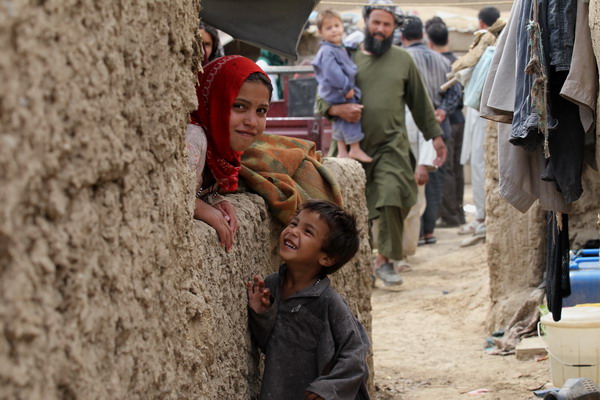 Children still manage to have fun in the slums of Kabul. [Photo by Wang Jing/China Daily]
|
Moreover, the Afghan Power Human Resources Service Company is working with the Metallurgical Corporation of China to run a training program for the Afghans who?may work on the project. Those who go through the training will receive a month of classes in technology, management, accounting, safe production and the Chinese language. They will then spend two months getting hands-on experience at their jobs.
Yasir Allmadjai, a 21-year-old trainee, has a job at the Metallurgical Corporation of China. Before that, he was in Pakistan helping Afghan refugees through the nongovernmental charity Save the Children, which gives aid to children who are suffering from various hardships throughout the world. He was also an interpreter for a US-led Provincial Reconstruction Team's military detachment that was working to rebuild Afghanistan's Paktika province.
Despite the good pay he made, amounting to $950 a month, the dangerous work led him to quit in 2009. Shortly before that, Al-Qaida and the Taliban had hit the province with frequent strikes launched from Pakistan. His father later received a warning from the Taliban stating that his son "must stop working for the US enemy".
"Weapons and explosions have the sole purpose of destroying things," Allmadjai said. "Investment instead could help construct people's lives."
Beyond the mine, the Metallurgical Corporation of China is obliged by its contract with the Afghan government to build schools, mosques, hospitals and similar places.
As can be expected from so large of an undertaking in war-torn Afghanistan, the mine project has encountered many difficulties since work began on it on July 9, 2009.
The general office director of MCC-JCL Aynak Minerals, who preferred that his name not be printed, said "We also received threats of abductions. Although no one has been hurt from this hostility, it is a shadow hanging over our staff."
Historical site
|
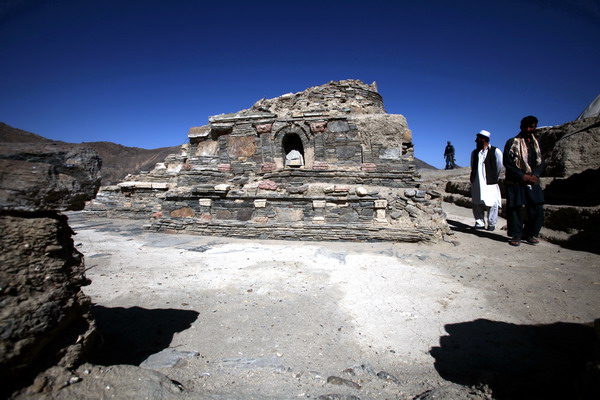 A historical Buddhist site, dating to the 6th or 7th century AD, was discovered in the Aynak mining area. An excavation of the site is expected to take place during the next three years.[Photo by Wang Jing/China Daily]
|
And there are other complications. In 2009, several news outlets began reporting that a historical Buddhist site, dating to the 6th or 7th century AD, had been discovered in the mining area.
As a compromise, MCC-JCL Aynak Minerals has said it will allow an excavation of the site to take place during the next three years. But a French archaeology company working there said that is not enough time. The work, according to the archaeology company, will take at least 10 years to do properly.
According to reports, MCC-JCL Aynak Minerals has the right to mine the site for 30 years.
"In Afghanistan, a manager should not only be good at managing but also has to know about politics, economics and even foreign relations," said a senior manager in the joint venture, who declined to give his name. "So we have to rely on the local government and clarify who is responsible for ensuring we can work safely and happily together."
"If the project can strike a balance between production and protecting culture and the environment, the benefits of it will be obvious and it will set an example for more foreign investors," the executive said.
Meanwhile, hanging over the entire project is at least one important question: Is Afghanistan safe and stable enough to allow such an operation to be successful?
Ten years since foreign troops began waging a war on terror in Afghanistan, military helicopters still fly over the leaking roof of a house where Sita, an 8-year-old girl, lives in Kabul, miles away from the mine site.
|
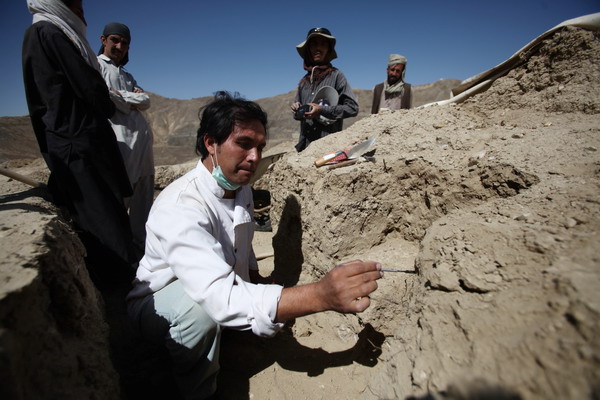 Qadir Teimuri, project manager and team leader of the Aynak excavation team affiliated with the Afghanistan Ministry of Culture, inspects the remains of the Buddhist site. [Photo by Wang Jing/China Daily]
|
Sita fled Afghanistan with her family of 40 in 2007. They first went to Pakistan and then to Iran, which they were eventually expelled from because they hadn't obtained legal residency. They then found themselves in 2010 returning empty-handed to live in a Kabul slum.
When asked about what she likes most, Sita answered, "school" and "drawing pictures of other children playing in class".
Even though she can still find enjoyment in some things, hope seems distant to Sita's family, which still burns kerosene lamps for light and fetches turbid water from a well.
Sita dropped out of school because she believed the place she was attending was too far away from home, according to her father. To support her family, she now gathers scrap metal with her brothers and sisters.
To her relatives and others, the 140,000 foreign troops who were dispatched to restore order and peace to the country have not always been welcome. Of the 1,462 civilians who died in conflicts and attacks there in the first six months of this year, 14 percent were killed by NATO troops, according to United Nations figures.
Abudulla Nasir, 19, a college student in Kabul, agreed that the intervention hasn't always been helpful.
"We need foreign aid badly, but we don't need them pointing guns at our lands," he said.
Baraimal Jeryan, a senior officer in the Afghan Ministry of Commerce and Industry's international trade department, said: "If a person is wealthy enough, he can go to university for further education and can have everything he wants to satisfy his needs. So there's no need for war.
"Afghanistan needs to absorb more foreign investment for development."
The commercial counselor at the Chinese Embassy in Afghanistan, Wu Gangchen, said he has also observed that "The Afghan people show a great eagerness for development and for cooperation with their neighbor, China, which has no history of being in conflict with Afghanistan."
Back at the copper mine, Ata Mohammad, a 53-year-old police officer, sat in front of a gate leading into the project site and said war will eventually come to an end in his country just like China wrested peace and prosperity from foreign invaders decades ago.
"I hope when you come back to Aynak in a few years, you'll see high-rise buildings and beautiful offices around the copper mine."
"Allah blesses us."


Copyright 1995 - . All rights reserved. The content (including but not limited to text, photo, multimedia information, etc) published in this site belongs to China Daily Information Co (CDIC). Without written authorization from CDIC, such content shall not be republished or used in any form. Note: Browsers with 1024*768 or higher resolution are suggested for this site.
License for publishing multimedia online 0108263 Registration Number: 130349