|
 Another healthy baby enters the world at Ruijin Hospital in Shanghai on Monday. [Photo by Carlos Barria/Reuters]
|
Questions arise over Earth's ability to sustain mankind, Shan Juan, Cui Jia and Jiang Xueqing report in Beijing.

The world's population is expected to reach 7 billion on Monday, four years later than once predicted largely thanks to China's family planning policy, according to the country's top population experts.
Population growth has rocketed. It took just 13 years for 1 billion more people to live on the planet, yet only at the dawn of the 19th century did a billion people first inhabit the Earth, according to a report by the United Nations Population Fund.
Baby No 7 Billion will probably be born in the Asia-Pacific region, where the population growth rate is the highest in the world.
China's family planning policy, which limits most mainland couples to one child, has prevented 400 million births since 1979, according to the National Population and Family Planning Commission.
The rising population presents challenges to humanity, Safiye Cagar, director of information and external relations for the fund, said on Tuesday.
"If we do not voluntarily stabilize population, we risk a much less humane end to growth as the ongoing destruction of the earth's natural systems catches up with us," the UN report said.
"How do we ensure that each of us has a decent standard of living while sustaining Earth's resources?" Cagar said
Such a huge population will put a lot of pressure on Earth, said Yuan Xin, a professor at Tianjin-based Nankai University's population and development institute. For example, the population increase plus the pursuit of a better quality of life will require more resources and therefore put the environment in danger.
"The prevented births of China are also significant for natural resource and environment preservation across the world," Yuan said Tuesday. "But that merit might be offset if the Chinese consume relentlessly like the Westerners did, given China's sheer population size."
|
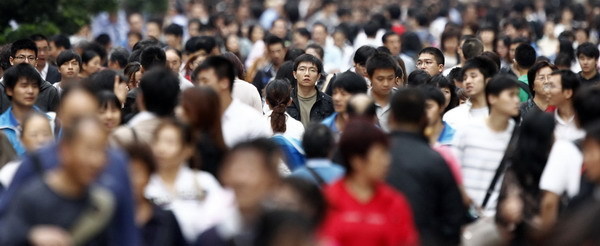 If the world seems more crowded, it may be because population will reach 7 billion on Monday, according to United Nation projections. The UN says this global milestone presents both an opportunity and a challenge for the planet. [Photo by Carlos Barria/Reuters]
|
Official data released by China and the United States show that per capita consumption in China is 20 percent of that in the US. If the Chinese were to use as much energy per capita as Americans, its total power use would be more than four times that of the US.
"Today, the individual Chinese is among the top energy consumers in the developing world, which would definitely impact the world's resources and environment," Lu Jiehua, a sociology professor at Peking University, said on Tuesday.
Take changing diet structure, for example. As income has risen for the Chinese, they began to eat more meat products, but Lu said that breeding livestock is much more polluting and energy intensive than planting.
"However, China still lags far behind most industrial countries like the US in consumption of meat or aquatic products, eggs and milk," he said.
According to Yuan, the Chinese government has recognized the potential for overconsumption of resources, and has adopted policies and taken steps to encourage a "green" economy and lifestyle.
For example, it has shut down energy- and pollution-intensive industries; has discouraged car buying through such measures as limiting license plates; has encouraged garbage sorting, water and electricity conservation; and banned the free distribution of plastic bags nationwide.
|
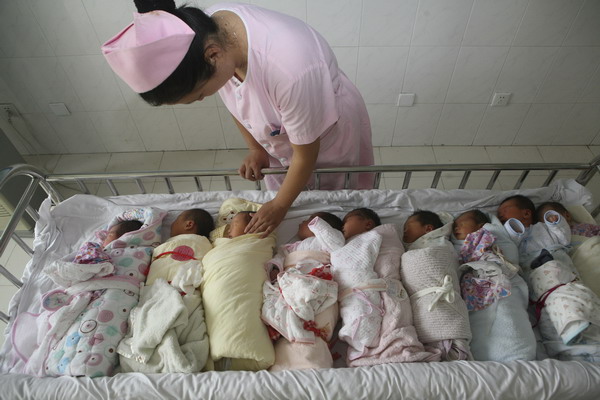 A nurse takes care of newborns at No 1 People's Hospital in Xiangyang, Hubei province. China's family planning policy has slowed the rapid growth of population. [Photo by Gong Bo/Xinhua]
|
World fertility
Despite the problems the world faces, the 7 billionth child has a better chance of surviving past age 5 than a decade ago, said Noeleen Heyzer, undersecretary-general of the UN and executive secretary of the Economic and Social Commission for Asia and the Pacific.
Yuan said that one-third of the world's countries, largely developed ones, have fertility rates below 2.1. That is the average number of children born to a woman over her lifetime, and it's the minimum rate to renew the population.
"Most developed countries, usually with lower fertility rates, are expecting a diminishing and aging population while the developing ones would instead see a stable rise in population, less aging," he said.
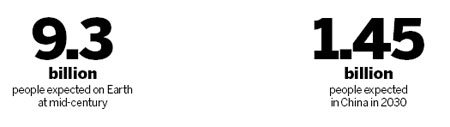
The world's fertility rate has been decreasing since the 1960s, easing global population pressure, Yuan said. On the other hand, population numbers keep rising. The UN has forecast that world population will reach 9.3 billion by the middle of this century.
China has succeeded in reining in its fast growth of population. In the 1990s, about 25 million people were born each year. The average today is 16 million.
Chinese statistics indicate the population, currently 1.34 billion, will peak at 1.45 billion in 2030 and will account for one-sixth of the world's population. That's a significant decrease from the one-third share of population held by China in the late 1660s and early 1700s, Yuan said.
According to the UN, India will overtake China as the most populous country in the world by 2050. The United States will be the only developed nation among the 10 most populated.
 |
 |
Labor migration
The population divide between developed countries and developing countries also will produce significant changes.
According to the UN forecast, among the 2.3 billion people to be added to the world by mid-century, 97 percent will come from developing countries. Developed countries will suffer a severe labor shortage, and labor will migrate to them from developing countries, which are vigorous in economic growth.
The global issue of aging populations is set to affect China, too, by increasing pressure on pension and healthcare systems. China will experience dramatic population changes, especially in terms of aging and gender balance.
"By 2050, some 25 percent of the world's gray population will be from China, compared with 20 percent now," Yuan said.
China's labor population - people 15 to 59 years old - will fall from today's 940 million to 750 million. Meanwhile, senior citizens will increase from 178 million to 480 million, from 13.3 percent of the total population to 34 percent.
Despite the shift in its labor population, China will still have more than 900 million people available to work in 2025, Yuan said, so pressure in the job market will remain high.
"We'll still have a huge base of labor for a long time, just a little bit older," he said. "Given improved life and medical services, the old could still be physically active."
 |
The sex ratio in China reached its peak at 120 - meaning 120 boys born for every 100 girls - in 2004. It stands at 118 now and is expected to drop to 115 by 2015.
The government has been trying to change people's minds about preferring sons over daughters.
"It still takes time for the sex ratio to fall to the normal level of 103-107," Yuan said. "When the generation born in the 1990s reaches its age of marriage and fertility, the relevant social problems will become more apparent.
"For example, a man will have difficulties in finding a wife; and male laborers will move into the industries that are traditionally dominated by the female due to oversupply of male labors."
Li Jing contributed to this report.


Copyright 1995 - . All rights reserved. The content (including but not limited to text, photo, multimedia information, etc) published in this site belongs to China Daily Information Co (CDIC). Without written authorization from CDIC, such content shall not be republished or used in any form. Note: Browsers with 1024*768 or higher resolution are suggested for this site.
License for publishing multimedia online 0108263 Registration Number: 130349