|
 |
|
A police officer in Nantong, Jiangsu province, shows local residents how to distinguish gutter oil from the genuine article. The classes are part of a September campaign in the city to reduce the use of recycled gutter oil in public eateries. Xie Yu / China Daily |
Waste liquid has energy use but process faces hurdles, Xie Yu and Wang Hongyi report in Shanghai.
The smell from Zhao Feng's van is so disgusting that anyone sitting in the cab for five minutes begins to feel nauseous.
And that is not the worst, according to the 26-year-old former courier. "In the summer the smell is so strong that even people passing by cannot stand it."
But Zhao has to bear the odor, because that is part of his current job.
|
 |
From time to time, he jumped down from the wagon and rushed off, returning with a number of dirty buckets filled with kitchen refuse and food waste blended with water and oil. It's a mixture that's often used to feed pigs in China.
From 7:00 am to 11:00 pm, Zhao and his father, 48-year-old Zhao Jinghua, a former farmer, drive around Suzhou in East China's Jiangsu province to collect kitchen rubbish from more than 100 restaurants.
Zhao Feng got this job more than a year ago. The work is much more tiring than delivering packages, but it pays much more, which is vital in helping to support his wife and two children. After Zhao had spent six months collecting waste, his father decided to join him.
In a good month as a mail courier, Zhao could earn more than 2,000 yuan ($317). His father used to make 2,000 yuan a year, growing peanuts and corn in their home province of Shandong. However, their new line of work means they can now earn a combined 10,000 yuan a month.
Moreover, both father and son believe they are performing a valuable service on behalf of the city. They are taking care of gutter oil, the discarded cooking material that clogs the city's sewers and can be seen glistening on the surfaces of the pools standing outside restaurants and other eateries.
Toxic product
After a simple procedure, the gutter oil is reclaimed as cooking oil and sold at a price of 11,000 yuan a ton. However, the reclaimed oil is toxic. After being reheated too many times, it begins to produce harmful substances such as fats, trans-fatty acids and even carcinogens. It is also a breeding ground for bacteria. However, it is difficult to distinguish the genuine article from gutter oil once it has undergone the reclamation process.
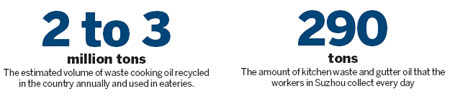
China was shocked last year when the media began to report on how the estimated 2 to 3 million tons of waste cooking oil produced every year is recycled and reused in restaurants, hotels and public canteens.
On Monday, the Ministry of Public Security in Beijing said a recent three-month national campaign against gutter oil had destroyed 60 criminal production networks, spanning 28 provinces. These networks usually comprise a number of links, including collection, rough filtering, advanced processing and sales. More than 700 suspects and 60,000 tons of recycled oil were seized during the operation.
Production chain
Despite this, the ministry said that it had found no evidence of major production or sales of gutter oil, and that it had only discovered a small number of illegal workshops, which, it said, indicated that the safety of cooking oil has improved.
However, it seems more likely that the production chain of reclaimed gutter oil is widespread and that the specter of toxic cooking oil will keep haunting the public.
Meanwhile in Suzhou, Zhao Feng and Zhao Jinghua, and their 200-plus colleagues are exploring the possibility of turning the waste oil into precious energy.
The workers in Suzhou collect approximately 290 tons of kitchen waste and gutter oil every day. It's sent to a processing plant in a nearby suburb, owned by a company called Jiangsu Clean Environmental Technology Co Ltd. There, the oil is broken down into marsh gas and biodiesel fuel, which can be used to run automobiles and airplanes.
The fuel is sold for about 8,000 yuan a ton. After costs, the company can make a profit of between 500 and 800 yuan from each ton of used oil, according to Song Kaibo, the manager, who added that the plant can produce 30 tons of biodiesel fuel a day when working at full capacity.
It seems a profitable business, but, of course, there's a snag. Song said his company is the "only one" that can survive and maintain a "slender profit" in China because of a "problem rooted in the raw materials".
"The production of biodiesel fuel is a high-tech industry, which requires high investment. That means we cannot afford expensive raw materials," he explained.
As the only authorized collector of kitchen waste in Suzhou, Jiangsu Clean doesn't have to spend a penny on collecting the used oil. According to the municipal regulations, restaurants and other outlets are legally obliged to give their kitchen waste to the company, and it is illegal to supply kitchen waste of any kind to other collectors.
However, in other places biodiesel fuel producers are not so lucky. In Shanghai, Zhongqi Environmental Protection Co Ltd and Luming Environmental Protection Co Ltd are the only companies authorized to dispose of waste oil. However, a lack of raw materials means that both of them are engaged in a desperate struggle for survival.
"Our factory can produce up to 40 tons of biodiesel fuel every day, but currently we are only producing nine or 10 tons. We only work two days a week and the number of employees has shrunk by 50 percent," Xu Zhenye, the deputy general manager of Shanghai Zhongqi Environmental Protection, told SMG Radio.
Luming Environmental Protection, Xu's rival, is facing a similar predicament. "We receive less than 20 tons of raw material on a daily basis, which makes it hard to maintain normal operations," said a Luming staff member, who declined to give his name.
Shanghai is home to approximately 40,000 restaurants. The city has licensed more than 20 companies with 450 workers to collect and transport waste oil to the premises of Shanghai Zhongqi Environmental Protection and Shanghai Luming Environmental Protection. However, the companies only receive around 30 percent of the total waste produced in the city every day.
Insiders have no doubt that the missing oil is sent for illegal further processing and is then reused in restaurants, but the collection companies denied the allegations.
|
 |


Copyright 1995 - . All rights reserved. The content (including but not limited to text, photo, multimedia information, etc) published in this site belongs to China Daily Information Co (CDIC). Without written authorization from CDIC, such content shall not be republished or used in any form. Note: Browsers with 1024*768 or higher resolution are suggested for this site.
License for publishing multimedia online 0108263 Registration Number: 130349