Asia-Pacific region is fast becoming vulnerable to climate change, Karl Wilson reports from Sydney.
It has been a year of devastation and wreckage for the region, and a year of warning about the dangers of climate change.
The impending cost of inaction could be catastrophic for both human beings and economies, experts say.
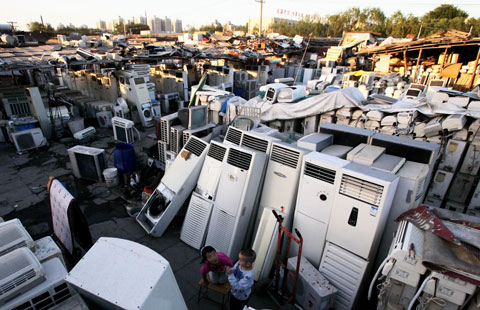
In 2011, the Asia-Pacific region was hit by some of the worst natural disasters in living memory, leaving thousands of people dead, millions homeless and wreaking havoc on domestic economies.
 |
|
AUSTRALIA: With one foot injured, a man makes it to his car so he can drive out of floodwaters at Depot Hill in Rockhampton, Queensland, on Jan 6. Daniel Munoz / Reuters |
Floods swamped large parts of eastern Australia and Thailand, while Japan and New Zealand experienced their worst earthquakes ever. Prolonged droughts and floods caused havoc in central and eastern China, with the Yangtze River basin suffering from both drought and severe flood.
Natural disasters in 2010 caused $109 billion in economic damage - three times more than in 2009, according to the United Nations. This year that figure will be much higher.
Damage from the earthquake and tsunami that destroyed much of northeast Japan in March cost in excess of $300 billion. The Australian floods in January cost the economy around $30 billion, and the February earthquake that destroyed much of Christchurch on New Zealand's South Island left a damage bill topping $20 billion.
The full economic cost of the recent floods in Thailand is still being calculated, but it is expected to run into the tens of billions of dollars.
|
 |
It will get worse
While Asia is no stranger to natural disasters, scientists say more extreme weather-related disasters are in store - droughts, floods and typhoons - owing to climate change as temperatures increase.
At a recent seminar on migration and global warming held at the Asian Development Bank's (ADB) headquarters in Manila, delegates were told that "the worst is yet to come". The United Nations and the World Bank have echoed similar warnings.
If climate change is not addressed now, the ADB said, it will severely hit the region's development and affect programs to cut poverty.
"Global warming is likely to cause rice yield potential to decline by up to 50 percent on average by 2100, compared to 1990, in Vietnam, Thailand, the Philippines and Indonesia, and a large part of the dominant forest or woodland could be replaced by tropical savanna and shrub with low or no carbon sequestration potential," an ADB study said.
It warned that the potential economic cost of inaction will be huge.
"If the world continues 'business-as-usual' emissions trends, the cost to these countries each year could equal a loss of 6.7 percent of their combined gross domestic product by 2100, more than twice the world average," the ADB said.
Dennis de la Torre of the Philippines Climate Commission said the country can expect mean temperatures "in all areas of the Philippines to rise by 0.9 degrees C to 1.1 degrees C in 2020 and by 1.8 to 2.2 degrees C by 2050". The Philippines is often referred to as Typhoon Alley because it is the first country in Southeast Asia to be hit by typhoons and other tropical storms as they barrel in over the Pacific Ocean. The country is poor, so the impact on the livelihood of millions each year is significant.
"The Philippines, as an archipelagic nation, is one of the most vulnerable to climate change. The country ranks No 1 in the world in terms of vulnerability to typhoons and third in terms of people exposed to such seasonal events," De la Torre said.
He quoted a recent Climate Change Vulnerability Index, released by the global risk advisory firm Maple-croft, as saying the Philippines ranks sixth among 16 countries in the world as extremely vulnerable to climate change.
|
 |
The ADB, in a study on climate change and its impact on Southeast Asia, has said several factors contribute to the region's susceptibility to climate change.
Southeast Asia's 563 million people, who rely heavily on farming, are concentrated along coastlines that total 173,251 kilometers. An increase in extreme weather and forest fires arising from climate change jeopardizes vital export industries that account for more than 40 percent of employment and about 11 percent of GDP.
"Rapid economic growth and structural transformation in Southeast Asia helped lift millions out of extreme poverty in recent decades. But poverty remains high and the poor are the most vulnerable to climate change."
The ADB said mean temperature increased by 0.1-0.3 degrees C each decade from 1951 to 2000, rainfall trended downward from 1960 to 2000 and sea levels rose 1-3 millimeters a year.
Heat waves, droughts, floods and tropical cyclones have been more intense and frequent, causing extensive damage to property, assets and human life.
Recorded floods and storms have risen dramatically, particularly in the Philippines, increasing from just under 20 in the 1960s to nearly 120 by 2000-08, the study said.
It warned that the region is likely to suffer more from climate change than the world average, if no action is taken. In its projection, the annual mean temperature will rise 4.8 degrees C on average by 2100 from 1990.
"Mean sea level is projected to rise by 70 cm during the same period. Indonesia, Thailand and Vietnam are expected to experience increasingly drier weather conditions in the next 20 to 30 years, although this trend is likely to reverse by the middle of this century," the study said.


Copyright 1995 - . All rights reserved. The content (including but not limited to text, photo, multimedia information, etc) published in this site belongs to China Daily Information Co (CDIC). Without written authorization from CDIC, such content shall not be republished or used in any form. Note: Browsers with 1024*768 or higher resolution are suggested for this site.
License for publishing multimedia online 0108263 Registration Number: 130349