Shelters offer care to those living rough on the streets, Yang Wanli reports in Beijing.
 |
|
Xiaoya (left) plays the recorder along with fellow students at the Beijing Juvenile Rescue and Protection Center. The 12-year-old, who has malformed legs, was abandoned by her grandmother at an early age. Photos by Zhang Wei / China Daily |
Wang Ming has visited three provinces in China since the beginning of 2011. That's not bad going for a 12-year-old. Without a guidebook or a change of clothes, the boy took nothing but 200 to 300 yuan ($31 to $47) for each trip. Sharing a passion for globetrotting with his hero Bear Grylls in the TV program Man vs Wild, he has attempted to realize his dreams by becoming a runaway.
At a juvenile center in Beijing, Wang is among 40 children brought in off the streets. Some ran away from home, others were abandoned. Since it opened in 2003, the center has helped more than 5,000 "lost" children.
It's difficult to gauge how many children are living rough on China's streets, but on June 1 the Ministry of Civil Affairs revealed that more than 10,000 juveniles nationwide had been rescued or were being given shelter and protection in government-run centers from January to April this year.
A 2007 survey conducted in nine cities, including Beijing, Hangzhou and Shanghai, by the National Working Committee on Children and Women under the State Council, estimated the number to be between 1 million and 1.5 million.
Situated close to Beijing's East 5th Ring Road, the pink roofs of the center's six bungalows are bright and vivid in a sea of gray or white buildings. Youngsters aged 3 to 18 - mostly from rural areas in provinces such as Hebei, Henan, and Sichuan and the Ningxia Hui autonomous region - make up the bulk of the inhabitants.
"The children sent here are those who can't remember where they're from or who haven't contacted their relatives for many years," said Xu Dong, director of the center, who explained that domestic abuse, difficult relations with parents or a cripplingly low standard of living are the reasons usually cited when the children are asked why they ran away.
Wang's story is slightly different. His parents are divorced and Wang and his older sister have been living with their father in a village in Jiangsu province in East China. Wang's father works in construction and rarely has time to devote to his children or their education. Wang found himself at a loose end. "I don't like school or the village. They're so boring," he said, his dark eyes twinkling mischievously.
Xu said that many of the children give false names and lie about their backgrounds when they are first admitted to the center to avoid being sent home, but they usually end up admitting the truth once they learn to trust the staff. That was the case with Wang, who was persuaded to reveal his real address and contact details for his father. "I don't want to stay here, even though it's nice to have clean clothes and sleep in a comfortable bed," he said.
He ran away from home earlier this month and sneaked onto a Beijing-bound train. This latest escapade followed two previous attempts to break free when he traveled to the provinces of Guangdong and Yunnan "to see those beautiful sites", he admitted, as he described the bridges and mountains he'd seen. With little money in his pocket, he ate food provided by locals until the police sent him to the juvenile center.
According to Xu, this type of "free traveling" is quite normal for runaway kids. They can easily avoid detection and the ticket checks on trains, although Wang occasionally bought a ticket using an ID card he found in the street and the money he had "borrowed" from home.
 |
|
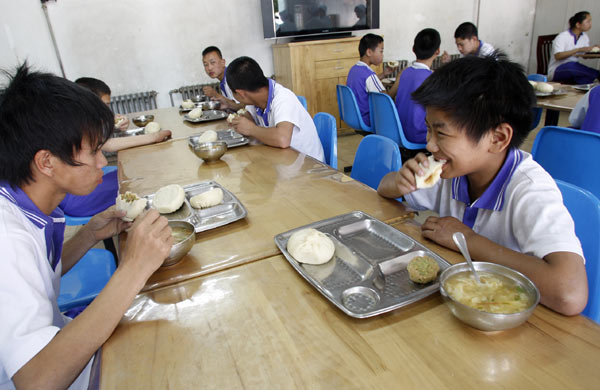
Street child Wang Ming (right) has dinner at a juvenile center in Beijing. Zhang Wei / China Daily |
Wanderlust
The mini-adventurer is driven by wanderlust. "I saw people traveling to famous places on TV, and I wanted to be just like them," he said. In the early days of his trip to Beijing, his love of TV prompted him to visit the Military Museum of the Chinese People's Revolution. "I knew the museum from a TV program. It's a place I dreamed about," he said.
Like Wang, who is moving from childhood to a sense of self engendered by adolescence and beginning to pursue his own choices, most of the children at the center are 11 to 16 years old but few have close connections with their immediate family.
However, their lifestyles have provided them with strong survival skills. Roaming the bar areas of the North 2nd Ring Road, Wang spent most of his days in electronic games arcades, picking up dropped coins to feed the machines, and slept on park benches at night. A number of residents provided food, including an African man who piqued the boy's curiosity. "I took a bus to the international airport and asked the service people how I could get to Africa. I even showed them the ID card," he said. "But, they refused to let me travel, saying that I could only go there with my parents."
After a few days on the streets of the capital, the police sent Wang to the rescue center. Once the boy revealed his real address, Xu contacted Wang's father, who refused to take his son back, reasoning that he will almost definitely run away again. "If the local government in his hometown can't send someone to collect him, we will have to send him back alone," said Xu.
Basic education is provided for long-term residents and the center is supplied with books covering the entire nine-year school curriculum. Although there are only about 40 students in the class, far fewer than in ordinary primary schools, teaching is not an easy task. Every 60-minute lesson is split into three, 20 minutes allocated for each group, with students taught according to their ability and previous educational background.
"Teaching those students really takes a great deal of patience and advanced skills," said Feng Guixia, a 59-year-old who teaches Chinese and mathematics. She has been working at the center, earning 1,500 yuan ($236) a month, since retiring from her job as a teacher at a nearby school five years ago.
 |
|
Li Shengli, who arrived at the center in 2005, makes his bed. Born with just vestigial digits and not fully formed fingers, the 15-year-old was abandoned on a train by his parents. |
Just like a family
"The bonds that connect the kids are very touching," she said. "Unlike a lot of children nowadays, the kids here always share what they have, whether it's delicious food, new toys or other things. The youngest child is always treated well, just like in a family," she said.
Roughly 90 percent of the children sent to the center are eventually reunited with their families, but the others, those that have been abandoned, are destined to live there until they are 18. Li Shengli, 15, who arrived at the center in 2005, was abandoned on a train. "I was traveling with my parents and fell asleep. When I woke up, they had gone," he said, avoiding eye contact and rubbing his left hand on his clothes. His hand looks unusual because he was born with just vestigial digits and not fully formed fingers. He doesn't know if that is the reason he was abandoned.
Li said he can't remember anything about his birthplace and little about his family, but he knows that he has an older sister and a brother. When asked if he wanted to find his family, he looked down at the floor and shook his head.
He perked up momentarily only when he spoke of the things he's seen and done. "I love the Great Wall. It's so long and so beautiful. We climbed for hours until our legs were tired and we could hardly take another step. We went to the highest part and saw the lovely scenery, colorful trees, blue sky and birds," Li smiled. "I know where Beijing is. It's on the neck of the cockerel (to many people, the depiction of China on the map makes the country look like a crowing cockerel)."
But his interest evaporated when he spoke of life outside the center, a life with which he's unfamiliar and a frightening prospect: "I dare not explore the outside world. If I leave here, I will just be homeless again," he said.
Contact the reporter at yangwanli@chinadaily.com.cn
Tang Yue and Wu Wencong contributed to this story.


Copyright 1995 - . All rights reserved. The content (including but not limited to text, photo, multimedia information, etc) published in this site belongs to China Daily Information Co (CDIC). Without written authorization from CDIC, such content shall not be republished or used in any form. Note: Browsers with 1024*768 or higher resolution are suggested for this site.
License for publishing multimedia online 0108263 Registration Number: 130349