Cities may struggle to fund and maintain ever-expanding underground systems, report Xin Dingding and Wang Xiaodong in Beijing and Shi Yingying in Shanghai.
China has spent 39 billion yuan ($6.1 billion) in the past 20 years on its manned space program, which has sent 10 craft into orbit and achieved several notable breakthroughs.
However, even that vast sum would only fund construction of 78 kilometers of subway given the current average cost of 500 million yuan for each kilometer. And for most big cities with a subway, or planning a subway, 78 km is a mere fraction of a network.
So far, 28 cities have had their plans approved by the National Development and Reform Commission. According to those plans, 2,500 km of subway will be built between 2010 and 2015.
"Construction will cost at least 1 trillion yuan in total," said Chen Xunru, a member of the Chinese People's Political Consultative Conference, who conducted research into subway construction and delivered a speech on his findings to the CPPCC's annual meeting in March.
 |
|
Subway Line 1 in Beijing is one of the busiest in the city. Many Chinese cities are planning to build subways, but some ignore the cost and safety aspects. Jin Song / for China Daily |
Experts are concerned that the construction could strain the resources of some city governments and plunge them heavily into debt.
They are also worried that the cities may not have taken account of the possible long-term costs of operating and maintaining the network. Moreover, there are concerns that the large-scale move toward construction has resulted in a shortage of trained professionals, which in turn could lead to reduced safety levels.
China's first subway went into operation in Beijing in 1969. Three of the country's biggest cities - Tianjin, Shanghai and Guangzhou soon followed suit and opened their own systems in the 1980s and '90s.
"Subways have many advantages, including large-volume transport capacity, high efficiency levels and low energy consumption. They can also save land and boost economic development along the line. Big cities regard subways as an important means of reducing traffic congestion and upgrading their image," said Chen.
However, the belief that a subway system is a symbol of a modern metropolis means smaller cities are also keen to build. "They see subways as their chance to polish their civic image and look like a modern city," he said.
Amid the raging competition between many similar-scale cities, some lost their ability to think rationally. "Some cities are mapping subway networks that will cost their entire combined income for five years," he said.
According to Chen, a large proportion of the funds come from the government - usually around 40 percent - and bank loans. "Subways can barely attract investors, because the (low) ticket prices are set by the government to benefit the public," he said.
Local governments are likely to shoulder a heavy financial burden if they build subways, said Chen, citing figures indicating that provincial, city and county government debt had risen to more than 10 trillion yuan by 2010. "Large-scale construction of subways will pile more debt onto local governments, increasing the financial risks."
The NDRC imposed minimum requirements to prevent financially weak cities from building subways: A city must have an urban population more than 3 million, annual GDP must exceed 100 billion yuan, the local government budget must be at least 10 billion yuan, and the one-way traffic flow must reach 38,000 at peak time.
But, caught in the grip of subway fever, some cities have acted inappropriately.
 |
|
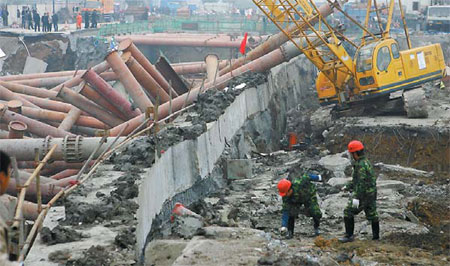
A scene of a collapse at a subway construction site that killed 21 workers in Hangzhou, Zhejiang province, in November 2008. Gao Erqiang / China Daily |
In 2008, the State Council eased its grip on subway construction in the hope that infrastructure construction would further boost the economy. Zhang Yan, secretary general of the China Association of Civil Engineers, said that some cities manipulated the figures to meet the minimum requirement and obtain the green light: "Except for those in the first-tier, most other applicant cities submitted exaggerated figures for local one-way traffic flow."
Adding to the problems, enthusiastic cities tend to overlook the huge construction costs and overestimate the potential operating income. The heavy financial burden on local governments has crushed some underprepared cities.
"We're not just talking about the huge amounts of money involved in building the infrastructure. There are also annual operating and maintenance costs," said Yang Di, a manager at Shanghai Shentong Metro Group Co, which owns the Shanghai Metro and is the parent company of the listed Shanghai Shentong Metro Co.
"It's just not going to be sustainable for cities such as Nanchang, capital of Jiangxi province, or Kunming, capital of Yunnan province, given their average GDP performance," said Yang.
The fact is that it's difficult to make money from subway operations, and only Hong Kong's metro system is profitable, he added.
Dragged into debt
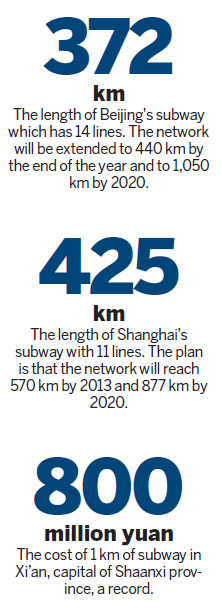
Even Shanghai, with a population of 23 million and GDP of 1.9 trillion yuan in 2011, has been dragged into debt. It has China's longest subway network, with 11 lines totaling 425 km by January. That's longer than New York (370 km) and catching up with London (439 km). The network is set to reach 570 km by 2013 and 877 km by 2020.
The city has the globe's fifth-busiest metro network - following Tokyo, Seoul, Moscow and Beijing - with 2.1 billion passengers in 2011, but the annual income it generates is insufficient to support itself.
Ying Minghong, board airman of Shanghai Shentong Metro Group Co, said that only Line 1 is profitable. The income from ticket sales and advertising covers its daily operating costs, but is not enough to pay for maintenance or the interest on its loans. The city's other lines are in debt.
Chen said that the interest on bank loans cost the municipal government several billion yuan, not to mention the cost of construction and other outlay.
Shanghai Shentong Metro Co had gross liabilities of 609.7 million yuan by the end of 2011, according to its annual report. The figure was 262.8 million yuan in 2009.
However, Yang Di warned that the report did not reflect the overall situation, since only what are deemed "optimal resources" are listed as a part of Shanghai Shentong Metro Co.
"I doubt there are more than five people in our company and the local government who know how much money the Shanghai metro loses every year. The problem is that it's not a simple mathematical question of adding the government's yearly subsidy and subtracting the metro's annual operating costs," said Yang.
A slew of State-owned enterprises are responsible for financing, construction, management and operation, according to Yang. For example, Shanghai Shentong Metro Group owns the system and is responsible for maintenance. Meanwhile, Shanghai Shentong Metro Co operates and manages the system, while Shanghai Jiushi Corp and Shanghai Chengtou Corp are in charge of financing.
"With their individual account books hidden in the dark, it is impossible to know the exact scale of the losses," said Yang.
According to a Xinhua News Agency analyst, who spoke on condition of anonymity, the total liabilities of the Shanghai metro exceed 100 billion yuan.
However, the situation is far from unique.
Beijing, with a population of 20 million, has 372 km of subway, which will be extended to 440 km by the end of the year and to 1,050 km by 2020, according to the Mirror Evening News in Beijing.
The local government donates around 10 billion yuan for subway construction annually and allocates another 2 billion yuan to subsidize operations and maintain the low ticket price, according to Wu Lishun, financing manager at Beijing Infrastructure Investment Co, which is responsible for financing subway construction.
It's estimated that in 2015, when the network reaches 581 km, the system will have an operating loss of 4.3 billion yuan, despite the huge traffic volume, Wu said. If depreciation and accounting costs are included, the loss will hit at least 17 billion yuan.
Costly, but not safer
Many cities now spend money on subway equipment that consumes energy and pushes up construction costs, but doesn't improve safety, according to Wang Mengshu, of the Chinese Academy of Engineering. Wang, who participated in the design of the country's first subway line, said that 1 km of subway cost about 400 million yuan several years ago, but the cost has soared in the intervening years. The record is currently held by Xi'an, capital of Shaanxi province, where 1 km of subway costs 800 million yuan.
One reason behind the spiraling cost is that builders blindly seek size and luxury in most cities, said Wang. "When the first subway line was built in Beijing, the platforms were smaller than 8,000 square meters. Now, none of the new platforms is smaller than 12,000 square meters," said Wang.
Wang also noted that recently built subway lines include more than 20 components, some of which he couldn't even name. "But if you look at high-speed railways, which operate faster trains and require more-sophisticated technologies, they include fewer than 10 components," said Wang.
Many of components are added out of "unnecessary safety concerns", he said, citing the example of the shield doors that have been widely adopted in newly built subway stations. The doors, which prevent access to the track from the platform, completely seal the train from the outside environment, resulting in much higher power consumption for ventilation. The shield doors are meant to prevent passengers from jumping onto the track, but such incidents have been rare in recent years.
One of the drawbacks of the complex systems is that they use too much energy, with the power to drive the engines accounting for just 30 percent of total energy consumption.
The unnecessary facilities also pose potential hazards to subway operations. "Once a small problem occurs, the whole line is halted," added Wang.
This is partly because decisions about subway construction in many cities are not made by professionals. "Since the construction of subways in most cities is guided by the government, officials often have the final say in design and construction, instead of the experts," said Wang.
The November 2008 collapse of a subway construction site in Hangzhou, Zhejiang province, that killed 21 workers is a good example of the situation, he said. The local government blamed violations of construction regulations and technical failures. "But I think the accident exposed the serious consequences that can result from excessive interference by government officials in subway construction," said Wang, who inspected the accident scene.
"It normally takes three years to build a subway station of that size, but the construction period for that line was reduced by one-half by the city government," he said, adding that local government saw the completion of the subway line as an achievement of its tenure and thus attempted to reduce the construction period.
The CPPCC's Chen believed that the construction boom has resulted in a shortage of professionals: "Construction teams in many cities were scrambled to meet a deadline and untrained workers were hired. Safety cannot be guaranteed."
He suggested that the requirements for subway construction approval should be upgraded. Even if some cities meet the basic requirements, they should not be given the green light if they have problems raising funds or are able to solve traffic congestion by other means, such as improving the existing road network.
Moreover, the decision-making procedure involving subway construction should be more open and the public should be involved to prevent the plans being hijacked by parties with a vested interest, he said.
Contact the writers at xindingding@chinadaily.com.cn, wangxiaodong@chinadaily.com.cn, shiyingying@chinadaily.com.cn


Copyright 1995 - . All rights reserved. The content (including but not limited to text, photo, multimedia information, etc) published in this site belongs to China Daily Information Co (CDIC). Without written authorization from CDIC, such content shall not be republished or used in any form. Note: Browsers with 1024*768 or higher resolution are suggested for this site.
License for publishing multimedia online 0108263 Registration Number: 130349