Road to nowhere
Because of previous problems buying train tickets for his trip home, Cai Zhigang, a 36-year-old travel agency manager in Shanghai, was excited about the toll-free policy that would save him about 500 yuan in fees.
Hundreds of cars were already in line when Cai and his wife arrived at a tollgate for the expressway to his hometown of Anqing, Anhui province, at 11 pm on Sept 29, one hour before the toll-free policy came into force. It was slow going and he only moved around 20 km in two hours. Finally, after five hours in the queue, they got through the tollgate.
By dusk the following day, Cai and his wife were only halfway to their destination and the traffic was still moving at a snail's pace. Cai decided to leave the expressway and turned on to the nearest national highway, but soon realized that repair work was underway and was forced to make a detour and use yet another highway. However, the journey still took another 10 hours and the couple finally arrived in Anqing a day later than planned.
"It was a nightmare. I underestimated how many cars would be out there," said Cai, who was so unnerved by the experience that he and his wife returned to Shanghai two days earlier than scheduled.
 |
|
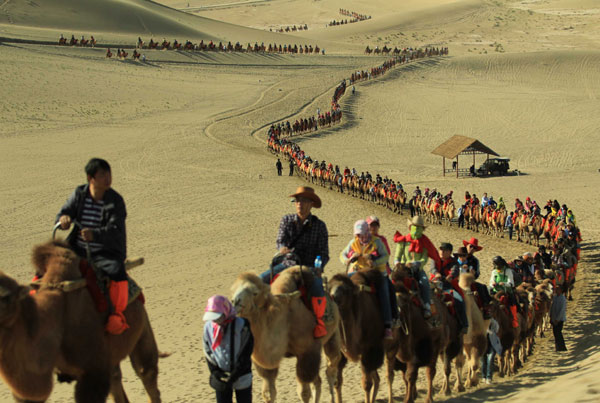
The desert in Northwest China's Gansu province is no longer an isolated place. Provided to China Daily |
 |
|
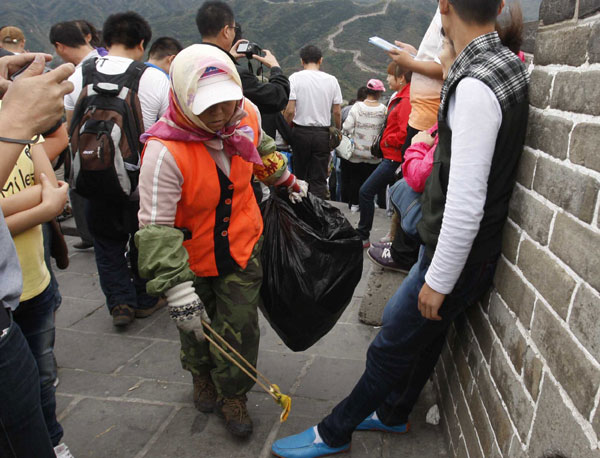
A cleaner collects garbage at the Great Wall at Badaling. Zhu Xingxin / China Daily |
Snail rail
Ma Hui, planned to take a bullet train from her home in Dongguan, Guangdong province, to Guangzhou and then catch another train to Kunming on Sept 29.
Keeping to her usual practice, Ma arrived at the local railway station to buy her ticket two hours before the scheduled departure of the train she planned to take. She felt she had left enough time, because the journey only takes around 25 minutes and trains run every quarter of an hour.
"I can always buy the ticket directly at the station. Even during the National Day holiday, I thought I could get a standing ticket at worst," she said.
However, when she got to the ticket office, there wasn't a train available for five hours. Despite having originally dismissed the idea of road travel for fear of congestion, Ma decided to take a cab to Guangzhou. The driver managed to find a relatively clear route and drove at about 100 km per hour, ignoring the speed limit of 80. The journey took around 60 minutes.
However, Ma's problems didn't end there, "The train was leaving in five minutes and the gate had closed," said Ma.
Fortunately, Ma was able to buy a ticket for the following day, although she was put to the expense of staying in Guangzhou overnight.
Meanwhile, 13,000 people were stranded at a station in Wuhan, the capital city of Hubei province, on the last working day before the holiday, according to reports in the local Chutian Metropolis Daily newspaper.
Too few holidays
Why were the roads so crowded? The lack of holidays in China might be to blame. Employees in China, Canada, the Philippines and the United States have the least generous holiday entitlement among statutory employees in 62 countries and regions surveyed for a 2011 report by Mercer, a global human resources consultancy.
Chinese employees are entitled to one paid five-day vacation if they have worked for one to 10 years. Those who have worked for 10 to 20 years are allocated 10 days of paid vacation. That low allocation often means that people are desperate to make full use of their time off.
China was ranked 59 in the Mercer list, just ahead of Thailand, the Philippines and the US. By contrast, workers in the UK enjoy 28 days of statutory leave per annum, while those in Poland get 26 days, according to the Mercer report.
Poor highway design and changes to the pattern and number of holidays are also to blame. Zhang Lingyun, vice-dean of the Tourism Institute at Beijing Union University, said that many years ago he predicted that the roads would become a major mode of travel, but the highway administration bureaus failed to anticipate the high level of demand and so the roads were not designed to accommodate such high traffic volumes.
"Those who travel by car can be flexible in their plans. That makes it extremely difficult for tourist attractions to estimate and control the volume of visitors during the holiday," he said.
In 2008, the seven-day Labor Day holiday was replaced with four shorter breaks, meaning that Chinese workers now have only two seven-day holidays each year, the National Day holiday and Chinese New Year.
As New Year is traditionally a time for family reunions, people naturally use the National Day holiday to undertake trips lasting longer than two or three days.
"It was a bad decision to replace the Labor Day holiday with shorter holidays," said Zhang. "May is a very good season for traveling, but New Year is not, because of family traditions and the cold weather. So there's only one option left for sightseeing - the National Day holiday."
With the Labor Day holiday trimmed to just three days, people are forced to visit major tourist attractions during peak season. Many parks and scenic areas - even those where the views and facilities are not very good - take the opportunity to raise the prices of tickets, food and accommodation, he added.
"Tourist attraction managers only care about profits. They are happy to see people rushing to them, as long as that doesn't cause any accidents," said Zhang. "However, we can't blame them because this is a once-in-a-year opportunity to make big money."
Contact the reporters at jiangxueqing@chinadaily.com.cn and huyongqi@chinadaily.com.cn
Wu Wencong, Peng Yining, Tang Yue and Zhang Yuchen contributed to this story.


Copyright 1995 - . All rights reserved. The content (including but not limited to text, photo, multimedia information, etc) published in this site belongs to China Daily Information Co (CDIC). Without written authorization from CDIC, such content shall not be republished or used in any form. Note: Browsers with 1024*768 or higher resolution are suggested for this site.
License for publishing multimedia online 0108263 Registration Number: 130349