National laws
Hu's question is a simple one, but before China can unify its halal logo, it will first have to codify the local regulations into a national law, said Jin Chunzi from the politics and law department of the State Ethnic Affairs Commission, who has spent the past eight years working on the formulation of the country's first law on halal foodstuffs.
 |
|
Food packaging bearing the halal logo. China has been urged to standardize the regulations on halal products. Yu Chenkang / China Daily |
"Once the law is passed, we will be able to establish a national standard, and the halal logo is a part of that," she explained. "'Ethnic unity' is not just a slogan. It should be about better protecting the rights of people from different ethnic groups and respecting each other's traditions."
However, a lack of public and official awareness about halal food and its importance to Muslims has resulted in difficulties in formulating the new laws, with some protagonists arguing that it's unnecessary to draft a law based on ethnic tradition.
Jin Chunzi disagreed. "It (the law) will actually help to maintain social stability," she said.
"The misunderstandings about halal food and a lack of law enforcement caused a lot of conflicts in the past," said Jin Rubin, who is in charge of supervision and certification of China's halal food exporters at the China Islamic Association.
Some restaurant owners believe that as long as they don't sell pork they can label their food as halal and often describe their food as such, despite not holding the relevant certification. When Muslims explain that the food is actually not halal, they don't see a problem because they just sell beef and lamb, according to Jin Rubin: "At the moment, public awareness of halal food is still very poor. People need to be educated about it and learn to respect the rules, otherwise it will create tensions."
While waiting at the checkout, Hu recalled an experience that upset him. "I once went to a restaurant with my colleagues. When we arrived, I didn't see a halal sign on the door, so I suggested we should go to a halal restaurant instead, because I am Muslim. One of my colleagues said that I could simply eat vegetable dishes or pick the vegetables out of a stir-fry that contained pork," he said. "I was embarrassed and angry at the time. I thought they would have known better. However, once I explained, my colleagues apologized, and that never happened again."
Although Jin Chunzi declined to specify a timetable for passing the law, she said legislation regarding halal food at national level is in progress. "We held a competition to design national halal food logos last year. Five designs were chosen and earlier this year they were sent to local ethnic affairs commissions for consultation." All five logos display the word halal in Chinese, English and Arabic. 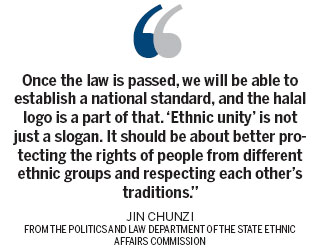
"Xinjiang's halal food logo has no Arabic - the universal sign for halal - on it. It has caused problems for exporters because of course foreigners can't read Chinese or Uygur," said Radil Abla, chairman of Arman Muslim Foods Industrial Group in Xinjiang, which exports sweets, dairy produce and desserts to more than 25 countries. "The regulations require that we have to print two types of packaging for the each product, one for domestic use and one with halal written in Arabic for the international market, which increases our costs."
As a member of the Chinese People's Political Consultative Conference, Abla has frequently proposed a national standard for halal foods. "Although China has great potential in food exporting, without a national standard those exports will never catch up with the Asian leaders, such as Malaysia, which has a world-recognized standard for halal food."
Radil said an increasing number of Chinese enterprises have noticed the global growth of the international food market for Muslims, but the process of obtaining international certification is both lengthy and costly - candidates have to cover the travel expenses of the foreign inspectors and it can take as long as six months for a certificate to be issued - and many would-be suppliers have decided not to pursue the market as a result.
Local certification is not the answer, either. "Muslim countries will never recognize products that have only been passed by local ethnic affair commissions," he said.
The Muslim market
At present, there are more than 1.8 billion Muslims globally, almost a quarter of the world's total population and the growth rate of the Muslim population could be four times as rapid as that of non-Muslims, said Jin from the China Islamic Association. The annual global trade in halal products was worth $150 billion in 2008, but exports from China average out at just $100 million annually.
 |
|
The Arman supermarket in Urumqi, capital of the Xinjiang Uygur autonomous region, is believed to be one of the largest outlets in the region selling halal food. Wang Jing / China Daily |
"The market demand and business opportunities have emphasized the need for China to speed up the process of creating a national standard," added Jin Rubin.
Ningxia was allowed to establish its own international halal food standard in 2009, as part of a trial. That standard is now recognized by seven countries, including Saudi Arabia, Egypt, Qatar, Australia and Malaysia, which means certified foodstuffs from the region are automatically eligible for export to those countries.
"At the moment, we mainly certify manufacturers within Ningxia," said Wang Shengjun, director of the region's international certification center. The region's most popular exports are meat, honey and dehydrated vegetables.
"A large milk powder company from southern China approached us once to obtain certification, but they decided not to continue with the application after learning that all key workers must be Muslims. They felt unable to guarantee that would be the case," said Wang.
A national standard is one thing, but for exporters, product quality is of prime importance, according to Jin Chunzi. "Manufacturers need to guarantee the quality of their products, first and foremost. Otherwise, they still won't get any orders, even if they reach the national standard. The depletion and degradation of the grassland means the overall quality of raw meat in China has fallen far behind other countries, whether it's halal or not."
Contact the reporter at cuijia@chinadaily.com.cn


Copyright 1995 - . All rights reserved. The content (including but not limited to text, photo, multimedia information, etc) published in this site belongs to China Daily Information Co (CDIC). Without written authorization from CDIC, such content shall not be republished or used in any form. Note: Browsers with 1024*768 or higher resolution are suggested for this site.
License for publishing multimedia online 0108263 Registration Number: 130349