Pollution gives expats a chance to air their concerns


 |
|
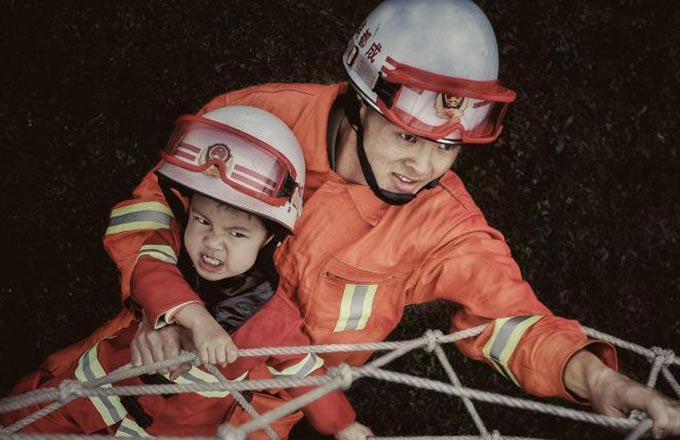
Air pollution has become an increasing important issue for expats when deciding whether to live and work in Beijing. [JIN WEN / FOR CHINA DAILY] |
Beijing's attractions shrouded by haze of anxiety, report Tang Yue, Jiang Xueqing, He Na in Beijing and Shi Yingying in Shanghai.
Usually, when people decide to live in a foreign country, two contrasting factors are uppermost in their minds - work opportunities and distance from family and friends.
However, for expats in Beijing, air pollution has become an increasingly important issue after weeks of lingering, severe smog.
On the upside, Beijing's booming economy, diverse culture and long history, Chinese cuisine and interesting people all combine to lure an ever-increasing number of foreign residents; there were approximately 100,000 in 2012, a rise of around 50 percent from 2006.
On the downside is haze, haze and haze, with record high levels of PM2.5 - particulate matter less than 2.5 microns in diameter that can enter the lungs and bloodstream, making it dangerous to human health.
January was the worst month for pollution since 1954 with five days free from smog and haze. Few residents expect the problem to be eradicated in the near future.
That harsh reality has prompted many of those who traveled thousands of kilometers to live in the city to reconsider their choice.
"I have an inner conflict because Beijing is my home, but my home is lethal, very unhealthy. So I'm very torn because of my love of living and working in Beijing. Everything about it makes me so happy," said Alison Friedman, 32, who has lived in the city for 11 years.
"Whenever any of my friends or family in the US asks me about Beijing or living in China, I say I love everything except the pollution. It's the only thing that makes me hesitate about what I'm going to do long term."
She has considered Guangzhou as an alternative location because the capital city of Guangdong province has the same kind of cosmopolitan, professional energy as Beijing, but crucially also has cleaner air.
Jonny Hutong, who came to Beijing from Vancouver, Canada, in 2010, is caught in the same dilemma.
"The air (quality) I experienced on arrival was tolerable; not ideal, but tolerable. The pollution that has become more and more prevalent over the time I have spent here, including and culminating in the last couple of months of dangerous levels of toxicity, has caused me to think about whether or not to continue living in Beijing," said the China Radio International broadcaster.
"I love Beijing, the culture, the people and my job. However, I don't know how much longer all the great things about Beijing will outweigh my basic need to breathe air that is not labeled 'very unhealthy' even on a good day."
Friedman, the director and founder of Ping Pong Productions, which develops international cultural-exchange projects, said the recent air pollution has made foreign dance troupes reconsider plans to perform in the city.
Two troupes, one from New York, the other from Los Angeles, considered performances in China, but concerns about air quality have made them hesitate.
"They didn't say clearly that they wouldn't come because of the air quality, but they definitely hesitated and asked if they should worry, should they bring masks, maybe they should wait a year until it's cleared up a little bit?" said Friedman.
The troupes have said they will "rethink" their visits, but the likelihood is that they will perform in the city either later this year or in 2014.
Political will and money
On Feb 1, Matthew Cuerdon, managing director of Bo Le Associates, one of China's largest executive search firms, conducted a personal survey of 40 senior managers aged 26 to 57. The respondents, comprising 30 expats and 10 Chinese, were asked whether they plan to leave Beijing because of the smog. As many as 10 percent said they did.
"Air pollution is always a topic of conversation when I'm interviewing a (job) candidate," said Cuerdon, who has lived in Beijing for more than six years.
Having been born in the Los Angeles area, Cuerdon grew up in a heavily polluted city. He recalled that in 1968, when he was 13, the levels and frequency of pollution in Long Beach, California, were as bad as Beijing now.
"The pollution problem can be solved, but it takes two things - political will and money," he said.
"Beijing faces the same issue that Los Angeles faced, and that is that pollution knows no boundaries. Greater Beijing needs a more comprehensive approach, (rather) than just (municipal) Beijing doing something but that takes political will because it's going to cost a lot of money, and fundamentally, the people that will end up paying are the consumers," he said.
Cuerdon believes that change will come, prompted by the rising level of discontent among Beijing residents, especially those in the middle class.
Dave Feickert, a coal mine safety adviser to China's State Administration of Work Safety, is also in the optimist camp. He is currently in his native New Zealand, but experienced the pollution in Beijing before departing.
"I believe China will solve this problem, but it will take concerted action. Most developed countries have had this problem with industrialization as well. Some have solved it in a better way than others and a great deal can be learned from those experiences," said Feickert.
Related: