The lessons learned from SARS


 |
|
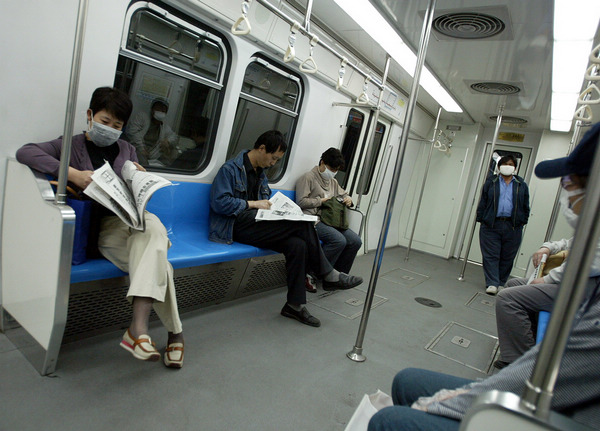
Beijing's normally bustling subway was unusually quiet during the epidemic in the spring of 2003. [PHOTOS BY XU JINGXING / CHINA DAILY] |
In Guangdong, all disease control and prevention centers from county to provincial level have been upgraded, reconstructed or even built afresh at new locations. More than 100 health inspection institutes have been established to supervise the enforcement of health laws and regulations. More than 400 stations have been set up to monitor contagious diseases. The government invested heavily in hospitals to treat infectious diseases, and in the relevant departments of general hospitals to improve their equipment and facilities.
Guangdong No 2 Provincial People's Hospital received 200 million yuan from the provincial government to build an emergency center and now serves as the main emergency hospital for the province.
The emergency center provides 600 hospital beds in the normal course of events, with 200 of them ring-fenced for emergency admissions in the event of a major epidemic. It came into service in January 2012 and can operate independently of the other parts of the hospital. Even in isolation, patients will be eligible for treatment such as imaging, surgery and intensive care, according to the hospital director Tian Junzhang.
Government funding of 16 million yuan allowed the hospital to establish a 60-member emergency medical rescue team, complete with doctors, nurses, psychiatrists and liaison and support crews. Every year, the members undertake training in wilderness survival techniques, in providing emergency treatment in the mountains and at sea, and on how to cooperate with other rescue teams.
The provincial government gave the team 25 million yuan to buy life-detection equipment, portable intensive care units and electrocardiograms, life-support systems, electric generators, tents and vehicles, so a mobile hospital can be erected wherever the team happens to be.
In the event of an epidemic in Guangdong, the hospital will collect information through an online emergency response platform and send the medical rescue team to the spot. During the process, members of the team will wear head-mounted video cameras to record their movements, the scenes they observe and the results of their inspections. Patients will be tracked via GPS wristbands, no matter which hospital they are sent to. All the information will be passed on to the provincial department of health and the Ministry of Health.
At the time of the SARS outbreak, Guangzhou No 8 People's Hospital, the city's largest facility for the treatment of contagious diseases, had no intensive care unit, central oxygen supply system or negative-pressure wards. The hospital admitted 413 suspected SARS patients, 265 of whom were later confirmed as having the disease.
To prevent the virus from spreading throughout the hospital, Tang Xiaoping, then director of the hospital, oversaw the installation of five industrial-sized electric fans at each end of the corridor, plus three others over each wardroom door and window. The fans worked 24 hours a day to ensure the rooms were properly ventilated.
Moreover, in the wake of the outbreak, the Guangzhou Municipal Government spent 500 million yuan on the first phase of a new contagious diseases hospital, and will spend a further 600 million yuan on phase 2. The building, with a floor area of 120,000 square meters, will have 1,000 beds and will be equipped with state-of-the-art technology when the second phase of the project is finished at the end of 2014.
In 2003, Guangdong's budget for monitoring a wide range of infectious diseases was as low as 2 million yuan. Now, the central government gives the province 20 million yuan annually to monitor acute infectious diseases alone, said He Jianfeng, chief expert at the Center for Disease Control and Prevention of Guangdong Province.
Thus, the center is able to monitor more than a dozen diseases, such as flu and dengue fever, and has established 84 monitoring stations in hospitals, schools and factories in 21 prefectures and cities.
The center also helps the provincial government to provide field epidemiology training programs every year since 2004. Approximately 80 of the best-qualified professionals in disease control and prevention have been selected to attend year-long off-the-job training courses.
The training and investment proved to be fortuitous and highly effective. During September and October 2010, shortly before the opening of the Asian Games in Guangzhou, China's first documented outbreak of Chikungunya fever occurred in the Wanjiang district of Dongguan city in Guangdong. Out of the 253 patients recorded, 129 were confirmed with the mosquito-borne illness that causes fever and headaches. Initially, the doctors thought the disease was dengue fever, so samples were sent to the disease control and prevention center to be tested. The experts took less than 24 hours to confirm Chikungunya fever and kick-start an emergency program to train local doctors in techniques to monitor and report the disease.
The chief of the Wanjiang district local government led disease-control professionals to every household in the district to kill adult Aedes mosquitoes thought to be responsible for transmitting the disease, and destroy their breeding habitats. The outbreak ended on October 29, 2010.
Related: