 |
|
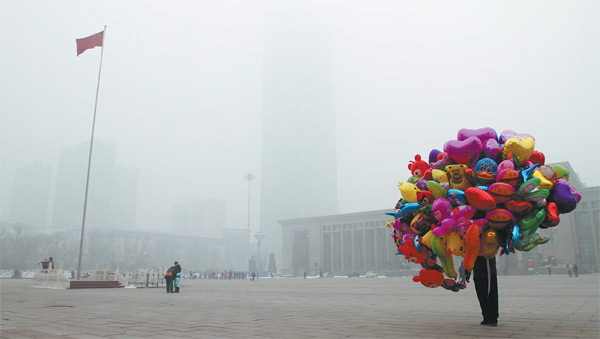
The desire for economic development has resulted in severe air pollution in Shijiazhuang, capital of Hebei province, which also affects nearby cities such as Beijing and Tianjin. CUI HUARUI / FOR CHINA DAILY
|
Before a heavy rainstorm cleared the skies above Beijing on Sunday and delighted people with a rainbow, the city had been shrouded in smog for a week.
Of the 23 air monitoring stations in the city, 14 detected heavily polluted air in the areas surrounding the capital on Saturday, while seven other areas were deemed to be moderately polluted. The monitors also identified PM2.5 - particles up to 2.5 microns in diameter and able to enter the lungs and blood stream - as the primary pollutant.
Studies by a number of academic institutions have found that on average about 25 percent of PM2.5 in Beijing comes from nearby cities. That means regional collaboration to control air pollution is crucially important, said Zhuang Zhidong, deputy director of the Beijing Environmental Protection Bureau.
|
How monitoring works byJiang Xueqing Beijing has 35 automatic air quality monitoring stations, including 23 in the city proper and the outer suburbs. The stations monitor major air pollutants such as sulfur dioxide, nitrogen oxide and PM2.5 - ultrafine particles measuring 2.5 microns in diameter or smaller. The stations analyze the pollutants and transfer concentration data to a center that produces a daily report and air quality forecasts. In addition, the Beijing Municipal Environmental Monitoring Center publishes an air quality index and real-time concentration of major pollutants on its website and micro blog, and also on mobile phones and TV. The air in Beijing is polluted on roughly half of the 365 days in the year and PM2.5 constitutes the major pollutant on 80 to 90 percent of those days. Because the launch of the PM2.5 monitoring program was hurried, various levels of government have still not fully completed their preparations, and some technical problems remain, said Zhang Dawei, director of the Beijing Municipal Environmental Monitoring Center. For example, different equipment is used in different regions and cities and the methods to monitor PM2.5 vary from place to place. As a result, the figures may show a disparity of 10 to 20 percent and cannot be compared on equal conditions. |
He said officials in Hebei province and Beijing have signed an agreement on joint pollution control - including measures such as mutual industrial development - and Beijing and Tianjin will soon sign a similar treaty.
Economic differences
Compared with some other regions such as the Yangtze River Delta, where the economies of Shanghai and the provinces of Zhejiang and Jiangsu are comparable in size, collaborative efforts between Beijing, Tianjin and Hebei province to control air pollution have been made much more difficult by the huge differences in economic performance, said Zhuang during a media event called A Century of Action for Environmental Journalism in China.
In 2012, the service sector accounted for 76.4 percent of Beijing's gross domestic product of 1.78 trillion yuan ($290 billion). However, in Hebei province, the service sector accounted for just 35.3 percent of GDP of 2.66 trillion yuan, while the industrial sector, including iron and steel, coal, construction materials and petrochemicals, contributed 52.7 percent.
"Different areas are at different stages of development and have different priorities. Because they are not on the same page, it's very difficult to carry out joint regional prevention and control of air pollution," said Ma Jun, director of the Institute of Public and Environmental Affairs.
During the process of economic development, Beijing enjoyed a number of advantages that allowed the city to discover low-carbon development paths, such as financial services and the cultural and creative industries. Tianjin and Hebei, which did not have the same advantages but still wanted to keep up with Beijing, elected to grow through energy-intensive industries instead.
To gain a mutual understanding of air pollution, the governments of the three areas must share basic information such as emission levels from the major pollution sources and their compliance with national emission standards every year, said Ma.
The Institute of Public and Environmental Affairs and several nonprofit organizations have pushed for the disclosure of real-time monitoring data of pollution sources by the governments of Beijing, Tianjin and Hebei.
"Considering that the three areas are different in terms of their developmental stages, per capita GDP and living standards, they should help each other when working towards the same goal, that of fighting air pollution, by sharing ideas, technology and funds," said Chai Fahe, vice-president of the Chinese Research Academy of Environmental Sciences.
|
|
|
|
|
|
|
|

Copyright 1995 - . All rights reserved. The content (including but not limited to text, photo, multimedia information, etc) published in this site belongs to China Daily Information Co (CDIC). Without written authorization from CDIC, such content shall not be republished or used in any form. Note: Browsers with 1024*768 or higher resolution are suggested for this site.
License for publishing multimedia online 0108263 Registration Number: 20100000002731 
















 Op Rana
 Berlin Fang
 Zhu Yuan
 Huang Xiangyang
 Chen Weihua
 Liu Shinan