The C919 will make its maiden test flight at the end of 2015, according to reports, and Zhang Yanzhong, a member of the Chinese Academy of Engineering and also an advisor to the C919 program, told the China News Service that the aircraft has already attracted 380 orders from overseas.
In addition to its use on the C919, 3-D printing technology has been employed in the design of fighter jets, according to Sun Cong, the designer of the J15 fighter, who said the technique was used in the production of the plane's supporting structure.
"In the field of aviation applications for 3-D printing, China is making synchronous progress with the developed countries," said Lu. "This technology will be widely used in aviation worldwide, and will be a sharp competitive edge in the field," he predicted.
Wang Minghua, a professor at Beijing University of Aeronautics & Astronautics who specializes in material sciences, explained that Chinese research has already had a huge impact on the nascent technology.
"Although scientists in other countries know how to print smaller parts from titanium alloys, we made the technological breakthrough for larger components that can be used in planes," he said.
Wang and his team developed the methods and equipment that allow lasers to print 5-square-meter components made of titanium alloys, expensive materials whose high tensile strength and lightness make them perfect for use in the aviation industry.
 |
|
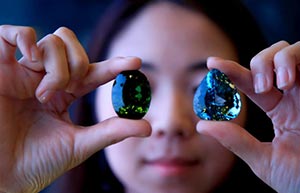
Visitors examine a model of China's first domestically designed commercial aircraft, COMAC's C919, at an exhibition in Beijing. Scientists used 3-D printing technologies to design components for the plane, such as the example pictured below right. Da Wei / for China Daily |
Reduction of wastage
"Production of aircraft parts faster and cheaper with 3-D printing," according to Wang.
Traditionally, components are made by the process of injection molding, where liquid metal is forced into molds at high pressure and then left to cool. The drawback is that the molds have to be designed and made before the parts can be manufactured, which is costly and wastes materials. "For example, the production of a component might involve the use of three metric tons of steel, but after machining, the part may weigh just 144 kilograms," said Wang.
Printing the parts is a more efficient method, because it avoids the time-consuming process of making and assembling the molds and then refining the cast components into the finished article.
Traditionally, very large components have been made in piecemeal fashion. The parts are assembled and welded into the finished product at the post-production stage - an approach that can have ramifications in terms of strength and durability. "The strength of a welded part is surely not as good as an integral, one-formed printed component," commented Wang.However, he admitted that 3-D printing is not necessarily more efficient in every circumstance. "The larger and the more sophisticated the component, the more competitive advantages 3-D printing has," he said.
The technique also has applications in a wide range of spheres. For example, military experts are pinning their hopes on a "revolution in logistical support" that may be brought about by 3-D printing.
In the future, armies may be able to print medicines and other supplies, even basic foodstuffs, on the battlefield, instead of waiting for deliveries from their supply lines, according to a report authored by two military experts in the Science and Technology Daily.
In addition to the military applications, the technology can also be widely used in high-end manufacturing, including the design of automobiles and home appliances, according to Lu.
"This new 3-D printing is an efficient tool to help improve manufacturing levels and, as such, can play a major role in upgrading China's high-end industries," he said.
|
|
|
|
|
|
|
|

Copyright 1995 - . All rights reserved. The content (including but not limited to text, photo, multimedia information, etc) published in this site belongs to China Daily Information Co (CDIC). Without written authorization from CDIC, such content shall not be republished or used in any form. Note: Browsers with 1024*768 or higher resolution are suggested for this site.
License for publishing multimedia online 0108263 Registration Number: 20100000002731 

















 Op Rana
 Berlin Fang
 Zhu Yuan
 Huang Xiangyang
 Chen Weihua
 Liu Shinan