International practice
Germany, South Korea and Denmark have all signed bilateral social insurance agreements with China, meaning people from those countries don't have to make contributions in both countries.
Xi Heng, a professor of social insurance at Northwest University in Xi'an, said it's common international practice for expats to be covered by the social insurance system of the host country.
Xu Yanjun, an official from the Ministry of Human Resources and Social Security, said that it's usual for expats to be covered this way because it helps to protect their rights.
Although she has doubts about its implementation, Jacquin welcomed the policy. "It's a very good thing that the Chinese government is pushing and building the social insurance system, treating expats the same as Chinese and aiming to provide safety and security for workers from overseas."
Jacquin described the system as aggressive, but often ineffectual. "The concept is great, but the policy lacks clear guidance for implementation."
A lack of guidance
Liu Dongsheng, from the Chongqing human resources and social insurance bureau, conceded that implementation lacks clear, detailed guidance.
"For example, the pension can only be collected by foreigners who've worked in China for more than 15 years, but most expats only work here for a short time. Even those who have worked in China for the specified time are vague about how to collect their pension," he said.
Jacquin also questioned the policy, saying it's unfair to expats who work in China for short periods of time.
Others were concerned about unemployment and maternity benefits. Julia, a foreign worker in Beijing who would only give her first name, doesn't have social insurance and has no plans to enroll.
"I don't see the benefit," said the 29-year-old. "For example, my work visa is tied to my job. Once I become unemployed, I have to leave the country, so how can I collect the money?"
She was also unsure about the scale of maternity insurance and wondered if her cover will still be valid if she has more than one child.
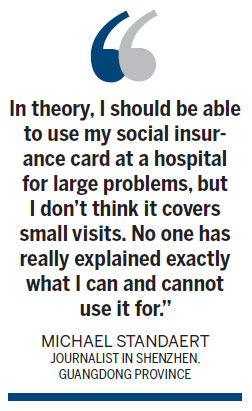
Journalist Michael Standaert enrolled in the social insurance program in Shenzhen, Guangdong province. "In theory, I should be able to use my social insurance card at a hospital for large problems, but I don't think it covers small visits. No one has really explained exactly what I can and cannot use it for," he wrote in an e-mail. He said he hasn't visited the hospital since he obtained the card.
In addition to the State program, Standaert began paying for private health insurance in 2012.
Other expats questioned the value of the medical insurance, saying the cover is useless for non-Chinese speakers.
Francesca Roberts, a 23-year-old English teacher in Chongqing, described her visit to a public hospital as "an experience I never want to go through again".
Because Roberts speaks little Chinese, a colleague accompanied her to the hospital. "I told my colleague how I felt, and my colleague translated to the doctors. After an examination, the doctor explained everything to my colleague and finally my colleague told me. My colleague knew more about my health problem than I did. I felt there was no privacy at all," she said.
However, when she attended the examination room on her own, Roberts was unable to understand the doctors and nurses, who all spoke in Chinese. "For quite a long time I didn't know what was going on," she said.
Extra payments
To better benefit employees and abide by the law, many employers supplement the State system by buying additional medical insurance that covers international and private hospitals.
"The medical insurance in the program doesn't cover the international departments of public hospitals or private clinics, where most English-speaking doctors work," said Zhang Fulan, deputy general manager of China Services International, which provides a range of services for expats, including enrolment in the social insurance program.
Zhang said most large companies, such as State-owned and international enterprises, enrol in the program to abide to the law, but private companies, especially small and medium-sized businesses, are reluctant to do so.
"Employers have to pay nearly 40 percent of an employee's monthly contribution, which is a huge drain on small businesses," she said.
As general manager of a small business with four employees, Jacquin said small and medium-sized companies feel the pinch more than larger businesses. "The cost is enormous," she said.
Lei Ting, a human resources expert at Microsoft, said the company provided training for HR staff when the policy was introduced in 2011 to ensure they fully understood the program.
"We explain to prospective expat employees that the insurance is mandatory and that they have to sign up if they want to work here. Our company is in China and we are obliged to abide by the country's laws and regulations," she said.
Lei declined to provide details of any other cover the company provides for foreign employees.
Both employers and employees are concerned about the lack of information about the program.
Zeng Yu, an HR specialist for Brose, a German autoparts company, in Chongqing, said she knew very little about the policy until she attended seminars and discussion groups to learn more.
"German workers don't need to pay the pension, but they are still required to pay for other insurance policies, including maternity and work injuries," she said.


Copyright 1995 - . All rights reserved. The content (including but not limited to text, photo, multimedia information, etc) published in this site belongs to China Daily Information Co (CDIC). Without written authorization from CDIC, such content shall not be republished or used in any form. Note: Browsers with 1024*768 or higher resolution are suggested for this site.
License for publishing multimedia online 0108263 Registration Number: 130349