 |
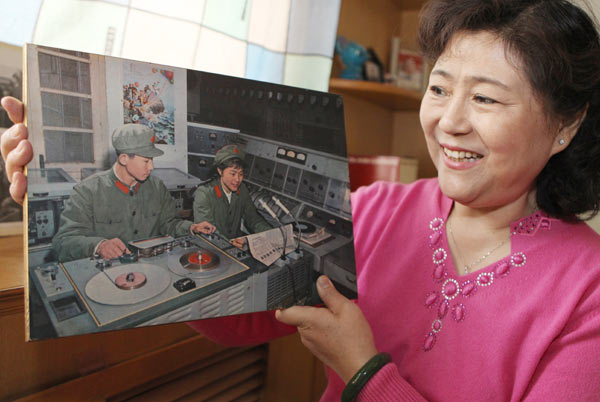
| Ni Wen holds a photograph of herself at work at the frontier broadcasting station in Xiamen, Fujian province, in 1976. ZHU XINGXIN / CHINA DAILY |
|
A place out of time First person | Ni Wen, 58, (1975-80) Being a frontier broadcaster was the most valuable experience of my life. Xiamen is very different from the inland cities. As a Beijing native, I was surprised at how open and fashionable Xiamen people were in the 1970s. I remember that there were street vendors who sold fruit and clothing, but in other cities in China, private enterprise was still illegal. The women wore high heels and wore their hair in curls. In the '70s, heels and curly hair were very rare in China. They were considered a sign of decadence, but I thought they looked good. I curled my hair as well, and I was immediately the most fashionable girl in my neighborhood when I came back to Beijing, although my new hairstyle did attract a lot of attention and almost got me into trouble once or twice. Many products from Taiwan were available in Xiamen, including tapes of Deng Lijun (Teresa Teng), one of the most popular singers in Taiwan. I hid the tapes in the bottom of my suitcase and brought them back to Beijing. At that time, Deng's songs were considered indecent and politically incorrect, so I could only listen to them through earphones. The other reason that I loved Xiamen was its beauty. I enjoyed living in a beautiful coastal city. The ocean is so wide and fascinating. I think the personality of the Xiamen people partly comes from the spirit of the ocean: open, brave and free. |
Facing out across the ocean, the ruined hulks of huge loudspeakers dominate the eastern shore of Dadeng, a leafy island of 20,000 residents that lies off the coast of Xiamen, Fujian province.
These sentinels, battered by the wind and rain, have long been silent, but once they blared across the Taiwan Straits that separate the mainland and Taiwan as an integral element of a long-running war of words.
Alongside one of the biggest horns, 2.8 meters in diameter and weighing 1.6 metric tons, is a sign proclaiming: "The world's largest military broadcast speaker".
Between 1953 and 1991, the voices of the "frontier broadcasters" that issued from the speakers were easily audible across the 7 kilometers to Taiwan's Jinmen Island, urging national unity, and encouraging Kuomintang soldiers and officers to cross over to the mainland.
"Xiamen's frontier broadcasts might as well be the voice of history itself, because they contributed to the improvement of cross-Straits communications," said Yang Guozhen, history professor at Xiamen University.
Xiamen has long been a platform for exchanges between Taiwan and the mainland. "The broadcasting program stopped in 1991, but as a special economic zone, Xiamen continues to be a frontier town where people can learn about life on the other side of the Straits. Not via loudspeakers, but through deeper and wider economic and cultural contacts," he said.
Chen Feifei, 79, a mainland frontier broadcaster from 1955 to 1989, said the speakers and studios were often the targets of artillery fire from the other side.
"We were too close. They could easily aim at our speakers. At first, every time we made a sound the shells came and shook our underground control room," said Chen, who took charge of the stations during the 1970s. "I could hear the sharp sound of the shells while I was broadcasting. Once, a piece of shrapnel ricocheted into our bunker, smashing an audiotape I was holding in my hand. It was a miracle I survived without a scratch," she said, adding proudly that she had carried on unperturbed.
Cross-Straits tensions in the 1950s resulted in four frontier broadcast stations being established off the coast of Xiamen, where the distance between the mainland and the Taiwan islands is shortest. The aim was to counteract messages being broadcast through speakers from the other side of the Straits.
Chen said the mainland broadcasts were intended to lower KMT soldiers' morale by stressing that their cause was dark and lost, while encouraging them to surrender and claim a reward for doing so.
She said that when the windspeed dropped, the broadcasts ran 24 hours a day. To compensate for the distance between the stations and their audience, the announcers spoke at a rate of 120 to 130 characters a minute, far slower than the regular broadcast speed of 200 characters.
"We spoke in Mandarin first and then repeated the message in the Fujian dialect, the language spoken by most Jinmen residents," said Chen. "Many KMT soldiers swam to Xiamen, using basketballs as buoys, after hearing our programs. Some of them could recite our announcements verbatim."
An important bridge
Because people on both sides of the Straits speak both Mandarin and the Fujian dialect, the shared languages and traditions have made Xiamen an important bridge between the two sides. 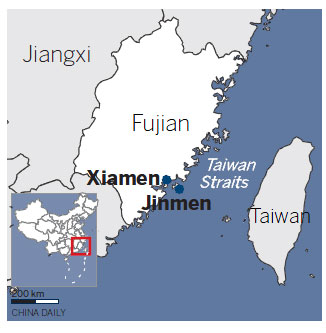
"During festivals, we played traditional Chinese music and told the KMT soldiers that their families were waiting for them - many still had relatives in Xiamen. We reminded them to wrap up warm when the weather grew cold and even teased them on special days by urging them to eat traditional spring rolls, just like Xiamen residents did during festivals," said Chen, who earned the nickname "The KMT Soldiers' Dream Girl".
"I talked to the KMT soldiers and officers almost every day and night for 32 years. In fact, I spoke to them more than to my husband and children," she said.
Unlike radio transmissions, listeners were unable to switch off the frontier broadcasts, according to Hong Chunji, 60, a mainland-based broadcaster from 1971 to 1989. He said the noise from the massive speakers was audible for 12 km and the volume "was overwhelming".
Hong was 17 when he first served at the station and was sometimes asked to cut the bushes in front of speakers to prevent them from being muffled.
"Once, they forgot I was cutting and started broadcasting," he said. "Thirty loudspeakers were piled 12 meters high and 8 meters wide. As the broadcast started, I felt the ground tremble and was knocked off my feet as though an invisible wall was bearing down on me. I rolled away and covered my ears as quickly as possible, but still felt my heart beating wildly," he said.
"The sound was so loud that it could not only make you deaf, but even kill you."


Copyright 1995 - . All rights reserved. The content (including but not limited to text, photo, multimedia information, etc) published in this site belongs to China Daily Information Co (CDIC). Without written authorization from CDIC, such content shall not be republished or used in any form. Note: Browsers with 1024*768 or higher resolution are suggested for this site.
License for publishing multimedia online 0108263 Registration Number: 130349