 |
|
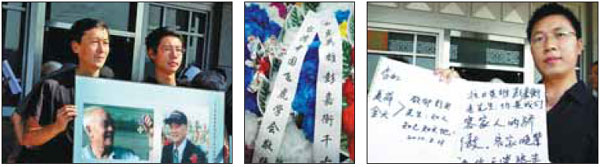
These 2010 file photos show the funeral of Peng Jiaheng, an expatriate Whampoa graduate, who became a pilot and took to the air 64 times to fight the Japanese during World War II. Provided to China Daily |
The bitter years
[Video: Whompoa spirit still shines]
Japan was the last of the Axis powers to admit defeat, and its official surrender on August 15, 1945, ended the bloody eight-year war on Chinese soil.
"'I'm going back to Thailand to see Mom' - that was my very first thought when I heard about Japan's surrender," said Fu, who had begun to miss his birthplace and family. However, his plans were wrecked by the ensuing civil war, which lasted for another three years. In all, 35 years passed before he managed to return to Thailand.
"Although most of the expatriate Whampoa men didn't actually participate in the civil war, which was fought between the Nationalists and the Communists, their affiliation with the Nationalist Party meant they had an extremely hard time after the founding of the People's Republic of China in 1949," said Xue Gang, 52, who has spent the last four years filming Chinese World War II veterans and compiling a huge oral history.
"Despite their wartime heroism, for nearly three decades, between the early 1950s and late 1970s, all former Nationalist soldiers were viewed as 'historical anti-revolutionaries', men who needed to be 'reformed'," Xue said. "And the overseas connections of the expatriates made them even more susceptible to wanton charges of espionage."
Fu returned to Thailand in 1980, having spent 29 years on a labor reform farm in a remote corner of northwestern China. His father, a prominent merchant who always refused to take Thai citizenship and had enthusiastically supported his son's decision to fight in China, had died a long time before. Fu's mother, then in her 90s, hugged her son and wept silently. The elderly lady still had the black-and-white photograph Fu had sent home a month after his matriculation into Whampoa. In the photo, the 21-year-old had just had his head shaved as part of a rite of passage for all freshmen.
"They all wanted me to stay in Thailand - my mother, my brothers and sisters - but I chose to return to China. My wife, who I married soon after Japan's surrender, had been waiting for me throughout my 'reform years'. She was proud of me," Fu said sadly, reflecting on his wife, who passed away three years ago.
Peng Jiaheng also survived the trials and tribulations. His mother, then in her 70s, visited him in 1967, when China was in the first stages of the "cultural revolution" (1966-76).
Peng Zhuonan clearly remembers his grandmother's arrival: "It was late autumn and my grandma, who had come from Indonesia, was still wearing slippers. I remember my father kneeling on the floor of the Beijing Airport to change her slippers for shoes he'd bought and taken with him."
Memorial
In 2005, on the 60th anniversary of the end of World War II, then-Chinese president Hu Jintao made a landmark speech, paying full tribute to the sacrifices made by Nationalist soldiers. As someone who had taken to the air 64 times to fight the Japanese, Peng Jiaheng was invited to attend a memorial celebration at Beijing's Great Hall of the People, the country's symbolic political heart.
In the same year, Peng gave the National Museum in Beijing the Distinguished Flying Cross given to him by the US air force in recognition of his "heroism and extraordinary achievement".
"My father died in 2010 at the age of 90. In his final years, he was in constant touch with his former classmates at Whampoa, making regular phone calls wherever they were. Like feathers in the wind, these men landed in different places around the world," said Peng Zhuonan.
"It's obvious to me that 'Fraternity and Sincerity', the motto adopted by Whampoa when it was founded, was deeply inscribed in their hearts. My father told me that he had no regrets about dying in a place he was once so determined to die for," he said.
Contact the author at zhaoxu@chinadaily.com.cn


Copyright 1995 - . All rights reserved. The content (including but not limited to text, photo, multimedia information, etc) published in this site belongs to China Daily Information Co (CDIC). Without written authorization from CDIC, such content shall not be republished or used in any form. Note: Browsers with 1024*768 or higher resolution are suggested for this site.
License for publishing multimedia online 0108263 Registration Number: 130349