|
|
A volunteer playing with children suffering from osteogenesis imperfecta at an event organized by the Beijing-based China-Dolls Center for Rare Disorders. ZHU XINGXIN / CHINA DAILY |
It has been three years, but Li Jia still remembers the day when she looked into her daughter's eyes and saw nothing.
"Her eyes wandered past me to focus, in an unfathomable gaze, on the motionless tree leaves outside our apartment window. There was no flame of excitement, no glint of curiosity, not even a faint glimmer of interest inside her dewy eyes, only the blurry outlines of the tree," recalled the mother, in a voice as calming as it was emotionally disturbing.
"For a brief moment, I felt my heart had been hollowed out. I was terrified."
|
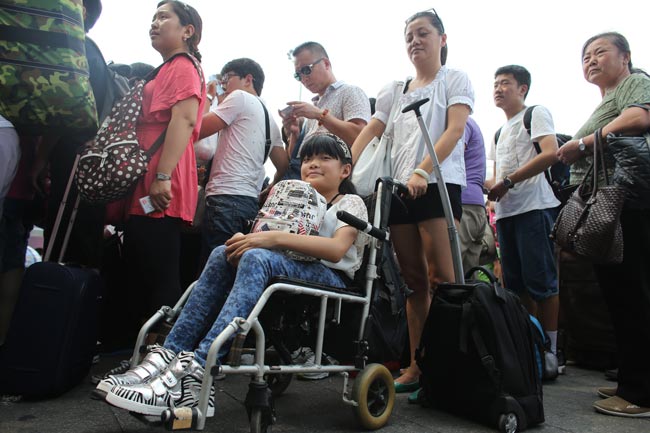
Four types of rare diseases Rett syndrome, originally termed cerebroatrophic hyperammonemia, is a genetic postnatal neurological disorder of the gray matter of the brain that almost exclusively affects females but has also been found in male patients. The clinical features include small hands and feet and a deceleration of the rate of head growth. Patients typically have no verbal skills and about 50 percent of individuals affected do not walk. Repetitive stereotyped hand movements, such as wringing and/or repeatedly putting hands into the mouth, are also noted. Phenylketonuria (PKU) is a metabolic genetic disorder characterized by mutations in the gene for the hepatic enzyme phenylalanine hydroxylase (PAH), rendering it nonfunctional. This enzyme is necessary to metabolize the amino acid phenylalanine to the amino acid tyrosine. When PAH activity is reduced, phenylalanine accumulates and is converted into phenylpyruvate (also known as phenylketone), which can be detected in the urine. Untreated PKU can lead to intellectual disability, seizures and other serious medical problems. Osteogenesis imperfecta (OI and sometimes known as brittle bone disease) is a congenital bone disorder characterized by brittle bones that are prone to fracture. People with OI are born with defective connective tissue, or without the ability to make it, usually because of a deficiency of Type-I collagen. Eight types of OI can be distinguished. Most cases are caused by mutations in the COL1A1 and COL1A2 genes. Mucopolysaccharidosis are a group of metabolic disorders caused by the absence or malfunctioning of lysosomal enzymes needed to break down molecules called glycosaminoglycans - long chains of sugar carbohydrates in each of our cells that help build bone, cartilage, tendons, corneas, skin and connective tissue. The result is permanent, progressive cellular damage that affects appearance, physical abilities, organ and system functioning, and, in most cases, mental development. |
What soon came after that fateful day was a discovery that plunged the whole family into turbulent waters. Li's daughter, An An, then merely 16 months old, was diagnosed with Rett syndrome, a sporadic neurological disorder that strikes one in every 15,000 people, predominantly female.
In its early stages, the syndrome's symptoms are similar to that of autism. Although patients gradually open up, in most cases, they will be unable to use their hands or feet, or develop any verbal skills, as a direct result of the brain damage. The majority fail to live beyond their 30s.
"It was excruciatingly painful - I cried my eyes out. But we persisted, living on day by day with all the mishaps and mayhem of the disease while hoping for the best," said the 36-year-old mother.
"In retrospect, any possible road leading to the future begins with acceptance; to accept the illness for what it really is. For a child patient, that acceptance starts to build with his or her family."
Yet that process could take years, said Wei Min, a leading pediatrician with Peking Union Medical College Hospital in Beijing.
"Upon being told the bad news, some parents just collapsed, while others sat there, dumbfounded, seeing and hearing no more. But all would eventually manage a reprieve from the initial shock to ask the same question: 'How could this be true?' And you know instinctively that no amount of medical knowledge would help here," said Wei, 69.
"Quite often, such denials are aided by the fact that rare diseases, by definition, are diseases that hit only a tiny segment of the population."
Rough figures
In the United States, the Rare Diseases Act of 2002 defines the term as any disease or condition that affects fewer than 200,000 people in the country, or about one in 1,500 people. In Japan, that ratio is set at about one in 2,500 people.
However, ratio alone can give the wrong impression, and in a country as populous as China, "tiny" means more than 15 million people, Wei said.
"The 15 million figure often cited for China is a rough estimate at best, since we have no official definition for 'rare diseases' and have conducted no comprehensive census on the number of sufferers. Among them, nearly 70 percent are children."
Wang Yi'ou is the founder of the Beijing-based NGO China-Dolls Center For Rare Disorders. After suffering repeated fractures since 1, Wang was diagnosed with osteogenesis imperfecta, also known as brittle bone disease, at the age of 16. Hitting one per 20,000 live births, the congenital disease gives its victims defective connective tissue, rendering them petite "China dolls" with stunted growth and fragile bones.
"There was one time two years ago, when we sent a copy of our monthly magazine to an address we believed to have belonged to a fellow patient. A few days later, we got a reply, in the form of a mail parcel, which contained a pair of scissors and a scribbling of words. It basically read: 'Dare to send me another copy and I'll commit suicide in front of you'," said Wang, 32.
"A phone call soon followed, made by a woman who admitted to subscribing our magazine with the address. It was not meant for her son, who had brittle bone disease, but for herself and her husband, the heartbroken mother told us."
"She said, 'It kills my son to be reminded that he's a rare-disease patient. I don't know how he found the magazine, but please, don't send it, never again!'" Wang said.
"Telling from my own experience, the boy's denial of his own condition, and by extension himself, has stemmed in large part from the evasiveness adopted by his entire family against the disease. What was meant to be protection ended up to be harm."
|
 |
|
Gu Ruofan, 15, who suffers from mucopolysaccharidosis, with her mother Zheng Yu at the Beijing West Railway Station on Aug 21. WANG JING / CHINA DAILY |


Copyright 1995 - . All rights reserved. The content (including but not limited to text, photo, multimedia information, etc) published in this site belongs to China Daily Information Co (CDIC). Without written authorization from CDIC, such content shall not be republished or used in any form. Note: Browsers with 1024*768 or higher resolution are suggested for this site.
License for publishing multimedia online 0108263 Registration Number: 130349