|
| A man observes a herd of wild Asian elephants at Huashiban village, Pu’er, Yunnan province. Elephants regularly visit the village in search of food, trampling and destroying crops. WU HAO / FOR CHINA DAILY |
Wild Asian elephants have been wreaking havoc in villages in Southwest China as their habitat is destroyed and they're forced to search for food. Yang Yao reports from Huashiban, Yunnan province.
|
Ivory trade takes its toll The number of elephants without tusks is rising because of the ivory trade, according to wildlife experts, although a lack of samples means there are no exact figures. Unlike African elephants, only about 50 percent of male Asian elephants have tusks, while the same percentage of females have short tusks called tushes, which don't contain pulp. Xiong Chaoyong, manager of the Asian Elephant Breeding Center, located near the Wild Elephant valley in Xishuangbanna, Yunnan province, said that as the number of tusked elephants killed rises, tuskless elephants are becoming dominant and passing on their genes to new generations. Xiong has worked at the center, which aids sick and injured elephants and attempts to reintroduce them to the wild, for more than 14 years. During that time, he and his colleagues have rescued 11 injured or sick elephants and bred three calves. Every day, the staff sends the elephants to the mountains in search of food, but they also provide 20 kg of carrots, 20 kg of bananas, 10 kg of corn, and 160 kilos of grass as daily dietary supplements for the animals. |
Cai Yansheng will never forget March 13. It was the day his wife was trampled to death by rampaging wild elephants searching for food.
Early in the morning, Cai's wife, Zhang Defen, 61, left home to sprinkle pesticide over the couple's banana fields. "She was only supposed to work on the land for an hour or so," Cai said.
As noon approached and Zhang had still not returned to the house, the elderly farmer began to sense that something was wrong. "I ran to the banana field, but I didn't see her," he said. "I found her bag lying on the ground, then I saw her feet "
To his horror, Cai realized that body parts were scattered across the field.
Unsurprisingly, the 70-year-old from Huashiban village, Pu'er, Yunnan province, breaks down in tears whenever he tells the story.
The incident wasn't an isolated event, though; on April 12, a herd of wild elephants attacked farmers working in cornfields in the village. Despite their popular public image and their protected status as an endangered species, the elephants are a major problem for the villagers, who say that in addition to the human cost, the animals also gorge the crops and ruin people's livelihoods.
Escalating conflict
When the elephants first arrived in Huashiban three years ago, the villagers were excited, but the damage the animals have done has resulted in mixed feelings towards the animals.
According to Liu Wei, an official in Zhengdong town, which administers Huashiban in Jiangcheng county, 18 wild Asian elephants first came to the county on Oct 18, 2011, from the neighboring city of Xishuangbanna.
Their numbers rose to 24 in 2013, and now 43 live in the area. "The amount of damage they cause is growing too," Liu said.
According to information published on the local government website, the elephants live in three separate herds and mainly reside in a nearby mountainous region called Maofei. Their area of activity covers about 35 square kilometers under the jurisdiction of three villagers' committees. "That's about 70 households, comprising 2,691 people," Liu said, adding that the elephants visit the farmers' land regularly throughout the year, and are most active at dawn and dusk.
By the end of 2013, the cost of the damage had reached 10 million yuan ($1.63 million), according to the government website.
Diminishing habitat
Yunnan province is the only remaining habitat for China's wild elephants, who are estimated to number about 200 at most. However, since 1992, human activity has resulted in the depletion of their natural habitat, and the elephants have taken to entering villages in Pu'er and Xishuangbanna, where they have destroyed crops and houses, and injured the local residents.
The villagers lived in fear of the elephants and are hostile toward them. As a result, the human-elephant conflict has escalated, perpetuating a vicious cycle.
The reason elephants invade human areas is that their habitat and food resources are diminishing rapidly, according to experts.
According to Zhang Li, a professor of behavioral ecology at Beijing Normal University, there are 165 to 213 Asian elephants living in Yunnan. Zhang and his students have been monitoring elephants in the province since 1999.
"We analyzed satellite photos from 1975 to 2005, and they show that the elephants' natural habitat has been reduced from 5,000 square kilometers to 2,700 sq km, mainly because of the growth of rubber and tea plantations. As the rain forest has diminished and become more fragmented, the elephants have had to adapt to the changed circumstances and look for food in villages," he said.
In the 1970s, Yunnan started to grow rubber. The expansion of the industry has destroyed the rain forests, the elephants' natural habitat, a problem compounded by forest fires, illegal logging, the construction of roads and the expansion of villages and cities. Moreover, the habitat has become fragmented, leaving different herds of elephants isolated from each other and preventing the exchange of genes.
|
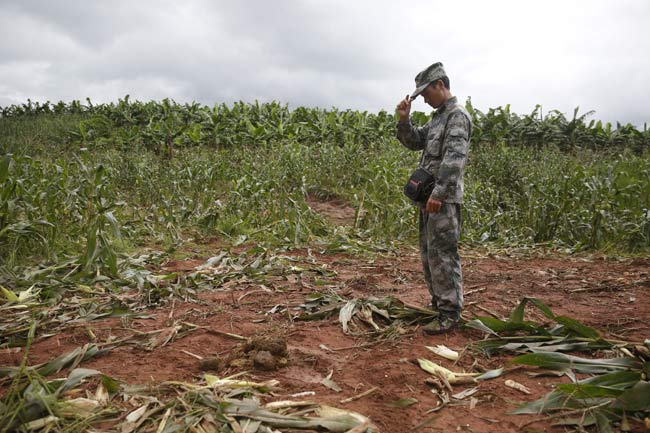 |
| A man observes a herd of wild Asian elephants at Huashiban village, Pu’er, Yunnan province. Elephants regularly visit the village in search of food, trampling and destroying crops. WU HAO / FOR CHINA DAILY |


Copyright 1995 - . All rights reserved. The content (including but not limited to text, photo, multimedia information, etc) published in this site belongs to China Daily Information Co (CDIC). Without written authorization from CDIC, such content shall not be republished or used in any form. Note: Browsers with 1024*768 or higher resolution are suggested for this site.
License for publishing multimedia online 0108263 Registration Number: 130349