 |
|
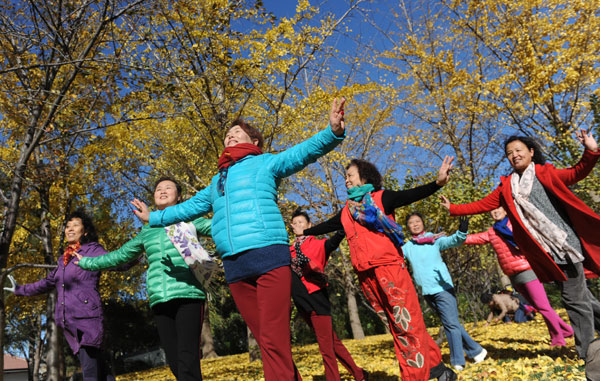
Beijing residents dance under the blue sky in Yuyuantan Park on Wednesday. PROVIDED TO CHINA DAILY |
Coal-fired power plants deal with tough transition to cleaner energy, but environmental benefits are obvious, as Zheng Jinran reports
|
Beyond the blue They called it "APEC Blue".The Asia-Pacific Economic Cooperation meetings in Beijing concluded on Tuesday, but many residents are already missing the blue skies that they enjoyed as a result of tough measures to rein in air pollution during that time. From Nov 3 to Wednesday, authorities in northern China had implemented joint efforts to cut air pollutants covering Beijing and Tianjin municipalities, Hebei, Shandong, Shanxi and Henan provinces, and the Inner Mongolia autonomous region. The moves included suspending production at polluting factories, shutting construction sites and restricting the number of private vehicles on the road. During the APEC meetings, the air quality in northern areas hit the "good" range, with the PM2.5 pollutant index kept at about 20 for days in Beijing alone. "The experience in cooperating to cut air pollutants should be learned and expanded in the region," said Chai Fahe, vice-president of the Chinese Research Academy of Environmental Sciences. Since 2013, the Beijing, Tianjin and Hebei authorities have conducted joint efforts to control the air pollution that hit the area frequently, especially during autumn and winter. The three have jointly developed a platform to share information on air pollution, pollution sources, measures and other necessary services, which will be available by the end of 2014, Li Lixin from the Beijing Municipal Environmental Protection Bureau said. The governments in the trilateral zone also started to make a regional long- and medium-term plan to curb air pollution by considering the three areas as a whole in dealing with environmental capacity and urban development. "The feasibility report on the plan has been approved and the draft may come out in 2015," Li said, adding that the plan can significantly promote coordinated efforts in curbing the air pollution. Several experts and government officials have pointed out the low efficiency of joint efforts in the area and provided suggestions for improvement. The coordination should move beyond monthly discussions on the weather to include a new organization with the power to mobilize resources and control pollution effectively, Chai from the Chinese Research Academy of Environmental Sciences said. Still, results from the joint efforts to improve regional air pollution have been encouraging. In the first nine months of this year, the average concentration of major pollutants like sulfur dioxide, nitrogen oxide, PM10 and PM2.5 dropped from that of the same period in 2013 in the 13 cities of the trilateral zone, figures from the Ministry of Environmental Protection showed. The governments of the three areas have voiced their determination to reduce air pollutants to meet the regional goal of cutting the average PM2.5 level by 25 percent by 2017. |
Liu, 50, has been working at the coal-fired heating plant in Beijing for 27 years. After facing the basic buttons and instrument panels of the plant's former operations room in the past few decades, he found himself having to study and re-train with younger colleagues to get up to speed with the latest technology.
"It took me more than a year to learn how to read the parameters on the computer screens and control the complex system through them," said Liu, sitting in the plant's new core operations hall.
As Liu familiarized himself with the new equipment, he also had to get used to changes in his duties—from experienced technician to beginner in the energy sector, where colleagues in their 30s now played the central role.
Liu's experience reflected the challenges from the generational and mindset shift amid green upgrades at the Datang International Beijing Gaojing Thermal Power Plant, in the capital's Shijingshan district.
The plant has more than 1,200 workers at an average age of 45 and many of them are also couples with families, said He Zhiyong, Party chief of the plant.
"More than 1,000 of them have been made redundant because the new facilities and operations require just a few workers to manage,"He said.
The plant had to redeploy the workers from the frontline of production to other departments such as maintenance and cleaning, which were previously outsourced to other companies, he said.
"Many of them have had to accept lower salaries because of the changes in their positions,"He said.
"We're making plans to keep them occupied and paid appropriately, but it's not easy."
Liu Jinming's wife has also worked at the plant for two decades and shifted to the office with a reduced wage.
"We all accept the changes as long as they improve the environment,"Liu said.
Powering up
The Datang International Beijing Gaojing Thermal Power Plant, built in 1959, took the technological lead to improve its thermal power generation and waste management, and has since become a national model of environmental protection.
Faced with serious air pollution in recent years, the coal-fired plant was required to push ahead in its use of natural gas to generate power and supply heat for households from November.
"It's important to cut coal consumption by replacing it with cleaner energy sources like natural gas and solar power,"said Liu Wei, director in charge of air quality control at the Beijing Municipal Commission of Environmental Protection.
Coal-fired power plants have been identified as a main target of the move, Liu said.
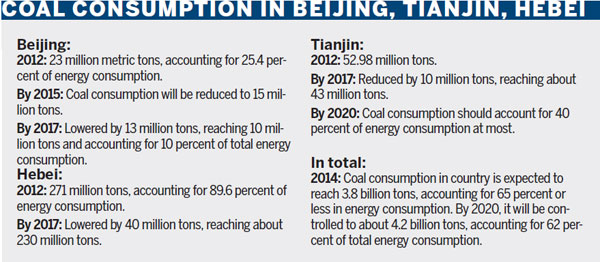
Coal consumption has become a major source of particulate pollution, known as PM 2.5, in Beijing since 2013, generating 22.4 percent of the emission. Ninety-five percent of sulfur dioxide discharged into the air was also from coal consumption, the municipal commission said.
In 2012, Beijing burned 23 million metric tons of coal, 40 percent of which were used by power plants and 24 percent for winter heating. The capital has promised to cut its coal consumption to 10 million tons by 2017 to control the major polluting source.
To help make up for the resulting shortfall in power generation, authorities will launch four natural gas-fueled thermoelectric centers by 2015.
 |


Copyright 1995 - . All rights reserved. The content (including but not limited to text, photo, multimedia information, etc) published in this site belongs to China Daily Information Co (CDIC). Without written authorization from CDIC, such content shall not be republished or used in any form. Note: Browsers with 1024*768 or higher resolution are suggested for this site.
License for publishing multimedia online 0108263 Registration Number: 130349