 |
|
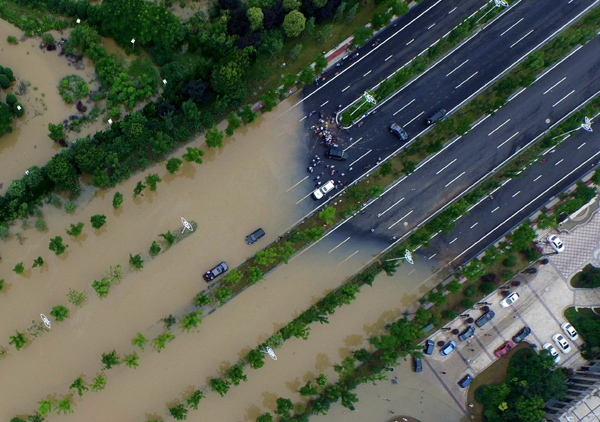
A photograph taken from a drone shows Jiangjun Avenue in Nanjing, Jiangsu province, covered with water on Sunday after heavy rains. Urban areas of the city experience urban flooding every year. [WU JUN/CHINA DAILY] |
Summer floods are an annual curse for many cities across China, but especially in the south. Now, new measures are being introduced to reduce loss of life and the economic damage caused by flooding. Xu Wei reports.
For residents of Shanghai, Nanjing and Wuhan, rainstorms often mean high levels of water, flooded roads ... and sometimes even an unexpected opportunity to fish in the streets.
On the night of June 16, torrential rain flooded Shanghai's northern districts, crippling the city's transportation network as vehicles stalled in floodwater and pedestrians were forced to roll up their pant legs and wade through the deluge.
Students at Tongji and Fudan universities, both located in Shanghai, managed to find a little fun when goldfish escaped from the flooded ornamental ponds on campus, and a fishing contest ensued as the students tried to catch and return the fish.
At Fudan University, students had no alternative but to trudge to classes through the high water and heavy rain, leading senior student Su Yiwei to lambaste the school, which she said should have responded to the conditions more effectively. "In such a scenario, the university should establish an emergency response plan and cancel classes in time," she said.
Yang Zhenghong, an official with the School Assets Department at Tongji University, said ongoing construction work near the university campus has reduced the efficiency of the college's drainage system.
"The base height of the roads around the campus has continued to rise along with the urban construction drive, especially the building of new rail transit lines. Our drainage system cannot cope in times of heavy rain," he told China Central Television.
In recent years, summer flood shave disrupted campuses at other schools, including universities in Wuhan, Nanjing and Xiamen.
Although they have dominated the headlines, Shanghai, Nanjing and Wuhan are just three of more than 100 cities across China that are disrupted by urban flooding every year, according to the State Flood Control and Drought Relief Headquarters. In 2012, urban flooding affected 184 cities, while in 2013 the number was 234, and last year it was 125, it said.
Zhang Jiatuan, a spokesman for the authority, said local governments have failed to pay sufficient attention to drainage systems, which has led to regular floods in a large number of cities.
"For a long time, local authorities have paid too much attention to 'above ground' construction projects, which are highly visible political achievements, and have ignored factors that aren't usually seen, including the drainage systems," he said.
Failure to meet standards
More than 300 of China's 657 cities fail to reach the national standards for flood prevention in urban areas, and more than 90 percent of older urban areas don't even meet the lowest criteria for flood prevention, according to Zhang. "Urban flooding will only get more serious if we continue to ignore the construction of drainage systems and sewers," he said.
Liu Bo, an official with the Office of Environmental Sanitation in Changde, Hunan province, who is one of the country's leading authorities on low-impact development, said many cities have to rely on pumping stations to drain storm water, mainly as a result of a poorly designed and maintained drainage systems.
"The urbanization drive, especially the construction of large areas of land with impervious surfaces, has made storm drainage virtually impossible. The storm water runoff stays on the surface and then converges into floods," he said.
Liu also said that local authorities have largely ignored the construction of drainage systems amid the urbanization drive, adding that urbanization and construction have resulted in huge areas being covered over with impervious materials, such as tarmac, which prevent excess water from draining into the soil.


Copyright 1995 - . All rights reserved. The content (including but not limited to text, photo, multimedia information, etc) published in this site belongs to China Daily Information Co (CDIC). Without written authorization from CDIC, such content shall not be republished or used in any form. Note: Browsers with 1024*768 or higher resolution are suggested for this site.
License for publishing multimedia online 0108263 Registration Number: 130349