|
|
 |
|
30th Anniversary Celebrations
New Rural Reform Efforts
Political System Reform
Changing Lifestyle
In Foreigners' Eyes
Commentary
Enterprise Stories
Newsmakers
Photo Gallery
Video and Audio
Wang Wenlan Gallery
Slideshow
Key Meetings
Key Reform Theories
Development Blueprint
Alexis Hooi:
How 30 years changed my view of the world  Dan Steinbock:
US pushing world economy to redeflation  Zhang Tuosheng:
Aso's positive signals on Sino-Japanese ties  Hong Liang:
Doujhi, food of kings and commoners  You Nuo:
SMEs play vital role in economy  Journey through three amazing decades
(China Daily)
Updated: 2008-12-18 07:45
1978 The beginning
The Third Plenary Session of the 11th Communist Party of China (CPC) Central Committee convenes in Beijing on Dec 18. It is widely considered the pivotal juncture at which the CPC began to launched its grand reform and opening-up policies and switched focus to "economic construction". A year earlier, the resumption of National College Entrance Examination signalled another new beginning. In November and December, 1977, 5.7 million eager candidates flocked to makeshift exam centers across the country to take the first university entrance exam in more than a decade. Those who passed the two-day test and are subsequently enrolled numbered 270,000. Thirty years later, many of them occupy the upper echelons of politics, economics, law, education, the arts and business. 1979 Special economic zones
The central government accepts the request of Guangdong and Fujian provinces to "move ahead of others" and approves special economic zones (SEZs) in Guangdong's Shenzhen, Zhuhai and Shantou, as well as Fujian's Xiamen. Embracing more flexible market policies, SEZs offers preferential terms for foreign investors vis--vis land use, taxes and foreign exchange management in order to encourage exports and raise revenue. The four economic zones stimulate economic growth to propel the country's towards development, and most famously transformed Shenzhen from a fishing village into a manufacturing and shipping hub. Fashion comes to town Pierre Cardin becomes the first internationally renowned fashion designer to visit China and stage private catwalk shows in Beijing and Shanghai. Time magazine reports he is made "exclusive consultant to China's embryonic fashion industry". Cardin later opens a Maxim's and Minim's in Beijing. His brand of suits and dresses remain popular among the Chinese. Family planning policy The family planning policy is first propagated in 1979, encouraging that most urban families to have only one child to stem the population growth. The policy was officially written into China's Constitution three years later. 1982 1 country, 2 systems Late leader Deng Xiaoping proposes the idea of "one country, two systems" as a solution for the reunification of the country. He suggests there be only one China in the world while Hong Kong, Macao and Taiwan maintain their capitalist economic and political systems. The rest of China would maintain its socialist system. 1983 First JV 5-Star hotel White Swan Hotel, the first five star joint-venture hotel on the mainland, opens its doors to guests. The bold move by Hong Kong tycoon Henry Fok Ying-tung spurs the opening up and reform policy. A year earlier, Jianguo Hotel, the first joint venture hotel on the mainland had opens in Beijing. 1984 Commodity economy The Third Plenary Session of the 12th CPC Central Committee endorses a planned commodity economy, a sign that the country would open up and devote more effort to revitalize the domestic economy.
Plenty of fabric As textile industry flourishes, cloth is no longer a limited commodity and coupons rationing families' cloth quota are phased out. 1985 Disarmament of a million As early as 1975, Deng Xiaoping had made slashing redundancies a primary task of the People's Liberation Army. That call is followed by a bold move to shed 1.039 million from the ranks in 1985. This precipitated the transition of China's armed forces to greater efficiency and improved scientific and technical strength. Education and science The CPC Central Committee approves reform for the country's scientific research and education system, paving the way for future successes. Goals to set up a market-based scientific development scheme and nine-year compulsory education system are also formulated. 1986 Enterprise ownership The State Council launches reform for State-owned enterprises (SOEs) by allowing the introduction of multiple operational means. Pilot projects to restructure firms begin and cut a path to future mergers and acquisition and share-holding companies. The same year, the Shenyang Explosive Devices Plant declares bankruptcy, the first SOE to do so since 1949. 1987 KFC makes entry
Kentucky Fried Chicken opens its first outlet in Beijing. The first American fast food chain to set foot on the mainland, it quickly becomes one of the most popular restaurant chains. Three years later, the 'golden arches' also begins to spread across the mainland following the opening of the first McDonald's outlet in Shenzhen, Guangdong province. 1988 Rocket fired from sub China conducts the first experiment to blast carrier rockets underwater from nuclear-powered submarines, giving the PLA the capability to launch long-distance nuclear strikes. 1990 Stock market
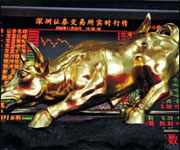
Shenzhen Stocks Exchange and Shanghai Stocks Exchange both officially open in December. The two establishments are considered engines to drive China's market economy. Previously, stock markets were reviled as a symbol of capitalism, so their arrival symbolizes China's opening up and weaning off the "iron rice bowl". Pudong development The State Council approves a proposal raised by the Shanghai municipal government to develop its Pudong area. Preferential monetary policies are approved to facilitate its development, which fuels the lightning growth of Shanghai. 1992 Famous tour down south Deng Xiaoping tours southern China's special economic zones and shows his support for the country's opening-up policy by pressing for faster economic reforms, thus sparking a fresh wave of market growth. 1993 Coupons are history Commodities were scarce during the early days of the People's Republic of China, prompting a rationing system in the 1950s with coupons issued for products. But following the growth of industrial and agricultural production, Chinese homes bid goodbye to ration coupons as the country begins to loosen control of most commodities prices. 1994 Global connection China becomes the 77th country to connect to the Internet. The commercialization of the Internet starts in 1995 when Ding Lei, quits his job to set up Netease.com. About 220 million people in China were connected by the end of 2007, making it home to the largest number of netizens. 1995 Two-day weekend China begins a five-day work week on May 1 to promote work efficiency, tourism and consumption. This change greatly boosts the country's leisure time and cultural and tourism development. 1996 Convertible yuan China allows the yuan to be convertible on the current account, a significant move that allows the frees flow of money for imports and exports. In 2005, China freed the yuan from the dollars' peg, letting it float within a tightly managed band.
 1997 SOEs reform From September 12 to 18, 1997, the 15th National Congress of the CPC convenes in Beijing. Among many decisions, the congress announces plans to reform, sell, merge, or eliminate the vast majority of SOEs. Hong Kong 's return Under the policy of "one country, two systems", on July 1, 1997, China resumes sovereignty over Hong Kong, ending more than 150 years of British control. On December 20, 1999, China resumes sovereignty over Macao, ending 442 years of Portuguese rule. Deng passes away Deng Xiaoping, the chief architect of China's economic reform and socialist modernization, dies from complications associated with Parkinson's disease. 1999 Western development
On March 22, the State Council stipulates 10 measures for the further development of western China, covering six provinces (Gansu, Guizhou, Qinghai, Shaanxi, Sichuan and Yunnan), five autonomous regions (Guangxi, Inner Mongolia, Ningxia, Tibet and Xinjiang) and one municipality (Chongqing). Over the past nine years, China's western regions have upgraded their infrastructure, economic prosperity, social structures and the environment. 2000 Economic miracle China's GDP surpasses $1 trillion, making the country sixth in economic volume that year. The country's foreign exchange reserves reaches $1 trillion in October, 2006, making it the top in the world. 2001 China joins WTO
On November 10, the Fourth Ministerial Conference of the World Trade Organization (WTO) in Doha, Qatar, approves China's entry into the WTO following 15 years of negotiations. This takes 1.3 billion Chinese people into the global trading system. China enjoys trade liberalization under the multilateral system, as well as unconditional most-favored-nation benefits. China has since made significant strides and overcome a number of challenges. 2002 A well-off society In November 2002, the 16th National Congress of the CPC proposes the concept of building a well-off society - materially and socially both - as the goal of China's accelerated growth and bid to steadily lift living standards. 2003 First man in space On October 15, China successfully launches the Shenzhou V with astronaut Yang Liwei aboard, the first manned spacecraft mission, from Jiuquan Satellite Launch Center. It makes China the third country to launch a human into space after the former Soviet Union and the United States. 2004 Banks go the SOEs' way In 2004, the State Council decides to reform debt-laden State-owned commercial banks (SOCBs) by allocating $45 billion of the nation's foreign exchange reserves to supplement the capital of two pilot SOCBs-Bank of China and China Construction Bank. The same year, the two pilot banks are transformed into State-controlled joint-stock commercial banks. This is a valuable experience for subsequent banking reform in China and is followed by other SOCBs. 2005 Agricultural tax dropped The Standing Committee of the 10th National People's Congress approves the draft to abolish agricultural taxes, relegating the thousands of years old levy system to history. In 2008, the CPC Central Committee again announces a decision to allow farmers to lease or transfer land-use rights in a step to boost incomes in the countryside. KMT chairman's visit From April 26 to May 3, 2005, Lien Chan, chairman of Taiwan's Kuomintang (KMT), leads a delegation to the mainland. The first time he has been to the mainland since 1949. Relations between the two sides have improved steadily ever since. Direct cross-Straits postal, transport links are launched on Dec 15 this year. 2006 Three Gorges Dam On May 20, 2006, the 2,309-m long Three Gorges Dam, the world's largest hydroelectric project, is completed. Train to Tibet The Qinghai-Tibet railway is put into operation on July 1. Some 1,000 km of the railway tracks sit 4,000m above sea level. The railway connects Tibet with the hinterland and plays an important role in boosting the local economy. 2007 Property law China's landmark property law, which grants equal protection to both State and private property, is approved by the 10th National People's Congress and takes effect on Oct 1.
2008 Beijing Olympics On Aug 8, the 29th Olympic Games opens with a spectacular gala show in Beijing. Under the slogan of "One World One Dream", China surprises the world by winning 100 medals and topping the gold medal tally with a haul of 51.
Moving on: in space At 16:43 on Sept 27, Chinese astronaut Zhai Zhigang floats out of Shenzhou VII, accomplishing China's first extra-vehicular activity in space. The feat makes China the third country to conduct a spacewalk after Russia and the United States.
(China Daily 12/18/2008 page8) 
|
       |
主站蜘蛛池模板: 国产午夜精品无码一区二区| 亚洲第一国产综合| 国产日韩综合av在线| 精品一区二区三区无码视频| 国产91在线播放免费| 宫西光有码视频中文字幕| 国产成人一区二区三区在线观看| 久久精品极品盛宴观看| 国产成人精品亚洲精品密奴| 日韩伦人妻无码| 婷婷丁香五月亚洲中文字幕| 加勒比无码人妻东京热| P尤物久久99国产综合精品| 亚欧洲乱码视频在线专区| 爆乳日韩尤物无码一区| 99久久99久久加热有精品| 欧美精品亚洲精品日韩精品| 四虎亚洲国产成人久久精品| 天堂网在线.www天堂在线资源| 激情综合网激情综合网五月| 久久亚洲国产精品日日av夜夜| 国产AV巨作丝袜秘书| 人妖系列在线精品视频| 久久久久亚洲精品无码蜜桃| 成人精品视频一区二区三区| 巨胸美乳无码人妻视频漫画| 伊人成人在线高清视频| 日本一区二区三区专线| 久久这里只精品热免费99| 久久亚洲女同第一区综合| 亚洲精品成人7777在线观看| 成人一区二区三区在线午夜| 国产精品中文字幕二区| 精品亚洲欧美高清不卡高清| 成人午夜污一区二区三区| 午夜精品福利亚洲国产| 国产精品人成在线观看免费| 日本夜爽爽一区二区三区| 日韩爱爱视频| 一区二区在线观看 激情| 国精产品自偷自偷ym使用方法|