



Spring Festival in the heart of remotest rural China









China Daily website is inviting foreigner readers to share your China Story! and here are some points that we hope will help contributors:
I have been living in the bustling metropolis of Beijing for over three years now, and I love it. However, one of the biggest pleasures of my life in China is to travel to other parts of the country during the Spring Festival break and see the "real China". It is something I have done every year since I arrived here. Well, this year I had the opportunity to see something more real than I could ever have wished for. A Chinese friend invited me to come to her little village in Shanxi province to spend the Chinese New Year with her family. The experience was amazing just because of the sheer remoteness of the village, and the opportunity to witness all sorts of ancient traditions associated with the Spring Festival which seem to have died out in Beijing, but are still alive in this tiny village. Getting a glimpse into the lives of people in rural areas of Central China, their hospitality and tight-knit family life, as well as the simple and frugal lives they lead, is not something which most foreigners in China ever have a chance to do.
|
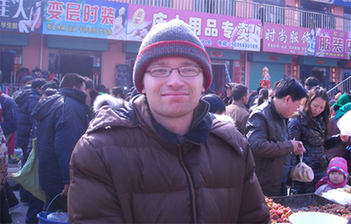
Gabriel Corsetti [Photo provided to chinadaily.com.cn] |
The village itselfis located in the depths of the Yellow Loess Plateau, the plateau that straddles the Yellow River and covers 640.000 square kilometers of Central-Northern China. The area is characterized by yellow soil, hence the name, and dramatic valleys and canyons. To get to the village I first took a train to the town of Sanmenxia, where I was met by my friend and we travelled by bus to her home. As the bus crossed the Yellow river and made its way through the countryside along dusty roads, houses and cars started to get scarcer and scarcer and I realized with pleasure that I was headed for somewhere quite remote. The village in question turned out to be the last stop on the bus line. It must have consisted of a few hundred houses. There was just one little shop in it, selling some basic items.
Although I have been to the countryside in China on other occasions, before this experience I had only ever been to rural areas in Southern China, where the villages and the landscape look remarkably different. In the North, houses tend to contain their own private courtyards, as my friend's house did. Most of the local houses were built in a traditional Chinese style. As I expected from my previous experiences in rural areas, the living conditions turned out to be quite rough. There was no heating, no possibility to shower and no running water. There was a tap in the courtyard, but it was frozen, so we had to rely on containers of hot water. What I found most trying was the constant cold. Since this was Northern China the temperatures were often bitterly cold, only slightly better than Beijing. Although in Shanxi central heating does exist in the cities, it still hasn't reached such small villages. I spent every waking hour with a heavy coat on. At night I was so cold that I slept with my hat on, as well as three thick blankets over me. Everyone else was clearly completely used to it, and didn't seem to suffer any discomfort.
What made up for the simple living conditions was the hospitality of my host family, who were always happy to attend to my every need.My friend's father works as a labourer in the cities during the year and only returns to the village during the holidays, while her mother lives there permanently. As a result her father could speak relatively good Putonghua (Standard Chinese), while her mother only spoke in pure local dialect, which I could hardly understand at all.Of course, on the first evening of my stay they displayed much curiosity towards me and asked me many questions, including the amusing one "what special food do people eat in your country for the Spring Festival?" During the following days, relatives of the family would pay visits to the home for the Festival, and I would also be taken to the homes of other relatives. I found that most people could speak to me in Putonghua, except for the elderly. Among the many questions I got from people, there were certain recurring ones: "is it true that England is very developed/more developed than China", "is it true that in your country you don't have the Spring Festival, but only Shendangjie (Christmas), "Can you get used to our food" etc... One rather unusual question which I was asked by various different people was if it is true that in the West when a person turns 18, their parents will stop looking after them. Lots of people also asked me if I thought their village was "luohou" (backward), to which I was forced to mumble politely that yes, the economy is not very advanced, however the people are friendly, the food and scenery are nice etc...
The food was indeed very nice. Rice is not usually eaten in rural areas of Northern China, and I never eat it once while I was there. Instead, the staple food which is eaten with every meal is MianBao (a kind of bread bun). Another interesting fact is that the family I stayed with only has two meals a day (one around 10 AM and one around 4PM), which is apparently the local custom. However, the food was really filling, so I was never hungry. I was told that in the summer they eat three times a day, but in the winter only twice because they days are shorter.
What really struck me was the apparent level of adherence to traditional folk religion and customs. The house where I stayed and many others displayed a shrine for the local gods in the living room, and a little shrine to the "earth god" near the entrance. My friend's mother is apparently a strong believer in these gods, while she herself said that she "believes in them sometimes”. There is a little temple to the gods located on the edge of the village. FengShui is also still followed and taken seriously by everyone.
My friend's family belongs to a clan which was begun by a man who arrived in the village 200 years ago. On the first day of the New Year, all the members of the clan gather together, and the men conduct a religious ceremony to commemorate the clan's ancestors. The ceremony is forbidden for women, but being a man I was given the chance to observe it. I followed all the clan's men to the courtyard of a house where the ritual would take place. Sitting among the others was a man who I immediately supposed must be a religious figure of some kind. He had long hair gathered into a ponytail, a long beard and big round glasses, all of which made him very conspicuous in the context of a Chinese village. Indeed, he turned out to be a professional FengShui expert. On my arrival he looked at me with curiosity and asked me where I was from and if in my country our ceremonies are the same. The ceremony consisted in all the men (about 40 people) bowing down in front of a shrine and praying under the guidance of the guy with the pony tail, while someone lit fire crackers on the side. Afterwards, fake banknotes with pictures of deities were burnt as an offering to the deceased, another widespread traditional custom. Some of the banknotes carry the words "hell’s bank" in English, and huge sums running into the billions printed on them.
I also observed some other interesting traditions related to the Spring Festival. Ash was scattered outside the door on the first day of the year, to prevent evil spirits from coming into the house. The usual red strips of paper containing duilian(Chinese lines wishing luck and prosperity) were pasted around the doors of the houses on the last day of the old year, just like everywhere else in China. I noticed that one home had white strips and not red strips pasted around the door. When I asked why, I found out that it means that someone has died in the home over the last year.
Another interesting feature of the area are the yaodongs, or homes inside caves. Many people used to live in rooms carved out of the rock below ground throughout the area, and a few elderly people still do. I myself visited a home in a cave in which an elderly couple live, in the middle of the village. It was necessary to walk down a flight of stairs to get to the cave's entrance. Seeing how warm the cave was inside, I wishedI could spend the night there myself. Apparently when my friend was a child, a big proportion of the people still lived in such dwellings, but nowadays most of them lie abandoned.
All in all, the experience was interesting and fun, if a bit uncomfortable because of the constant cold and lack of conveniences. It gave me an appreciation of how much traditional Chinese customs are still followed in the Chinese countryside, and how different rural life is from what you see in the glittering Chinese cities.
The author, born and raised in Italy, has been living in Beijing for three and a half years. He originally came to China to get a masters degree, and now he works as an editor and researcher.
The opinions expressed do not represent the views of the China Daily website.
[Please click here to read more My China stories. You are welcome to share your China stories with China Daily website readers. The authors will be paid 200 yuan ($30). Please send your story to mychinastory@chinadaily.com.cn.]


- Beijing E-Town launches world's first smart elderly care robotics station
- China extends 'green wall' in battle against desertification
- Hospital suspends staff after patient left on MRI table for six hours
- Robotic traffic police commander debuts in South China's Shenzhen
- Nine honored as 'most beautiful natural guardians' in China
- HKSAR govt actively aligns with national 15th Five-Year Plan to promote high-quality development: chief executive





