



Into the heart









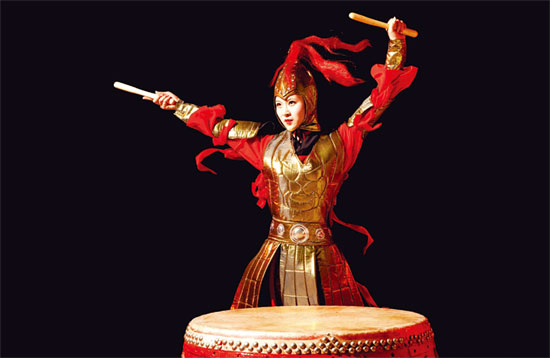
| Du Qianqian plays the lead role in a recent New York performance of Mulan, a musical adaptation of the Chinese folk tale. The use of drums and dance helped make the production accessible to American audiences, its artistic director said. Provided to China Daily |
China's performing-arts industry seeks ways to win over American audiences, Caroline Berg reports from New York.
In the past year, New York stages have hummed, trilled and quaked to the sounds of Chinese-born artistic productions.
Chinese opera troupes, an up-and-coming modern-dance company, an all-female percussion ensemble, the Shanghai Symphony Mongolian children's choir have all given audiences in the Big Apple a taste of China.
Not only are Chinese productions on American stages becoming more common, but an emphasis on China-US partnerships is gaining ground, too.
These developments are part of China's widespread effort to establish itself as a world leader in the performing arts. Through cross-cultural interaction including joint projects, China hopes to nurture creativity while bolstering its international appeal.
Zhu Ke-ning, executive vice-chairman of the China Association of Performing Arts, said China generates 2 million to 3 million performing-arts products every year, among the highest in the world.
Zhu acknowledged, however, that China's popularity in this sphere remains low in the West. He said the nation urgently needs to improve its domestic arts production and management systems before it can achieve long-term success in foreign markets.
Zhu said Chinese producers often fail to recognize that something wildly popular with domestic audiences may not be a hit abroad. It is therefore crucial that China establish partnerships with US-based arts groups, to better determine foreign audiences' tastes.
Another pervasive problem facing Chinese productions is form and content. According to Zhu, Chinese producers are often more concerned about profit than the process of designing an attractive package for foreign audiences.
More attention should be paid to production elements such as creative development, marketing and travel management, he said.
At a seminar last week on cooperation in performing arts at the Chinese consulate in New York, Yu Peng, deputy director of the Ministry of Culture's Bureau for External Cultural Relations, welcomed increased interaction with foreign arts organizations to encourage new productions.
"It is maybe not difficult to walk out of China," Yu said. "However, what we must focus on is, 'How do we walk into people's hearts?'"
The consensus on a panel of American arts leaders at the seminar was that audiences basically want universal stories.
"In terms of the stage, historically based stories generally do not fly," said Laurie Brown, general manager of Town Square Productions, which has managed theatrical productions in China and other countries. "It's all about the emotional impact of a performance."
Gary Parr, chairman of the New York Philharmonic, argued that a visiting act doesn't have to be well-known to be come popular.
He cited last year's Chinese New Year music program as an example.
"We knew Lang Lang would be an obvious hit for our audiences," Parr said of the internationally acclaimed pianist.
What really touched audiences' hearts, Parr said, was the Quintessenso Children's Choir of Mongolia, which sang in members' rare dialect about their native grasslands.
In commissioning Chinese work, American directors and producers look for both the popular and the unusual.
"I think there is a pretty broad appetite all across the US," said Nigel Redden, director of the annual Lincoln Center Festival. "We have a highly diverse market for the arts."
Redden said he values artists who are committed to their craft and passionate about sharing it with diverse audiences. Moreover, he seeks work that can open a window to another culture.
"I selected the pieces 2 and 4 because they were so different," he said, referring to works by the Tao Dance Theater.
A movement in 2, for example, is set to a recording of conversations between the choreographer, Tao Ye, and dancer Duan Ni. Choreography in 4 blends elements of Asian martial arts, such as tai chi, with elements of American postmodern dance.
Artistic fusion has also proven popular, whether simply a blending of traditional Chinese instruments with familiar Western ones, or excising dialogue from an age-old Chinese legend and inserting percussion to narrate the story.
The Chinese arts community must be willing to take risks, observers say. Bill Meade, who produced the musical Mulan, credited the production's success to the courage of artistic director Zhou Li, who is also director of the Red Poppy Ladies percussion ensemble.
"The greatest reward from our New York trip was the realization of how much more emotion shows through in this story with the use of drums," Zhou said. "Now we know where and how to improve upon our portrayal of Mulan."
Mulan, a wordless drum-and-dance interpretation of the Chinese folk tale about a girl who masquerades as a warrior, is scheduled for an overseas tour in the 2014-15 season.
This year promises to afford American audiences even more access to Chinese culture and popular artists. Offerings include "cross-talks" rapid-fire comedic dialogues and performances by Han Geng, China's "Dancing King".
Contact the writer atcarolineberg@chinadailyusa.com
Derek Bosko and Liu Yuhan contributed to this story.


Today's Top News
- US should engage in dialogue with good faith: Editorial flash
- China offers $200,000 aid to Iran after school strike
- Chinese Vice-Premier He Lifeng to lead trade talks with US in France
- China-US economic and trade talks to begin on Saturday
- Chinese Vice-Premier He Lifeng to lead delegation to France for trade talks with US
- China to upgrade Beidou Satellite System to boost accuracy, services





