Henry Yin: Mobilizing community involvement










Chinese Americans should cultivate their grassroots organizations to participate in US civic and public affairs, prepare for future leadership by honing their skills, serve society as responsible citizens and see that their voices are heard in a structured format. That's the advice from seasoned community activist Henry Yin.
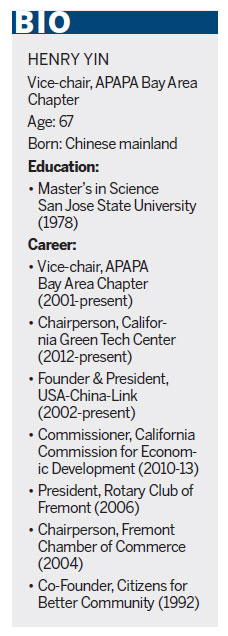
"This is from hard lessons learned over my 40 years living and working in the United States," said 67-year-old Yin. He immigrated to the US from Taiwan in 1974, earned a master's degree and worked as an engineer in Silicon Valley before starting his own business and getting involved in community matters.
Chinese Americans have long been stereotyped as politically petrified, said Yin. "We usually are the silent majority and won't act unless there is a fire at the doorstep," he said.
The most recent "fire", said Yin, was the California Senate Constitutional Amendment No 5 or SCA5. Written by senator Hernandez, SCA5 was passed by the state Senate on Jan 30 with a two-thirds vote and would allow such public education institutions as the University of California (UC) and the California State University (CSU) systems - and even K-12 schools - to use race, sex, color, ethnicity or national origin as a consideration for admitting students or hiring employees.
The passage of SCA5 caused a stir in Asian communities, with many families worried that UC and CSU would apply quotas on enrollment.
"We Asians attach great importance to education," Yin said. "SCA5 would likely put hundreds and thousands of Asian families and their children on an invisible grill."
The issue acted like a catalyst instead. It not only inspired Asian Americans in California to take to the streets to express their objections, but it fostered the formation of grassroots civic organizations such as the Silicon Valley Chinese Association and United Asian Americans for Activism.
"The momentum is unprecedentedly strong," said Yin, adding he had been invited into 20 some organizations through WeChat, the equivalent of Twitter in China, and was bombarded by messages from as many as 4,000 members each day.
"I'm very glad to see that more Chinese Americans care about politics, about issues of common interest, and are starting to express their views through democratic channels," said Yin. "This is something we wouldn't dare imagine 40 years ago."
The political enthusiasm of these volunteers and the ever-growing population of Asian Americans are two positive factors which will help lay a solid foundation for our playing a bigger and more important role in civic and public affairs, said Yin.
Yin cautioned, however, that good intentions only are not enough. He pointed to the current undisciplined management in some of these grassroots organizations, where information gets disseminated without being fact-checked and self-contradicting signals are sent out that confuse people and ruin our social undertaking in the long run.
"Politics is a broad field that requires charisma, intelligence and political acumen," said Yin.
Yin and the Asian Pacific Islander American Public Affairs (APAPA), where he has served as vice-chair of Bay Area Chapter since 2001, have held several town hall meetings and lectures to educate the public and train potential leaders.
In the past 13 years, the APAPA has expanded throughout California and beyond, with 30,000 members, according to its founder C. C. Yin, Henry's elder brother.
Yin said the APAPA jumped into the anti-SCA5 movement because he did not want to see today's organizers repeating his old mistakes. Economically and educationally stronger than their predecessors, the new generation of Asian Americans should aim high and dream big. "They should gain a better foothold by taking part in American politics," Yin said.
With monetary strength and growing numbers of Asian Americans voters - the two most powerful bullets, as Yin put it - Chinese need to unite and learn how to best integrate their resources and help shape social and civic undertakings in this country, he added.
Yin said he would probably have lived the simple life of most Chinese immigrants - being the bread earner of the family, a supportive husband and father and an indifferent US citizen - were it not for a sarcastic question thrown in his face by a Caucasian gentleman in the 1980s.
"How much do you know about the United States and us?" the white man asked.
"Sorry, not much, but I'd love to learn," Yin said. At that moment, Yin realized that he was still a stranger to the US, its political system, society and laws.
That man's question stuck in Yin's mind and prompted him to change his way of thinking. "We need to study this country, accept it as our home and strive to be part of the society," he said. "If you feel there is social inequality and abuse of power, use your vote and unite with people of the same mind to make changes."
Yin's political awaking goes back to 1980s when he lost an election for a seat on a local school board. His rival won by a razor-thin margin because Asian Americans in his district did not cast ballots as other ethnic groups did.
"I came to realize that elections are not only about funding or monetary strength," Yin said. "More importantly, it's about how many voters know about you, buy your point of view and how big and solid your grassroots foundation is."
In order to educate the Asian community to care about the public and civic affairs, Yin in 1992 co-founded the Citizens for Better Community (CBC) which intends to unite Asian Americans to get involved into civil and public affairs.
Sometime later, Yin shifted his focus and eyed mainstream society. He got his foot in the door by joining the Fremont Chamber of Commerce.
Yin said he was intimidated at first speaking in public at monthly meetings. But he listened intently and kept sharpening his public speaking skills. His persistence and connections finally paid off. He became the first Asian American ever elected chairman of the 49-year-old chamber.
In 2006, Yin also became the first Asian American in 43 years to ever serve as president of Fremont Rotary Club. "To serve others is not a lofty slogan," Yin said. "It's concrete deeds."
In 2010, Yin was appointed by then California governor Arnold Schwarzenegger, and reappointed by the current governor Jerry Brown, as the only Chinese-American commissioner of the California Commission for Economic Development. Yin won the Outstanding Asian-American Leader Award from the California state legislature in 2008.
"With my many social networking resources in both the US and China and many years experience in government, business and social communities, I won't hesitate if the Federal Government chooses to use me for something in the future," said Yin.
junechang@chinadailyusa.com
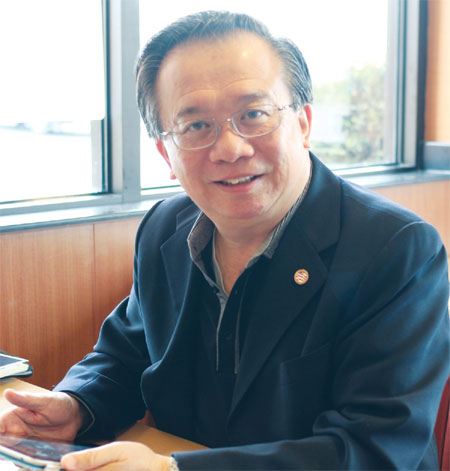
| Henry Yin, vice-chair of the Asian Pacific Islander American Public Affairs (APAPA), Bay Area Chapter, said Chinese Americans should cultivate their grassroots organizations to participate in US civic and public affairs. Chang Jun / China Daily |
(China Daily USA 04/04/2014 page11)






Today's Top News
- Finnish PM to kick off four-day trip
- Panelists: China, US lean toward practical risk control
- Leaders' visits give ties fresh momentum
- Trump's new 'Board of Peace' takes shape at Davos
- The new logic behind China's trade
- Unilateralism not the solution to global challenges and won't make US great again