China lifts shellfish ban









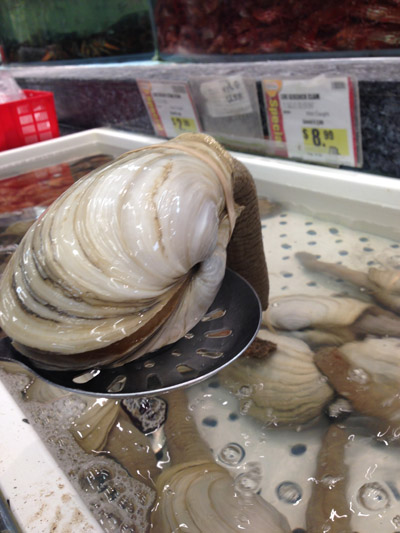 |
| Geoduck is sold at a local market in Seattle. On May 23, China lifted the five-month-old embargo on live seafood from the US' West Coast. [Deng Yu / China Daily] |
Shellfish farmers welcomed China's recent lifting of a ban of live shellfish from the US West Coast, a move signaled pickup in trade and creation of job opportunities.
China on May 23 lifted the five-month-old ban on imports of live seafood including clams, oysters, mussels and scallops from Alaska, California, Oregon and Washington State.
Mark Schaffel, a shellfish farmer and owner of Northwest Shellfish Co Inc in Olympia, Washington, told China Daily: "The lifting of the ban is great because geoducks are real big amongst the Chinese community, but markets otherwise are just not that huge. "[China] is an important market and they are looking for good seafood, which we have a lot of."
Schaffel, however, said the ban had some benefits for the larger geoduck trade, including addressing some "serious scientific issues".
"Since the ban, farmers have been looking to increase the market for geoducks, but there's still a limited amount of interest in the US," Schaffel said. "We could still sell elsewhere in Asia, but it's been slow."
The US exported more than $60 million of geoducks clams last year — up from $21 million in 2004 — with a majority of the trade stemming from the Northwestern US, according to the Wall Street Journal.
China first imposed the ban after identifying high levels of inorganic arsenic in a shipment of giant geoduck clams from Washington's Puget Sound. Around the same time, a separate batch of geoducks from Alaska was found to contain paralytic shellfish poisoning.
US officials said their examinations of the shipments in question were deemed safe for consumption.
Delegates from the National Oceanic and Atmospheric Administration (NOAA) traveled to China in March to discuss lifting the ban, a visit that included dialogues highlighting new ways to monitor for environmental toxicity issues.
In light of the removal of the ban, Chinese officials are increasing scrutiny of the US shellfish industry.
A note from the Chinese government on Friday said it would send a team of food safety officials to the US to monitor seafood-testing protocols.
A fishmonger at a seafood company in Olympia, Washington, said the geoduck trade in Washington represents a "very specialized product" that has become almost "inaccessible" for the people in the Puget Sound region.
"As a local product, geoduck was not something that was huge in Washington," he said. "When it became something that was sought after from the Chinese market, we saw a huge increase in farming and price over the past 10 years. That was something that kind of rubbed Washingtonians the wrong way."
"But at the same time it has been great as local product too because we've got jobs created by new shellfish farmers, so we've seen some of the good sides too," he said.
China's decision to lift the ban will bolster the seafood industry in the Pacific Northwest, according to a Washington State congressional representative.
US Rep Derek Kilmer said news of the ban's dismissal should help the US seafood industry rebound from trade bumps that began late last year.
"The lifting of this ban is great news for shellfish growers and businesses in our region," Kilmer said in a statement on Friday. "China is a key export market for our region's shellfish and this news means greater economic stability."
Kilmer said he is ready to focus on working with local, state and federal officials to make sure that "new testing and monitoring requirements can be swiftly implemented".
No timetable has been set for the readmission of US geoducks to China.
jackfreifelder@chinadailyusa.com






Today's Top News
- Xi congratulates Yoweri Museveni on re-election as president of Uganda
- Senior military officials under investigation: Defense Ministry
- Systematic approach sees return of clear waters to the Yangtze River
- IP protection for new fields to improve
- Draft rules define premade dishes in consumer interest
- Xi greets To Lam on election as Vietnam party leader