Military-to-military exchanges key to better Sino-US trust









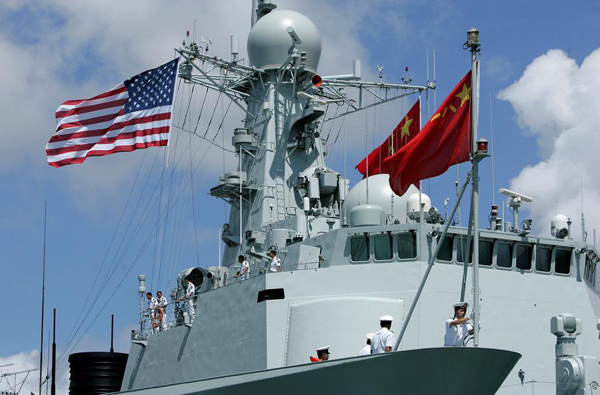 |
| Chinese Peoples Liberation Army Naval sailor aboard the Hengshui hoists the Chinese Flag after arriving at the Joint Base Pearl Harbor Hickam to participate in the multi-national military exercise RIMPAC in Honolulu, Hawaii, June 29, 2016. [Photo/Agencies] |
A fleet of the People's Liberation Army Navy is participating in the ongoing Rim of the Pacific Exercise even as much of the media attention remains focused on the South China Sea. In the US Congress some voices were raised not to invite China to this year's Rimpac because of the tensions in the South China Sea, but that argument was rejected by most. Among those who have rejected the argument is Admiral Scott Swift, commander of the US Pacific Fleet, who made his stand clear while speaking at the opening press conference of Rimpac 2016 at Pearl Harbor on Tuesday.
And at a talk held by the National Committee on US-China Relations earlier this year, four former US defense secretaries, Harold Brown, William Perry, William Cohen and Chuck Hagel endorsed more military-to-military exchanges between China and the US.
For long, Sino-US military-to-military relationship has been a weak aspect of overall bilateral ties. But that started to change after top Chinese and US leaders pledged to promote exchange and cooperation between their militaries. Despite some unresolved issues, many have called the military-to-military ties a bright spot in the overall bilateral relationship.
A PLA Navy fleet took part in the Rimpac for the first time in 2014. This year, China has sent five ships, three helicopters, a marine and diving squad each, and 1,200 officers and soldiers to the biennial military drill. The crew size is smaller than that of only the US and Canada, reflecting China's determination to cooperate with other countries to ensure maritime peace.
After covering the opening part of Rimpac 2016 at Pearl Harbor the past week, I more strongly believe that such drills will help China and the US, and indeed the 26 participating navies, better understand each other and help reduce the possibility of conflict.
Over the past years, the Chinese and US militaries have also exchanged high-level visits, including those of defense chiefs, and the PLA Navy has made quite a few port calls to the US, including to Florida last November. During the PLA Navy's first port call to the US' East Coast, the engagement between Chinese and US navy officers, as I witnessed in Jacksonville, Florida, was more than friendly. Also, Chinese and US navy chiefs have set up regular videoconferencing calls, and US Chief of Naval Operations John Richardson and PLA Navy Commander-in-Chief Wu Shengli have talked three times in the past year.
At the China-US Strategic and Economic Dialogue in Beijing in June, both sides reaffirmed their commitment to actively implement the two memorandums of understanding on "Confidence Building Measures", namely the notification of major military activities and rules of behavior for safety of air and maritime encounters. The two sides have also agreed to take measures to reduce risks and deepen practical cooperation to boost mutual trust.
When senior military leaders as well as lower-level officers get to know each other better and build personal relationships, they are less likely to give orders to shoot at each other in the sea or air. Unfortunately, US laws still impose strict restrictions on broader and deeper military-to-military exchanges and cooperation with China.
Lyle Goldstein, an associate professor at the US Naval War College, asked me why his school doesn't have a single student from the Chinese mainland, although, in his view, it should have had five to 10 of them, especially because every other country seems to have a student or two. It is true that China and the US will continue to disagree on certain issues. It is also true that tension in some regions, including the South China Sea, may continue for some time. But it is only through more bilateral exchanges, not less, that the two countries and militaries will be able to manage their differences more effectively.
The author is deputy editor of China Daily USA. chenweihua@chinadailyusa.com