US should rethink its foreign policy and show restraint









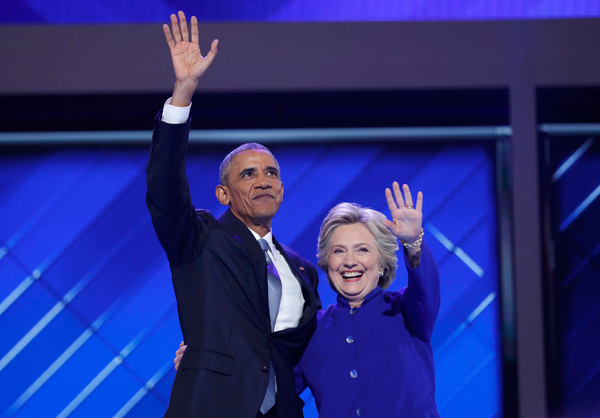 |
| US President Barack Obama and Democratic presidential nominee Hillary Clinton appear onstage together after his speech on the third night at the Democratic National Convention in Philadelphia, Pennsylvania, US, July 27, 2016. [Photo/VCG] |
When Barack Obama was first elected US president, many expected he would carry out a foreign policy that was less interventionist than his predecessor George W. Bush who ordered the invasion of Iraq and Afghanistan.
That has been mostly true. But Obama's intervention in Libya in 2011 to remove Muammar Gadhafi, the bombing of Syria without the invitation of its legitimate government and the arming of Syrian rebels, and his drastic escalation of drone strikes in other sovereign nations have made his foreign policy less distinct from that of the Bush administration.
Even Obama admitted that US intervention in the Mideast had failed miserably in an interview with Jeffrey Goldberg of The Atlantic magazine early this year.
Those in the US who now oppose military intervention on foreign soil are largely influenced by the 7,000 deaths and more than 50,000 injuries of US soldiers and the trillions of dollars of tax payers' money. Few seem to care about the much higher human and economic costs on the countries concerned, not to mention the pro-longed psychological trauma among the local populations.
However, it might be unfair to blame the US public for this because major TV net-works don't cover the conflict zones much, especially ground scenes after US bombing. People get far more news about Iraq, Afghanistan, Libya and Syria by watching CCTV, BBC, RT, France 24 or NHK.
When US presidential candidates Donald Trump and Hillary Clinton begin their first presidential debate at Hofstra University on Sept 26, foreign policy is unlikely to be a major focus. Economy, immigration policy and other domestic issues and even their personalities will get more time.
However, there is deep concern inside and outside the US about Clinton's hawkish track record. She has supported almost all the recent US wars, and as secretary of state, she was the one behind the regime change in Libya. One US foreign policy expert I met on Wednesday described her as "more hawkish than most people in DC".
While disapproving of Clinton, he won't endorse Trump either, calling him isolationist.
That is probably not isolationist in dictionary meaning, but relative to the excessive US interventionism in the past decades.
Trump might be less hawkish than Clinton if elected because he is a businessman and not an ideologue. For a businessman, there is usually a deal to be made and a solution to be found.
Concerned about both Trump and Clinton, a group of scholars at Cato Institute believe the US needs a major foreign policy change to alter the bipartisan consensus that the US is an indispensable nation.
The experts contend that while the end of Cold War ushered in a unipolar world, which suggested US foreign policy would be easier to manage, events in the last 15 years have proved otherwise.
In their report, Our Foreign Policy Choices: Rethinking America's Global Role, the experts believe that the US cannot rely on business-as-usual foreign policy but must seek alternative approaches that better suit the complexities of the 21st century.
The report criticizes the current US grand strategy, known as liberal hegemony, as it demands a massive, forward military deployment. They argue such a strategy tempts policymakers to use force even when vital US interests are not threatened.
For Christopher Preble, vice-president for defense and foreign policy studies at Cato and one of the authors of the report, the ability to act does not translate into the ability to solve problems.
Emphasizing that the US' global influence is strongest when spread by peaceful, rather than military, means, the choices the authors provide are based on a grand strategy of restraint.
The author is deputy editor of China Daily USA. chenweihua@chinadailyusa.com