



China should foster its own agenda of economic integration









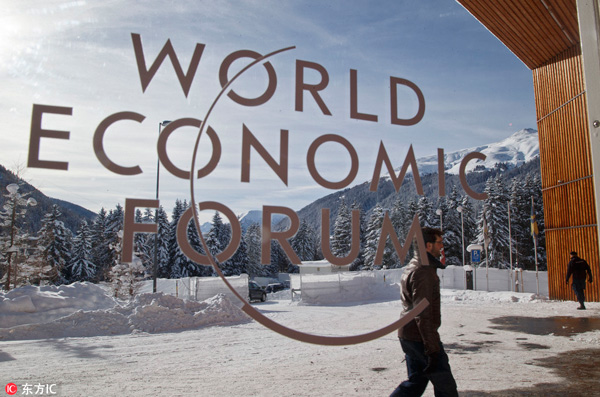 |
| A man walks at the main entrance of the congress center where the World Economic Forum takes place in Davos, Switzerland, in this file photo taken on Jan 18, 2016. [Photo/IC] |
Reporter's Note: As Davos Forum 2017 approaches, the China Daily website interviewed Assistant Professor Anthony Howell in the Department of International Economy and Trade, School of Economics, Peking University, seeking his insight into major issues of most concern to him at the Davos Forum this year. He emphasized that the most important initiative of the forum will be the issue of economic growth and social inclusion.
1. The official Davos website points out that global events this year have reminded decision-makers that the more complex a system, the greater a community's concern about its future. The weakening of multiple systems has eroded confidence at the national, regional and global levels. And, in the absence of innovative and credible steps towards their renewal, the likelihood increases of a downward spiral of the global economy fuelled by protectionism, populism and nativism. What's your outlook for the world economy in 2017? How can we innovatively and solidly foster the renewal of the global system? What kind of responsibility do you expect China to take within that process?
To put it frankly, it is very difficult to trust any economic forecast or outlook for the year 2017. Political dissatisfaction has swept across both the EU and the US, and it seems to have happened almost entirely under the purview of polls, pundits, experts and the elite. With that being said, the growth of the global economy will, in many respects, trend closely with that of the US and as of now, there are two quite extreme and countervailing views about the future of the US economy. In the business community, there is considerable optimism expressed by business leaders, which is easily observable in the markets, due in part, to president-elect Trump's anti-regulatory policy stance. By contrast, the overwhelming number of economists believe that the anti-trade, anti-environmental policies of the president-elect spells disaster for the US economy and the global economy more broadly. My own view is that in 2017, if president-elect actually converts his rhetoric into policy, which it looks like he will (e.g. tax cuts, ending the Trans-Pacific Partnership (TPP) and rolling back Dodd-Frank), then the US and by extension, the global economy will enjoy a boost in economic growth, at least in the short-term. Although in the longer-term, the concerns held by economists will come into play, and the same policies that brought about positive short-term economic gains, and in particularly protectionist policies, may ultimately have disastrous effects in both economic and political arenas for the broader global economy.
If protectionist policies intensify in the US and Europe, China will be presented with both opportunities and challenges, but ultimately, I think that China may unfortunately have a very short time to spread its integrationist agenda, which is spearheaded by its One Belt, One Road Initiative, including the creation of the AIIB, and growing leadership role in the Regional Comprehensive Economic Partnership, before a new wave of isolationism and protectionism spreads from the US and the EU to Asia and other regions.
2. The Financial Times commented in an article that people have extremely positive expectations of President Xi's attendance in Davos this year, thinking that China could cast itself as a guardian of global governance and the torchbearer for the open trading system, given that President Xi champions the Paris climate change accord, defends the international community's nuclear deal with Iran and supports trade liberalization in Asia. What topics do you expect President Xi to take up in the coming Davos Forum? What kind of expectations do you have of China's role in global affairs?
China, as well as other Asian economies, has benefited tremendously from free-trade agreements and since it entered the WTO in 2001, there has been a swelling in the ranks of its middle class. President Xi will certainly emphasize the importance of further economic integration as the best way to promote economic growth in the global economy. Many spectators have commented optimistically that the Davos Forum presents an unprecedented chance for China to exert itself as a benevolent global leader, it is unlikely that this will be possible. China is nowhere near ready to take the mantel from the US and preside as the leading player overseeing and advancing the economic integration project. Therefore the success of China's economic integration project under its one belt, one road policy hinges almost completely on US (and EU) acquiescence at a minimum but much more preferable is an active US role. In recognition of this fact, China will have to take a double-pronged approach using the Davos platform to publicly admonish president-elect Trump against implementing any policies that could destabilize the economic relationship between China and the US, the most important bilateral relationship in the global economy, while at the same time try to advance China's own agenda of economic integration within the greater Asian continent.
3. Martin Wolf mentioned in an article that behind the tendency towards economic growth lie two powerful forces: innovation at the frontier of the world economy, and catch-up by laggard economies. The two are linked: the more the frontier economies innovate, the greater the room for catch-up. An important longer-run possibility is that the underlying economic engine is running out of stream. Catch-up still has great potential. But core economic dynamism has declined. One indicator is falling growth in productivity. Another is ultra-low real interest rates. People are worrying about whether the advance of the frontier of innovation has in fact slowed. What do you think about the two forces? Is it possible that China could maintain catch-up growth?
It is certainly the case that economic dynamism has slowed hindering innovation in frontier economies and thus limiting potential spillovers for laggard economies. China has benefited greatly from catch-up growth and is in many ways approaching the technological frontier in many industries. A key question that looms heavy in China is whether it will be able to push the technological frontier and rely on innovation-led growth. The biggest barrier that China faces, however, is the lack of qualified and trained talent, and is one of the biggest complaints among firms in China that invest in innovation.
4. Of the 14 System Initiatives of the Davos Forum, such as shaping the future of consumption, digital economy and society, economic growth and social inclusion, financial and monetary systems, international trade and investment, long-term investing, infrastructure and development, which do you consider the most important? And in what areas might we see major advancement in 2017?
The disgruntled working poor who have largely been excluded from the economic gains brought about by globalization, helped bring about two of the largest unexpected political outcomes in recent history (Brexit and the election of Trump). The most important initiative of the forum will naturally be the issue of economic growth and social inclusion. While no specific policies have yet been developed, it is likely that considerable efforts and policy innovations will aim to curb rising income inequality, which is at the root of many economic and social problems and behind the Brexit and US election outcomes.
I think with respect to Economic Growth and Social Inclusion initiative, China has tremendous capacity to promote to the global community its successful anti-poverty programs that lifted millions of Chinese out of poverty and maintaining relative economics, social and political stability during the global financial crisis and in its aftermath. China can potentially leverage its success in this area and promote its model of development as a clear path for other developing countries to follow.



















