Local government urges relocation to bolster anti-poverty drive









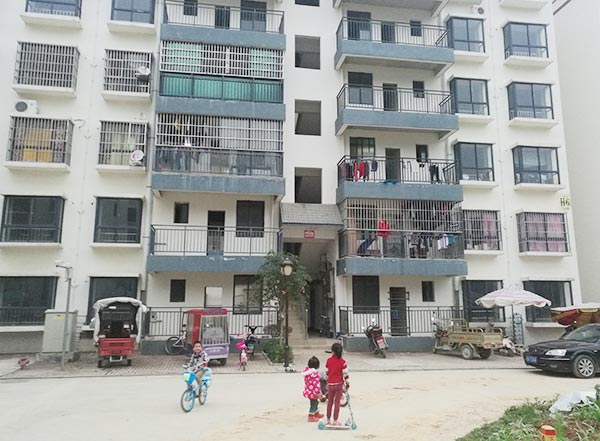 |
| New apartments and workshops are being constructed in Dahua county, Guangxi, to help people relocating from remote rural areas. [Photo provided to China Daily] |
In Dahua, a county to the northwest of Nanning, a program is underway to provide subsidized housing for the poor.
Since 2014, dozens of people have relocated from the nearby villages to Minzu Xin Cheng (roughly translates to "new ethnic town"), local officials say. The semi-urban site is located at about 150 kilometers from the capital of South China's Guangxi Zhuang autonomous region.
Of the county's 460,000 people, some 80,000 live below the poverty line, which is nationally defined by the annual household income of 2,300 yuan ($335).
The project started with the building of the first apartments in 2012 and is scheduled to be completed in the next three years. Spread across 310 hectares, the site's plan includes multiple housing blocks, a hospital and a school. It is being developed by the Guangxi Wuzhou Baoheng Investment Co Ltd.
"We expect 360 rural families to move in this year," says Qin Jie, who works at the relocation office on-site.
Members of the Yao ethnic group, the area's dominant population, have lived in the surrounding mountainous villages for generations, growing corn and raising pigs or poultry for subsistence. The rocky terrain has made it tough for them to farm other crops, with the scant availability of groundwater adding to their woes.
Wei Reipeng, a 52-year-old security guard at the housing project, earlier led a similar life in Jiasi village about 20 kilometers away.
"Before coming here (in 2014), my income was unstable," he says, adding that he, his wife and their son together make some 1,000 yuan a month these days working different jobs.
The apartments-in current sizes of up to 80 square meters-are coming up in a county that is only partly urbanized. To a visitor, the complex could give the appearance of being in the middle of nowhere. But Qin says the new settlers will find economic engagement in future. The project has witnessed an investment of 2.1 billion yuan to date, he adds.
At least two workshops for handmade clothing and an electrical hardware store were visible near a brand-new pavement at the site during a recent visit by China Daily.
By 2020, when China hopes to end absolute poverty, nearly 29,000 people in Dahua will need to be relocated.
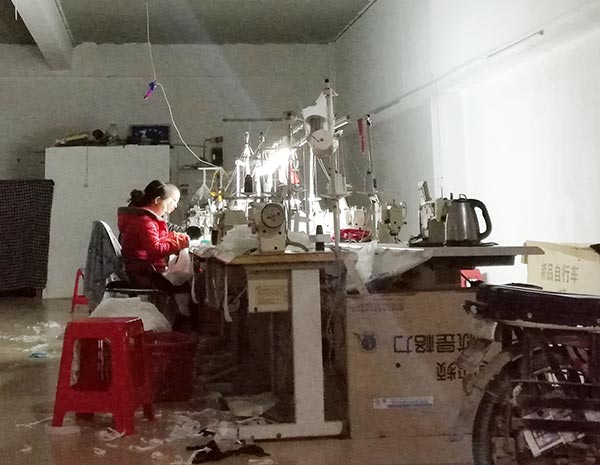 |
| New apartments and workshops are being constructed in Dahua county, Guangxi, to help people relocating from remote rural areas. [Photo provided to China Daily] |
The county government's relocation cost will likely be 240,000 yuan, including housing subsidy, for every poor family until then, Zhu Youkui, a top official of the region, says.
Overall, Guangxi aims to spend 60 billion yuan on relocating more than 1 million poor people by 2020. He says the main objectives are to move out the poor from vulnerable areas, settle them down in places with better connectivity and resources, and help them find jobs and receive technical training, especially among the middle-aged.
"The government has tried to move the affected people to places that aren't too far away from where they originally lived," Zhu, the chief economist for the Guangxi government's poverty alleviation program, says in response to a question about those that might fear a loss of familiarity owing to relocation.
There are very few examples of county-to-county relocations in Guangxi, he says in Nanning.
In addition to areas with a harsh topography, people are also relocated from remote villages where only a handful of families reside and investing in roads, for instance, seem financially infeasible for the local administrations. The prefecture-level cities of Hechi in the north and Baise, which borders Vietnam, have become Guangxi's major relocation hubs.
Zhu says typically three years are needed to complete the process of a single mass relocation.
But challenges lie ahead.
"Among them is the sustainability of livelihoods of the resettled."
The central government has said nationwide 3.4 million people living in poverty will be moved out of remote areas this year.
Zhang Li contributed to this story.