Sudan reaps rewards of new Silk Road










|
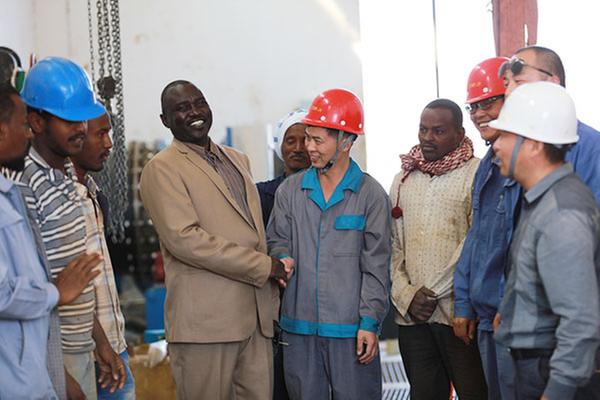
Peng Zhiyuan, from Hunan province, is welcomed by colleagues at a pumping station in Sudan.Ren Qi/china Daily |
Chinese companies and NGOs are helping to develop schools and other infrastructure in Africa's third-largest country. Ren Qi reports from Khartoum, Sudan.
Editor's note: This is the third installment of China Daily's special series on the Belt and Road Initiative.
Deep in the Nubian Desert, which covers northern Sudan, a Chinese company is helping to provide clean water from the Nile River for drinking and crop irrigation.
China International Water and Electric started construction on the Meroe Dam in the North African country in July 2003, and completed it five and a half years later.
It is the second-largest hydroelectric project on the main course of the Nile and at 9.8 kilometers, the longest dam in the world.
Along with Sinohydro, the company has operated a pumping station on the banks of the river since February 2015.
Wang Hongqiang, the manager of the facility, said the station has five pumps, each of which can deliver 2.4 cubic meters of water a second, and at least three are in operation every day, delivering a combined 7.2 cu m a second to local villages.
The dam is just one of several infrastructure projects that have arisen as a result of Sudan's participation in China's Belt and Road Initiative, a modern version of the ancient Silk Road trading route proposed by President Xi Jinping in 2013.
Sudan covers 1.9 million square kilometers, making it the third-largest country in Africa. Dongola, the economic and cultural center, is located in the northern region, where water is scarce.

"The north of Sudan is covered by the Nubian Desert, which is very dry," Wang said. "You only see plants near the water, not in the desert or in villages far from the Nile. Pumping river water is the only way to develop the agricultural industry."
The Nile has been Northeast Africa's most important source of water for drinking and irrigation for thousands of years. The northern section's course is almost entirely in the Nubian Desert as it makes its way toward Egypt. In ancient times, it sustained Egypt and several Sudanese kingdoms.
But until recently, most Sudanese, who did not live near the waterway, had to transport water to their villages themselves.
"Back in the old days, my ancestors had to walk for an entire day to fetch one barrel of water," said Ali Mustafa, 54, who lives in Meroe district, 35 kilometers from the River Nile. "Later, we drove a pickup for hours to fetch water. Now, thanks to the pumping station, we can enjoy fresh Nile water in our homes."
The pumping station near the Meroe Dam provides so many benefits to local villagers that more than 10,000 people attended a ceremony to mark its opening.
According to Wang Hongqiang, the manager of the facility, work on the station is expected to finish in the summer. Construction is much slower than on projects in China because resources are scarce and conditions in Sudan are much worse: "Still, the speed is acceptable and the progress has exceeded our expectations."
Peng Zhiyuan, a 20-something laborer from Hunan province in South China, has been working in Sudan for several months, helping to install a pumping system whose pipes are more than 8 meters long.
Although it is the first time he has worked overseas, Peng said he has already adapted to working near the Nile, adding that his Sudanese colleagues are friendly and helpful, both at work and in their daily lives.
Working in a desert, where there are few inhabitants, poses many challenges. For example, it takes about four hours to drive to the capital, Khartoum, to buy daily necessities.
"Of course, my family was worried about my safety and living conditions before I came to Africa, but I think it's safe here because of the great reputation China has in Sudan," Peng said.
Since the start of the project, more than 40 Chinese have worked on the dam, most of them from the provinces of Shaanxi, Hunan, Sichuan and Shandong, and Chinese companies built most of the basic infrastructure.
China International Water and Electric is helping with a project to raise the Roseires Dam on the Blue Nile, about 520 kilometers southeast of Khartoum. The project, which will raise the level of the dam by 10 meters to a height of 68 m, is worth $396 million.
Humanitarian aid
In addition to providing various types of aid for infrastructure construction, the governments of China and Sudan, along with several NGOs, have also cooperated closely in the field of humanitarian relief under the framework of the Belt and Road initiative, proposed by President Xi Jinping in 2013.
The Al Birr and Al-Tawasul Organization, a local NGO, is a key partner of the China Foundation for Poverty Alleviation in the African country.
Last month, the two organizations held a training workshop for teachers from two schools - the Salah Uddin Alayoubi School and the Khawla Bint Alazwar Basic School - in White Nile State as part of the Smiling Children Project, a humanitarian program that started in August 2015. The project provides education and free meals for more than 1,250 homeless children who have been brought to White Nile from Khartoum.
Ma Zhixin, an official from the Chinese foundation, said its cooperation with the Sudanese NGO continues to move on the right track.
He said the help provided by the two NGOS has benefited local schools in terms of clean water, the general environment and other services that will improve the children's lives. The assistance also allows schools to enroll a larger number of pupils.
China started its charitable NGO project in Sudan by building the Sudan-China Friendship Hospital in the rural area of Abu Ushar, Gezira State.
The hospital, which was completed in July 2011, received financial aid from China National Petroleum, and the Chinese Ministry of Foreign Affairs has listed it as one of its Model Public Diplomacy Programs.
Since the facility opened, China has continued to provide maternity and infant healthcare in Sudan.
"All the efforts, which started with a network of mothers and infants at Abu Ushar, represent great work in the field of healthcare cooperation between Sudan and China," Al-Khair Al-Noor, a former state minister of health, said.
"Our brothers in China are still supporting Sudan in many fields, and this work touches a very important issue in the provision of medical support for the least well-off people," he added.
Wu Peng, a senior official from the China Foundation for Poverty Alleviation, said the hospital project, along with other related healthcare aid, provides the African country with Chinese expertise in solving medical problems, and midwifery services have been improved by facility donation and capacity building.
The China-Sudan Maternity and Infant Healthcare Hospital in Abu Ushar is the first cooperative project between the Chinese NGO and its Sudanese counterpart in the field of maternal and infant healthcare.
Hassabo Mohamed Abdul-Rahman, Sudan's vice-president and a former commissioner-general for humanitarian relief, hailed the active and effective cooperation between China and his country. He stressed that projects such as the hospital and Smiling Children are important aspects of bilateral relations, and the friendly exchanges and cooperation between NGOs will further enhance the long friendship between China and Sudan.
Contact the writer at renqi@chinadaily.com.cn