Don't let Greater Bay Area opportunities pass you by









Chow Pak-chin urges young people in Hong Kong to change their mindset and jettison old views lest they miss prospects that await them just over the boundary
Hands up if you remember Premier Li Keqiang's mention of the Guangdong-Hong Kong-Macao Greater Bay Area concept at his annual Government Work Report at the start of the National People's Congress session on March 5. Raised hands would be few, as expected, since even I wasn't entirely familiar with the concept until it was put down in words by the handful of Hong Kong press immediately after Li's annual report. By the same token, I should not be so naive as to expect much knowledge of the Greater Bay Area among Hong Kong's younger generation, many of whom seem to be antagonistic toward the Chinese mainland. But if truth be told, it is precisely the city's young people who need to pay the area a visit, since young people is what Hong Kong's future is built on and the direction Hong Kong should take in the near future is to harness the abundant opportunities in the Greater Bay Area.
In essence, the Greater Bay Area comprises the two special administrative regions - Hong Kong and Macao - as well as nine Guangdong cities. The idea of establishing a Greater Bay Area was first mentioned in the 13th Five-Year Plan (2016-20) in 2015. In his report Li said a development plan would be drawn up for this city cluster, with distinctive strengths given to Hong Kong and Macao to elevate their positions and roles in the country's economic development. Unlike the Pearl River Delta area initiative which focuses on development on the mainland, the Greater Bay Area initiative is designed to develop external links and establish a significant position in the global industry chain.

I hear you wondering: What's the fuss about this Greater Bay Area development, which seems so integral to the nation's economic growth that it even garnered a mention in Li's latest work report? Accounting for less than 1 percent of the country's land area and less than 5 percent of the population, the city clusters of the Greater Bay Area combined created 13 percent of China's GDP in 2015. In 2014 GDP in the area reached $1.2 trillion, twice that of the San Francisco Bay Area. Hong Kong played a frontline role in the reform and development process of the Pearl River Delta but the city - together with Guangdong and Macao - will be given a new role in the 21st century; earmarked for the integration of a new phase of development, namely the bridge to other countries on the 21st Century Maritime Silk Road.
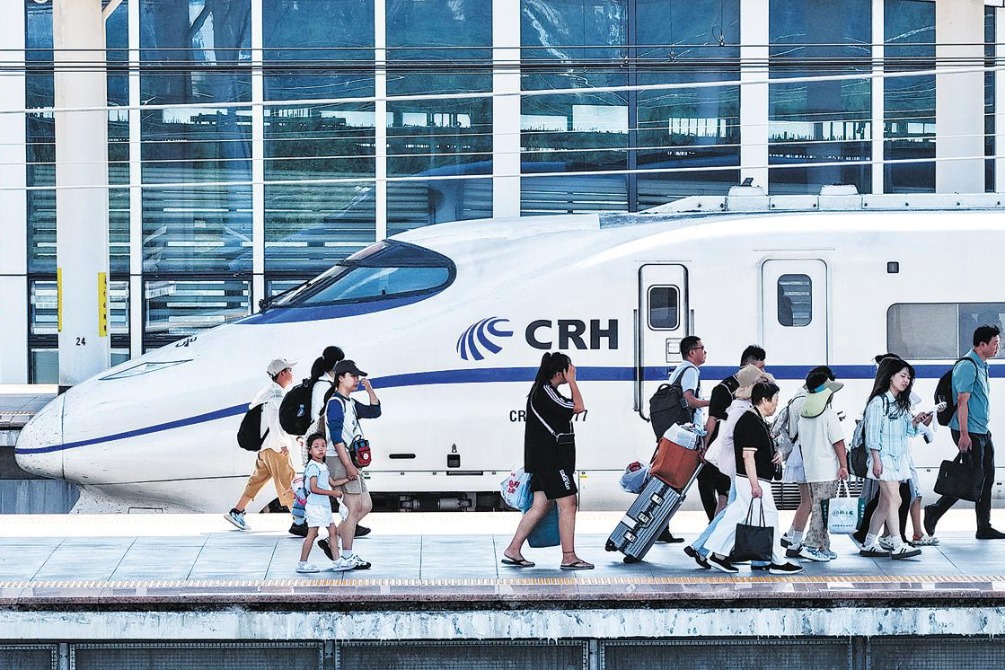
The development plan is as grand as it sounds but the question is whether Hong Kong's youths - the future of the city - are ready and well-equipped for this. Those who have been to mainland cities that have undergone rapid development invariably come home jaw-dropped, infinitely impressed by the cutting-edge technology used for the country's integrated transport network and other infrastructure projects. The high-speed railway system typically inspires awe with its futuristic concourse design and the sheer speed with which trains connect every nook and cranny of the country in no time. The same can be said about the road network, second only in size to that of the United States. With national and provincial highways comprising 4 percent and 7 percent of the road network respectively, China has easily the world's biggest highway network, measuring 96,000 km. Despite its length, however, China's highway network is extremely efficient, as shown by the numerous highways that go through long and short tunnels, as well as tall and winding bridges - to cross mountains instead of skirting them.
Hardware infrastructure is by no means the only thing about the modern mainland that leaves Hong Kong young people humbly impressed. One only needs to eat out or shop with his/her mainland friend to witness the technology leaps that let the mainland's citizens make all kinds of transactions through a single, simple-to-use mobile payment app called Alipay. To witness first-hand how physical money is almost going obsolete in an economy which just two decades ago was deprived of the technology and convenience Hong Kong people had long taken for granted is humbling to say the least. In the time it took Hong Kong to indulge in complacency, the mainland has advanced by leaps and bounds, surpassing us with the innumerable ingenious technological applications that we wouldn't even dream of, but gladly became loyal users of, for the immense lifestyle enhancement that they have brought.
In the 1,100 sq km of land that about 7.4 million of us call home, we Hong Kong citizens have grown almost too comfortable with our past glory that put us on the world's many pedestals in the late 1990s. We have rested on our laurels for so long that we are unaware of how swiftly our neighboring cities are closing the gap in terms of economic development: Guangzhou came in third - after Shanghai and Beijing - among the primary mainland cities boasting top GDP figures for last year, contributing 1.96 trillion yuan (HK$2.2 trillion) with a population of 14 million; Shenzhen, following closely, brought in 1.95 trillion yuan with a population of 12 million.
For political and administrative reasons, Hong Kong was not listed among the top GDP-grossing primary Chinese cities but with a GDP of approximately 2.2 trillion yuan last year, Hong Kong would have found itself placed third after Beijing, leading Guangzhou and Shenzhen by just a little more than 200 billion yuan. The point to note here is not that Hong Kong is still among the top three Chinese cities contributing to the country's GDP, but that it is both surpassed and followed closely by mainland cities whose socio-economic developments took off at a much later time.
With such a paramount role given by the nation to facilitate the success of the substantial development plan involving the Greater Bay Area, Hong Kong has all the head-starts any city would need to reinvigorate its economy and subsequently improve the general livelihood of its people. But the favorably given green light will only reach fruition with a change in mindset - a change that would encourage our youths to explore and harness the opportunities galore.
(HK Edition 04/07/2017 page1)



Today's Top News
- Wang to meet foreign ministers of Cambodia, Thailand in Yunnan
- China's top legislature concludes standing committee session
- Thailand and Cambodia agree to temporary ceasefire
- NPC's 4th annual session slated for early March
- Civilizational links for a fairer world
- Manufacturing in China spurs global growth