



It's time Japanese spoke truth about history









 |
| CAI MENG/CHINA DAILY |
Although Haruki Murakami mentions the Nanjing Massacre only a few times in his latest, thousand-page novel Killing Commendatore, the book and the author have drawn the ire of right-wing forces in Japan. In fact, Japan's mainstream news portals are full of criticisms against the novel.
This is not the first time that a Murakami novel has been criticized by Japanese right-wingers. Apart from his reflection on Japan's war crimes in some of his previous works, Murakami has on different occasions-including on the 70th anniversary of the end of World War II-stressed the importance of history and suggested Japan continue apologizing for its war crimes until China and the Republic of Korea feel contented. Japanese filmmaker and animator par excellence Hayao Miyazaki, too, has conveyed his anti-war philosophy in his works, for which he has been criticized by Japanese right-wing forces. And Japanese Nobel Literature Prize winner Kenzaburo Oe has been labeled a "traitor" by Japanese right-wing elements for his anti-war stance and opposition against the amendment to Japan's Constitution.
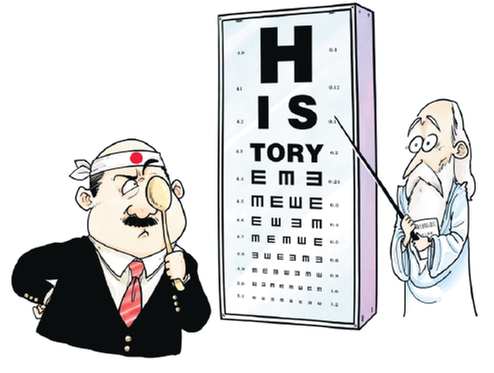
Japanese society has never lacked progressive and righteous voices. But at times the cacophony created by right-wing forces has been deafening. What is especially worrying this time is that more Japanese people are falling prey to the right-wing propaganda aimed at distorting historical facts.
Japanese Prime Minister Shinzo Abe's revisionist tendency is evident in his political stance and historical outlook since 2012, the year he assumed office for his second term. Among other things, he has said the nature of aggression should be defined neither by academics nor the international community, but by which side perceives it.
What Abe is trying to do is to whitewash Japan's history of wartime aggression and atrocities. He says he has not read the full text of the Potsdam Proclamation, and pretends to be ignorant of the bedrock declaration that shaped the post-war world order. And he sought unilateral reconciliation with the United States last year by visiting Pearl Harbor-which Japan attacked in December 1941 pulling the US into World War II-after inviting then US president Barack Obama to visit Hiroshima, while conveniently turning a deaf ear to the complaints of Japan's neighbors against revising Japanese history.
Many social factors have prompted Japanese society to tend toward conservativism. People born after World War II comprise the bulk of Japan's population today. With the memory of the war fading, Japanese people appear indifferent to the country's pre-war and war history.
And after Abe became Japan's prime minister for the second time in 2012, the teaching of true history in schools and colleges has become the exception, rather than the rule. What Japanese students are taught today are the atomic bomb attacks on Hiroshima and Nagasaki to show that Japan was a "victim" of World War II, not the initiator of the war and perpetrator of atrocities in neighboring countries.
As for the Nanjing Massacre and the issue of "comfort women", women and girls forced into sexual slavery by the Imperial Japanese Army before and during World War II, Japanese right-wing forces say those war crimes are pure "imagination".
Japan should face up to history, because as long as the historical issues are not resolved, reconciliation between Japan and its neighbors is impossible. We appreciate that some Japanese people, such as Oe, Murakami and Miyazaki, have been brave enough to accept history and oppose Japanese rightist forces.
Japan is now a developed country and sees itself as a pluralistic democratic country. But if its politicians continue to deny history or refuse to listen to rational voices, its pluralism and democracy will only be a self-deceptive trick. We hope Japanese politicians will listen to the voices that speak the truth and act as the conscience keepers of Japanese society.
The author is a researcher in foreign affairs at the China Foreign Affairs University.





