



Wheels of change bring a new route to convenience









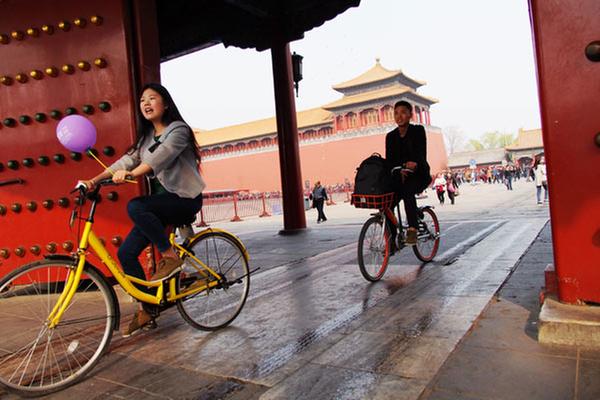 |
| Tourists riding shared bikes visit the Forbidden City in Beijing on March 18. With the advent of the era of shared bicycles, a variety of colorful bicycles add vibrancy to the Chinese capital. [Photo by Du Jianpo/For China Daily] |
Zhang Qiang, a 30-year-old engineer, was stunned when he saw that his bike, parked near a subway station in Beijing, was surrounded by fleets of internet-connected bicycles, which can be borrowed and returned with just a smartphone.
This is the Rainbow War as each bike company paints their products in orange, blue, yellow, green and other colors. Within just a year they have become a common sight in major cities.
But the rapid growth also spawns security concerns and worries that streets may be crowded with bicycles, just as Zhang witnessed. Several cities are rolling out policies to regulate the sector.
Wang Xiaofeng, CEO of Beijing Mobike Technology Co Ltd, and Dai Wei, CEO of ofo Inc, two arch rivals in the bike-sharing industry recently talked with China Daily, sharing their opinions on overseas expansion plans, government regulation and how the sector will reshape itself. Beloware the edited excerpts.
 |
| Wang Xiaofeng (left), CEO of Mobike, and Dai Wei, ofo CEO. |
Why is bike-sharing burgeoning in China?
Wang: Dock-free bike sharing is a home-grown innovation. We are the first one to experiment with the idea. The chic design and convenience of Mobike lures a greater number of young users, which fueled its popularity. Usually, it is very, very time-consuming for consumers to embrace new internet-connected products. But we markedly shortened the process. We built a network of more than 1 million connected bikes within just 300 days. That helps us stand out from other IoT applications.
Dai: ofo was the first across the world to raise the concept of bicycle-sharing free from docking stations. Thanks to the use of smartphones and the mobile internet, users can pick up bikes wherever they find them at their convenience. By thinking outside the box, public bike services are regaining vitality.
Will 2017 be the year of a cash-burning subsidy war among industry players?
Wang: The bike-sharing sector is in an infant stage where more efforts are needed to cultivate users. But giving out subsidies is not the only solution and we will embrace more innovative ways. We are, for instance, using "red envelopes" to motivate users to choose bikes that sit idle. It can not only lure new users but help dispatch bikes to where demand is high.
Dai: The ride-for-free promotion we offer is different from the last round of competition waged between Didi Chuxing and Uber, as it only slows down profit schedule other than burning cash to subsidize users.
Cooperation will outweigh competition in the bike-riding industry in the future. Ofo's idea is to set up a grand sharing plan in cities, connecting all bike manufacturers, products and users. The company will stick to it and help establish a smart commute system, assist regulators in devising industry guidelines and optimize users' transportation experience.
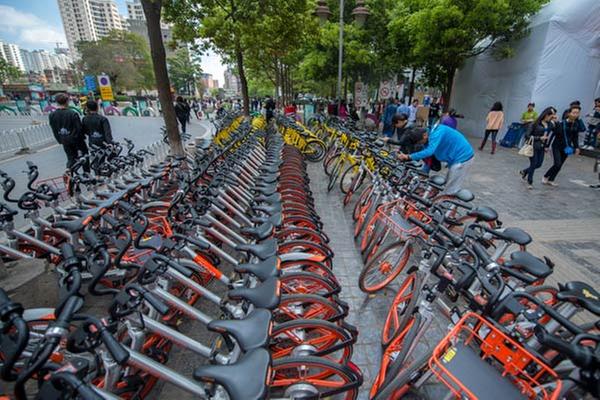 |
| Riders in Kunming, Yunnan province, park shared bikes in April 2017. [Photo/Xinhua] |
There are cases of users vandalizing shared bikes. How should the companies address the issue?
Wang: Such cases are isolated and only a tiny, tiny number of users are damaging bikes. The problem is over-exaggerated to some extent. We have taken a range of steps to prevent such cases from happening, starting from product design. Our real name verification system and credit system also help solve this problem. Our bikes have a very low damage rate.
Dai: The vandal cases are isolated. Ofo appeals to its users to remember others, especially by parking bikes in the right place. We at the same time have increased our operational staff to ensure supervision. The staff check the condition of the bikes and their parking.
In the future, ofo will actively work with related regulatory bodies in setting up parking points and ensuring the safe and orderly use of shared bikes. Ofo is also working with China Telecom and Huaiwei in a joint research on a narrow band of the internet of things, or NB-IoT solutions for smart bicycle locks.
Cities including Shanghai and Beijing are considering regulating bike-sharing amid security concerns and sidewalk congestion. What role should the government play in the booming sector?
Wang: Bike-sharing is a new thing. It takes time to straighten out relevant policies and laws to guide the industry. We welcome the government to play an important role in that. Also, it is unsustainable if enterprises just blindly throw bikes into a city without careful planning. Rather than wait until the government moves to rein in the wild growth, it is better to start refining services as soon as possible.
Dai: The government plays an important role in guiding healthy and orderly development of the industry. Bike-sharing companies should maintain an active dialogue with the government, assisting in devising industrial standards and setting up parking points.
What are the keys in replicating the bike-sharing model to overseas markets?
Wang: It is a systematic project to march into an overseas market. It means far more than just throwing bikes into foreign cities. Mobike, for instance, registered a company in Singapore as early as August, 2016, but we did not offer services there until March. It takes time for us to partner with local banks, transportation partners and authorities to offer a highly localized solution. Singaporeans, for instance, don't use WeChat and Alipay that much. They need a more local way to pay for the bike-sharing service. We now have dozens of Singapore-based employees. It is important to offer truly localized products.
Dai: Localization is an issue faced by any Chinese firms when going abroad. Ofo is no exception. The challenges include adapting to their specific rules and regulation, learning local consumer behavior and bonding with local culture. Ofo has been busy exploring a localized model that is replicable for peers to follow in their overseas expansion.
Please use three keywords or phrases to describe the bike-sharing industry over the past year and predict new trends in 2017.
Wang: The keywords for 2016: Home-grown innovation, Rainbow War, and smart transportation services.
The keywords for 2017: Refining services: Enterprises should focus on refining services and optimizing operations this year. No more blind expansion is needed.
Smarter commute: The industry will become increasingly smarter and technology will play a very more important role.
A more orderly market: Bike-sharing is beneficial to almost every one. It doesn't touch the vested interests of anyone. We desire a more standardized and orderly environment to grow.
Dai: The keywords would be sharing, smart commute and new travel. Ofo will accelerate its expansion at home and abroad. Right now, we have covered 43 Chinese cities and started trial operations in Singapore, London and California. I believe we have taken a concrete step, and will keep benefiting the world with low-carbon and environmental-friendly ways to commute.
Contact the writers at masi@chinadaily.com.cn and daitian@chinadaily.com.cn



















