Guilin's art river: charting the source of China's masterpiece









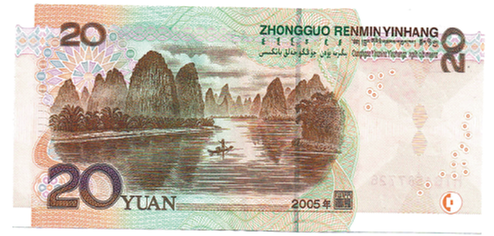 |
| The use of the Lijiang River as an emblematic subject of Chinese landscape painting received the ultimate stamp of approval when it was pressed on the 20 yuan banknote. [Photo provided to China Daily] |
The first Guilin native to inscribe the history scroll of Chinese painting was Shi Tao, who was probably born in 1642 in the still-extant Jingjiang Prince's Palace in Guilin. After his father was killed in armed rebellion in 1645, Shi Tao left Guilin forever. Although he is not known to have painted Guilin landscapes, his memories of home clearly influenced his works, which inspired generations of subsequent Guilin artists.
From the 18th century, an emergent Guilin art scene was dominated by three families; the Zhou, Li and Luo. Zhou Weigeng, known as the father of Guangxi landscape painters, created a new landscape method using ocher ink ax techniques. Li Xiyuan, Zhou's son-in-law, followed Zhou's techniques and devoted his life to landscape painting. In 1837, a journey to Wuchang along the Lijiang River and Xiangjiang River inspired a 35-work River Painting series, with each creation incorporating a poem. Li Xiyuan's son Li Jishou kept the family tradition going and their Chongshan village was renowned as a creative hotspot.
The Luo Family were equally respected for their artistic endeavors. Luo Cunli traveled widely to find creative patronage from lords and nobles. His son Luo Chen - known as "best at painting, calligraphy and poems in Guilin" - built a house on the bank of Rong Hu where he quickly rustled up a set of 33 paintings of Guilin scenery.
Like so much of modern China's iconography - her flag, her anthem, her martyrs' pantheon - Guilin's reputation as the symbol of national landscapes hails from the first half of the twentieth century. This was a time when many prominent artists visited Guangxi. In 1905 Qi Baishi spent nearly half a year in Guilin creating masterpieces like Solitary Beauty Peak and Lijiang River Rafting. He summarized Guilin's scenery as "peaks, banks and fishing". Later, in 1936, another renowned master, Xu Beihong, came to Guilin and opened a new path in Chinese painting with his renderings of the misty rain of the Li River. Xu's innovations included giving up traditional line texturing methods for a splash ink method, and he also used clear reflections to enhance the water texture.
The really significant moment for Guilin's reputation was during the War of Resistance Against Japanese Aggression (1937-45) when waves of émigré Chinese landscape artists, fleeing from war torn regions, washed up there. As well as Xu Beihong, other greats like Guan Shanyue, Zhang Daqian and Huang Binhong beat a path to Guangxi. Guan Shanyue arrived in October 1940 and created famous landscape works such as Lijiang River Hundred Li painting which portrays the whole length of the river from Guilin's Lijiang River Bridge along to Yangshuo.
It was after this formative period that the creative compass of Chinese landscape painting really spun from the southeast of China to Guilin. This development gave new impetus to local artists and encouraged the emergence of the Lijiang River Painting School, whose formative figures include Tu Ke. Since the 1980s a group of Guangxi painters led by Huang Gesheng have focused on the scenery of the Lijiang River and southern Guangxi.
The author is a Hong Kong-based writer, translator and publisher. Guilin: China's Masterpiece, a comprehensive guide to Guilin's scenery and culture, is out now from Make-Do Publishing.