Snapping up a market with superior selfies









Huawei's quality camera helps deliver soaring sales for smartphone
Snapping a picture on your smartphone was once just a matter of recording information easily, but in recent years it has become a hobby. The opening of the world's first-ever smartphone selfie exhibition at London's prestigious Saatchi Gallery last week showed that smartphone photography is now a fashionable means of self-expression.
|

|
| HUAWEI P10 LAUNCH at World Mobile Congress in Barcelona. |
A major innovative force in smartphone photography is the Chinese telecommunications giant Huawei, a relative newcomer to the phone industry, which has quickly risen to become the world's number three player, after Apple and Samsung.
Sales volume picked up last year when Huawei launched its P9 smartphone, which boasts camera technology developed in partnership with the German upmarket camera maker Leica. Last year, Huawei shipped 139 million smartphones worldwide, a 30 percent year-on-year increase. The phone has been supported by big investment in marketing, evident in a promotion film featuring movie stars Scarlett Johansson and Henry Cavill.
James Jie, chief executive of the Huawei UK Consumer Business Group, says: "The success of our P9 series is due to our product's quality, our branding and marketing strategy and, in particular, our collaboration with Leica."
Behind the attention-grabbing growth statistics, Huawei's smartphone success is down to a lot of hard work, which Jie knows from experience.
Before coming to the UK in 2015, Jie worked with Huawei's smartphone research and development team. He still vividly remembers the experience in 2013 of leading an R&D team developing the Huawei P6, which made a name for itself as the world's thinnest smartphone at the time.
Jie remembers the long nights he spent trying to achieve the target of producing the phone's metal back cover to a thickness of 0.3 millimeter, in order to achieve the overall specification.
Jie says: "We had already set June 18 as the launch date for the product and I knew we had to manage fullscale production before this date so, for about one month, I stayed with our mechanical supplier doing R&D work day and night."
He could have easily reduced the pressure for himself and his team by changing the target for the back cover to 0.35 millimeters, but he did not want to compromise.
"I said to the team, the appearance of the phone represents our attitude. A near miss is as good as a mile."
Within a month of the launch date, Jie's team achieved this target. The phone was 6.18 millimeters thick, quite an achievement, especially considering it has a 5-megapixel camera. That was the beginning of the Huawei smartphone's strong growth internationally.
|
|
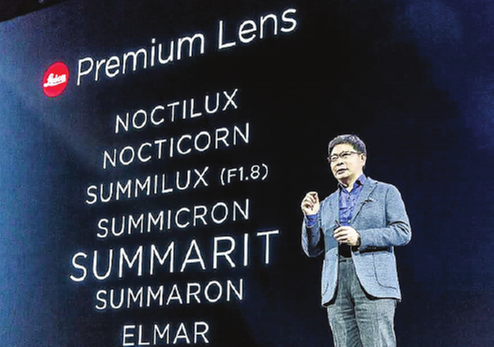
| RICHARD YU, chief executive of Huawei consumer business, at the presentation ceremony of Huawei P10 at Mobile World Congress in Barcelona. |
The R&D emphasis is deeply rooted in Huawei's culture, and what Jie learned from experience is representative of the company as a whole. R&D spending has reached $38 billion in the past 10 years and involves 45 percent of its 176,000 employees worldwide.
On the consumer product side, Huawei has continued to launch products pushing the boundaries of tech. Its latest smartphone, the P10, launched at the World Mobile Congress in Barcelona this year, comes with upgraded Leica camera functions, fast performance in-house Kirin 960 processors and a stylish finish. Its new colors, developed with the US color tech company Pantone, are well-liked by British consumers, Jie says.
Despite Huawei's growing success as a smartphone maker, it is actually a relative newcomer to this market. Traditionally, Huawei generates most of its revenue from its network business, providing services to operators including Vodafone and Telefonica. Its services and products are used in more than 170 countries and regions, serving more than a third of the world's population.
In 2015, it generated $60.8 billion in revenue and remains the only Chinese company in the Fortune 500 list to make more money abroad than domestically.
For Huawei, such global success grew from humble origins. Founded in China in 1987 by Ren Zhengfei with an investment of $3,500, Huawei started as a private reseller of PBX telephone switches.
Its international expansion picked up pace in the 2000s. In 2001 it established an office in the UK, and a major breakthrough came in 2005 when Huawei's international contract orders exceeded domestic sales for the first time.
In that same year, Huawei signed a contract with British Telecom to roll out the latter's 21st Century Network data network program, which delivered superfast broadband to 20 million homes across the UK.
Huawei's success in the UK has helped open doors for expansion into European markets, through partnerships with carriers including Vodafone, Orange and Telefonica.
The company's continued tech-driven expansion into Europe is further demonstrated by the fact that the company filed a notable 2,390 patents with the European Patent Office in 2016, the second-largest filing by a company globally, after Philips with 2,568.
Meanwhile, Huawei continued to invest in research and development work, often in pioneering new technology fields. One example is a partnership with the National Graphene Institute in Manchester on research work looking to incorporate graphene's thermal management properties into Huawei products. Graphene is one of the most interesting inventions of modern times. It enabled two academics to earn the Nobel Prize for Physics in 2010 but, due to its short history, much of its potential is yet to be unlocked.
Another pioneering field in which Huawei leads innovative research is 5G technology, characterized by low latency, high reliability and very high data capacity. It is expected to be realized by around 2020. Huawei has partnerships with 20 universities on 5G R&D and, in the UK, it is a key industry partner for the University of Surrey's 5G Innovation Centre.
Keith Robson, chief operating officer of 5GIC, says he is impressed by Huawei's concentration on R&D and long-term thinking.
He says: "The commitment from Huawei on R&D is second to none, and that may be because its policy is set in this way and it penetrates through the whole company culture".
In 2015, the thinktank Oxford Economics conducted a study on Huawei's economic contribution to the UK market and estimates the company made a £956 million ($1,183 million; 1,118 million euros) contribution to British GDP between 2012 and 2013, supporting 7,400 jobs.
Such statistics show that Huawei is not just creating growth but building an ecosystem to help many local companies grow.
"Huawei's global vision and open attitude makes it a great partner," says Alan O'Prey, managing director of telecoms at the British engineering firm MJ Quinn Integrated Services, which started working with Huawei in 2010. It currently has about seven projects with Huawei.
Huawei's continued success and growth in the telecoms industry has attracted much attention from international competitors and governments, and the fact that telecoms is an area related to national security previously led to the US and Australian governments raising suspicions about the company.
In 2012, the US government warned its companies against buying Huawei equipment, citing national security concerns. It warned that Huawei equipment could be used to leak sensitive information from the US to China. In the same year, the Australian government rejected Huawei's bid for work on its 35.9 billion Australian dollar high-speed broadband network for cybersecurity reasons.
Questions raised by the US and Australian governments have perhaps led to Huawei missing out on some business opportunities, but in more recent years such government attacks have been reduced.
Perhaps the global growth of consumer awareness toward Huawei's brand and story has helped it gain trust. Consumer products such as smartphones greatly contribute toward awareness.
Jie of Huawei Consumer Group says he personally believes the company's increased stress on consumer products in recent years has had three positive aspects. First, consumer products have greatly helped the company to grow its brand. Second, the good performance of these products has helped boost employee satisfaction. Third, the consumer segment generates solid profits.
"So there is a market-driven reason to justify our investment into this segment," he says.
Huawei UK
Industry: Telecoms
Year of entry into UK: 2001
Address: 300S Oak Way, Reading, RG2 6UF
Employees: More than 1,330
Parent company in China
Huawei
Industry: Telecommunications:
Year of founding: 1987
Global employees: 170,000
2015 Revenue: 395 billion yuan ($60.8 billion)
Address: Gaoxin South 10th Road, Nanshan Qu, Shenzhen Shi, Guangdong Sheng, China, 518057