



Home built aircraft carriers a strategic need









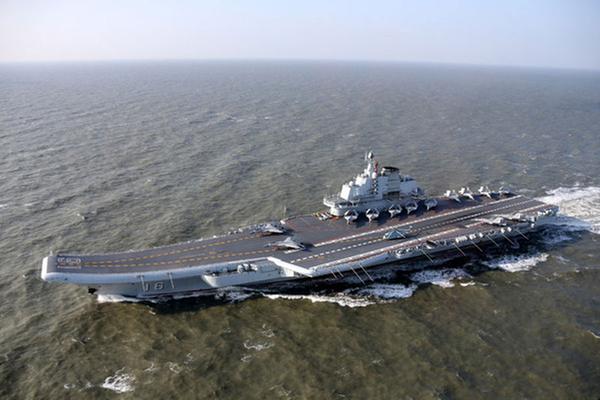 |
| Chinese aircraft carrier Liaoning returns to Qingdao, China after Pacific drill, January 13th, 2017. Comprised of aircraft carrier Liaoning, a number of destroyers, some J-15 carrier-based fighter jets and helicopters, the fleet sailed through the Bohai Sea, the Yellow Sea, the East China Sea and the South China sea. [Photo/CRI] |
The "homemade" aircraft carrier is expected to have a displacement of about 50,000 metric tons, and conventional engines and fighter jet launch systems, which are used on CNS Liaoning, China's first aircraft carrier. However, on-board fighter jets may still have to resort to ski-jump ramps instead of the more advanced catapult-assistance take-off.
CNS Liaoning, rebuilt from a former Soviet cruiser, Admiral Kuznetsov-class carrier Varyag, is primarily used for training and research, while the new carrier will serve naval combat and defense missions, as well as non-combat missions ranging from fighting terrorism and piracy to taking part in rescue operations. Pilots and commanders for the new carrier have been trained and its equipment tested on Liaoning for future operations.
Although the new aircraft carrier will be a much-improved version of Liaoning, it will not be as advanced as its US counterparts, including the nuclear-powered US Nimitz-class and the latest Gerald Ford-class carriers, in terms of size, scale and combat capability. Also, it will take a few more years to complete the functional operations of the new vessel's devices and weapons before it can embark on sea trials.
This is all the more reason Beijing should intensify its research in and enhance its capacity to build aircraft carriers. Such vessels are a necessity for a major power aspiring to better protect its legitimate interests in the open seas, as well as to safeguard regional stability and international sea lanes. Since strong naval powers like the United States are unlikely to exchange equipment and technologies used in their top carriers, China should emulate successful models and learn how to build more advanced carriers.
Two aircraft carriers, regardless of their size, are not enough for a country such as China. The basic principle is that a country the size of China should have at least three aircraft carriers-one for training, one for naval duty and one for maintenance. Six of the 11 US aircraft carriers are deployed in the Pacific Ocean and the rest in the Atlantic Ocean, which help Washington to maintain a formidable maritime presence across the globe.
China has no intention of challenging the US' global dominance nor will it seek to strengthen its navy beyond its defense-oriented strategic need. Chinese vessels are mainly used for self-defense and to preserve regional security. And there is plenty of room for improvement with regard to their capability and combat readiness.
Since aircraft carriers will continue to play a key role in securing open sea operations, China's efforts to design and build a competent carrier from scratch are more than justified. Besides, China needs to convince its neighbors with which it has maritime disputes that the carriers will not be used to flex its military muscles but to make the region safer.
The author is a senior researcher at the Naval Military Studies Research Institute of the People's Liberation Army. The article is an excerpt from his interview with China Daily's Cui Shoufeng.





