



Falling commodity prices big challenge for poor countries









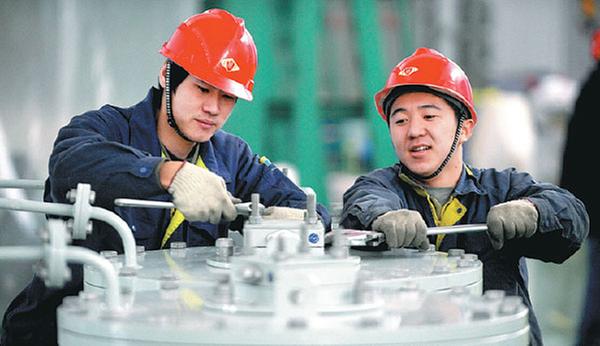 |
| Workers from TBEA Shenyang Transformer Group Co assemble equipment in a plant in Shenyang, Liaoning province. [Photo by Zhang Wenkui/For China Daily] |
As discussed in a recent report by the IMF, the situation is particularly challenging for commodity-dependent countries, which have seen tax and export revenues shrink markedly in response to lower commodity prices. With commodity prices expected to remain subdued over the medium term, more decisive policy changes will be needed to restore macroeconomic stability. But policies must be designed to reduce the pains on the populations and preserve the longer-term growth prospects.
Fuel commodity exporters have been the hardest hit by the commodity price decline-with the effects being more marked where exchange rate adjustment has either been resisted (by central banks) or is ruled out as an option (because currencies are tied to the US dollar or the euro). On average, in fuel exporters the large drop in oil prices, together with spillovers to the non-oil economy, has pushed countries into recession and more than halved fiscal revenues.
Non-fuel commodity exporters have suffered less-because export prices have fallen much less than oil prices and because they have benefited from lower oil import bills-but they are experiencing strains as well, with growth dropping below 4 percent, from 4.5 percent previously. While their growth rate seems solid compared with more advanced economies', it is too slow to lift large numbers of people out of poverty and provide jobs for young and rapidly growing populations.
Doing substantially better, economies less dependent on commodities (so-called diversified exporters) have generally maintained their growth momentum at some 6 percent per year. But some have felt the adverse effects of the end of the commodities boom.
The reversal in commodity exporters' growth momentum, coupled with only limited adjustment of macroeconomic policies so far, has resulted in significant weakening of fiscal positions of many countries, particularly fuel exporters. Thus, many of these countries are now seeing sharp increases in public debt. In diversified exporters, where fiscal deficits have remained high due in part to high outlays for public investment, debt is rising as well, from already high levels. With this, risks of debt distress are intensifying in many LIDCs.
The stress of the banking sector are further compounding the growing vulnerabilities. With weak growth and rising government arrears, indebted enterprises are facing loan-servicing difficulties, imposing strains on national banking systems. Such stresses have already emerged in one-fifth of the LIDCs.
Moreover, the story of economic development in LIDCs over the past year is not uniform. For example, it has been a very difficult period for countries suffering from armed conflict and/or those hit by drought in Eastern and Southern Africa-and millions of people are at risk of famine and starvation in the worst-hit countries.
The challenge for policymakers, particularly in commodity exporting countries, is to restore macroeconomic stability while containing the burden imposed on the most vulnerable and preserving longer-term growth prospects. This requires fiscal adjustments to put budget positions on a sustainable path while continuing to invest in people and infrastructure.
Policies will typically need to include efforts to raise fiscal revenue by broadening the tax base and to cut back on low-priority and wasteful spending; if budget deficits are not reduced, public debt levels will soon become increasingly difficult to sustain.
The sharp decline in commodity prices has depressed growth and fiscal accounts in commodity exporting countries, most notably fuel exporters, leading to rising public debt levels. With careful design, the budget adjustments needed to put public finances on a sustainable path can be implemented in a manner that limits the burden on the poorest segments of the population while protecting growth-critical outlays. Policymakers now need to act quickly and decisively. And for their part, development partners need to stand ready to provide more support.
Seán Nolan is a deputy director in the Strategy, Policy and Review Department, IMF; Hans Weisfeld is deputy division chief, Strategy, Policy and Review Department, IMF; and Klaus Hellwig is an economist, Strategy, Policy and Review Department, IMF.





