



No real future for a TPP without US









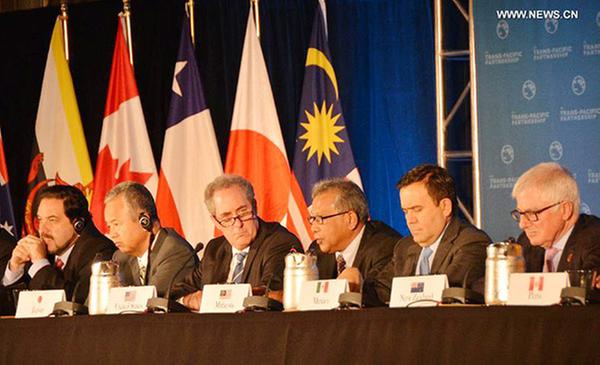 |
| Trade ministers of the United States and 11 other Pacific Rim countries attend a press conference after negotiating the Trans-Pacific Partnership (TPP) trade agreement in Atlanta, the United States, on Oct 5, 2015. [Photo/Xinhua] |
With the United States having withdrawn from the Trans-Pacific Partnership agreement, trade officials from the remaining members gathered in Canada on Tuesday and Wednesday seeking ways to keep it alive. But can they really make any breakthrough?
The US accounted for about 24 percent of the world's total GDP last year according to the World Bank. Thus, a TPP without the US is simply not feasible. With the US having a central role, the economies of the member countries were complementary to it. After the US' withdrawal from the deal, the total share of the remaining TPP members has decreased to 13 percent of the world's total GDP and the competition among them has increased while the complementary nature of their economies has decreased.
For instance, Japan and Australia both want to export their agriculture products. Australia and Canada both want to increase their exports of minerals. Thus, the real economic value of any TPP without the US is limited. Considering the business community is more sensitive to the economic benefits than its political purposes, the strategic advantages calculated by politicians may not be enough to win the support of the business communities in the various countries.
If a deal was ratified without the US, it would send a very strong signal that the US has lost direct control of it. Then US President Donald Trump's decision to quit would be harshly criticized as a policy mistake, the US' credibility would be doubted by its allies, and, should the US want to join someday, it would have lost the initial advantages it had.
For the Barack Obama administration, the TPP had dual values. One was its economic value, the other its strategic value.
The Peterson Institute for International Economics estimated in January 2016 that the TPP would increase annual real incomes in the US by $131 billion, 0.5 percent of its GDP, by 2030, and its annual exports by $357 billion, 9.1 percent of its GDP, by the same year.
But on Jan 23, Trump, the newly installed US president, signed an executive order to quit the TPP.
He had a number of justifications for this.
First, although joining the TPP would have been lucrative for the US as a whole, many of his supporters, especially blue-collar workers disliked the TPP and claimed it would hurt them. Fulfilling his campaign promise to these voters was necessary to legitimize Trump's presidency.
Second, Trump's withdrawal from the TPP doesn't mean it has died. The agreement is still there and can be resurrected if desired.
Third, Trump was not satisfied with some of the clauses in the TPP. He wants to use withdrawal from the deal as a way to shift from the multilateral mechanism to bilateral mechanisms, and then use the efficiency of bilateral negotiations to "fix" the clauses in the TPP he is not happy with, and push the US' allies to take more responsibility.
Fourth, even though the TPP would still have a strategic function, without the US as a member its hedging function has been weakened dramatically, since most of the remaining members have strong economic and trade relations with China.
Trump has thus concluded that is it not a good deal for the US to sacrifice its market opportunities for such a limited strategic purpose. For Trump, an ungratified and stagnating TPP that can be resurrected when needed is in the best interests of the US.
The author is a research fellow and director of the division of American Economic Studies at the Institute of American Studies of the China Institutes of Contemporary International Relations.





