Poland embraces strategic development role









The country is building a framework for far-reaching political and diplomatic changes to promote the 'new Silk Road'. Angus McNeice reports from Warsaw.
Editor's note: This is the eighth in a series of reports focusing on the development of the Belt and Road Initiative, China's proposed trading route linking Asia, Europe and Africa.
At the Belt and Road Forum in Beijing this month, Poland will be represented by an enthusiastic supporter of China's international development and infrastructure project.

Polish Prime Minister Beata Szydlo has been clear in her assessment of the Belt and Road Initiative. "It's in the best interests of our countries," she said, during President Xi Jinping's visit to Poland last year. She also spoke about the "numerous agreements" the countries have signed to "take the next step toward practical realization of the idea of the 'new Silk Road'".
Building on existing rail and maritime links between the nations, the leaders of China and Poland are in the process of constructing a political and diplomatic framework that will ease the path for key development projects.
A number of state visits have boosted Sino-Polish ties in recent years. The countries entered a strategic partnership in 2011 during President Bronislaw Komorowski's visit to China. Wen Jiabao, China's premier at the time, travelled to Warsaw in 2012.
Polish President Andrzej Duda, Komorowski's successor, visited China in 2015, and the following year Xi delivered a speech in Poland that directly addressed the Silk Road Economic Belt and the 21st Century Maritime Silk Road, known together as the Belt and Road Initiative.
Bogdan Goralczyk, a diplomat and sinologist at the University of Warsaw, said the visits launched the countries into a "new era".
"Probably for the first time in the country's long history it is in China's interest to come to Central and Eastern Europe, especially to Poland," he said. "From a geostrategic perspective - between Berlin and Moscow - it's the best location you can imagine."
Poland is perhaps the most broadly involved European Union member participating in the Belt and Road Initiative. It was one of the first countries to join the Asian Infrastructure Investment Bank, and it signed a memorandum of understanding on the initiative in 2015.
With the exception of China, Poland is the largest economy in the "16+1" initiative created to increase cooperation between China and Central and Eastern European countries.
Despite deep engagement and a raft of agreements, flagship Sino-Polish Belt and Road projects still have a long way to go.
Launched in April 2013, and now incorporated under the initiative's banner, the rail link between Chengdu in Sichuan province and Lodz in central Poland is the most notable infrastructure achievement involving the two countries. In September 2013, the Warsaw-Suzhou link started running, while the Lodz-Chengdu railway was extended to include Xiamen, Fujian province, in 2015. A direct container sea service between Gdansk and Shanghai commenced in 2010.
According to Justyna Szczudlik, China analyst at the Polish Institute of International Affairs, it's difficult to say if more specific projects were launched after the initiative was announced.
A number of proposals were sketched out during Xi's visit to Poland, including a new airport, a high-speed rail system, industrial parks and logistics hubs along the Lodz-Chengdu route.
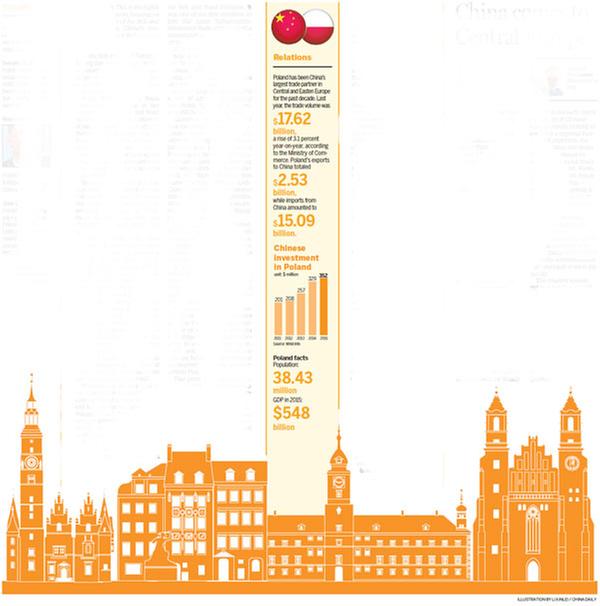
From a Polish perspective, collaboration on the initiative presents three major opportunities: to expand exports to China and mitigate a 12-to-1 trade imbalance; to attract Chinese investment; and, crucially, to link the Belt and Road to its own national development initiative, the Morawiecki Plan.
That point was underlined in June, when the countries upgraded their relationship to a comprehensive strategic partnership. Point four of the 11-point document signed by Xi and Duda was dedicated to coordinated implementation of the initiative and the Morawiecki Plan.
One of the most ambitious proposals is the construction of a new international airport near Warsaw. However, the capital's two main airports, Chopin Okecie and Modlin, have comparatively low numbers of connections, which is seen as a significant handicap in the ongoing competition with Prague and Vienna for tourism and business.
The huge price tag for construction - estimates vary between 7 billion and 12 billion euros ($7.6 billion and $13 billion) - is the biggest sticking point.
During a visit to Beijing in April last year, Witold Waszczykowski, Poland's minister of foreign affairs, held a meeting with the National Development and Reform Commission, after which he confirmed the Chinese were interested in participating.
Chinese investment in Poland's infrastructure was discussed by Duda and Xi during the Chinese president's visit to Poland. The deepening of Sino-Polish ties over the Belt and Road Initiative has pushed the airport closer to becoming a reality, but it remains in the discussion phase.
The slow-moving nature of initiative-related projects in Poland was highlighted by Waszczykowski during his visit to Beijing: "Many Chinese companies have great experience in building such infrastructure. Some of them could benefit from our tenders and join in the implementation of such projects in our country."
According to Szczudlik, tenders and the drawn-out process of public procurement for infrastructure projects in Poland and other EU member states has frustrated some Chinese investors.
"We're told by departments all the time that it's difficult for the Chinese to understand the tender procedures," she said.
"The Chinese want assurances straight away that we can't give them. That's part of the reason we have memorandums of understanding and agreements, but no specific projects. With Poland, China is in the process of learning by doing."
Contact the writer at angus@mail.chinadailyuk.com