



Initiative charting new trajectory for mankind









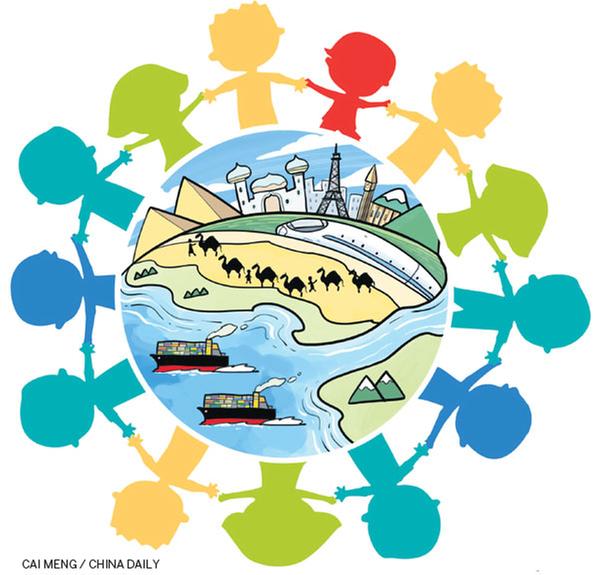
It was no doubt the unique circumstances of China's internal and external developments during the first decade of this century that convinced President Xi Jinping to place the Belt and Road Initiative at the top of China's foreign policy agenda.
First, it corresponded well with the overall economic situation. China had become the second-largest economy in the world, and the technological advances it had made, particularly in a number of fields like high-speed rail, had astonished the world. It also possessed the financial means of initiating a program of such magnitude, which comprises the Silk Road Economic Belt and 21st Century Maritime Silk Road.
Second, it was the ideal platform for a "good neighbor policy". The rise of China, the largest country in the region by far, had created some concerns among its smaller neighbors. But a China which showed itself willing to help them move forward on the road to progress could not be seen as anything but an important benefactor.
And third, it converged nicely with the "Go West" policy. Developing the western region of China thus became more than a social and moral imperative. With new rail connections established to Central Asia and further on to Europe, the western region has become central to the development of this project, with cities like Chongqing, Chengdu, Xi'an and Lanzhou now becoming major transit hubs for the Belt and Road traffic.
More importantly, China has reinvigorated with the Belt and Road spirit, the spirit which imbued the ancient Silk Road with its profound exchange of both goods and ideas. That was a period of time during which there was a tremendous exchange of goods-silk, spices, jade and gold.
But there was also an important transmission of ideas and cultures, of styles, fashion and music, indeed one of the first attempts to create an international dialogue of cultures, a transmission of different philosophies and outlooks, each enriching the others in a glorious intellectual interplay. Along the ancient Silk Road appeared important centers of intellectual activity in places like Samarkand, Bukhara (both in modern-day Uzbekistan) and Alexandria (in Egypt). The transmission of culture along the Silk Road provided the basis for the advancement of culture in Egypt and Greece, leading to the development of European culture itself, coming out of Greece and Sicily.
Another aspect of the Belt and Road agenda has to do with China's growing role on the global stage. Given the tremendous turbulence characterizing the world situation in the last decade-the economic crisis in Europe and in the United States, the continual deterioration of the conditions in developing countries, and the spread of international terrorism, enflamed by the numerous military interventions by the US and NATO into various Middle Eastern and North African countries-the Belt and Road represented a bright light in an otherwise uncertain world. Already it has created a sense of optimism, not only in Asia but also in Africa and Latin America.
The unprecedented success of the Asian Infrastructure Investment Bank, which has mobilized the majority of the world's population behind it, has engendered a feeling that the world can now go forward, after many years of economic stagnation. The adherence of the BRICS group to the Belt and Road perspective has largely brought the great majority of the world's population behind the initiative.
The enthusiasm for the Belt and Road Initiative has been enhanced by the fact that it was China that put forward the proposal. China remains the only developing country which has succeeded, in the post-Cold War period, to move in the direction of becoming a moderately prosperous nation. And such a development by the largest country in the world, demonstrated to other developing countries that they too could move from poverty to prosperity.
In China's case, this involved a conscious attempt to "leapfrog" from the low-wage production that characterized Chinese production in the early days of reform and opening-up to higher-value production. The conscientious striving for the "cutting-edge" technologies, including the ambitious Chinese space program, became a "science driver" for the Chinese economy.
Countries in Africa and Latin America gained valuable lessons from the Chinese experience and were therefore very open to working with China in advancing their own prospects. Infrastructure investment plus an emphasis on developing science and technology was proving to be the road to success.
China has made it a priority to utilize that model in order to help benefit its neighbors-both near and far. Investment in infrastructure, in particular transportation infrastructure, creates the network for a functioning industrial structure and a flourishing trading pattern, increasing overall productivity by providing access to wider markets for both agriculture and industry, and quicker turnover and less travel time for people and goods in the urban centers.
The Belt and Road Initiative represents much more than simply a needed development program. It is a key element in a new model of governance in the world. The era in which politics was determined by a single power is really at an end. While the US remains militarily the most powerful country in the world, new countries have come forward and taken their place in the world arena, China being the most striking example. Russia, too, has fought its way up from the destruction incurred by the post-Soviet malaise and dismantlement of key scientific and industrial structures. And in spite of its continued difficulties, India has become a key player in world politics.
While China has the financial capability of initiating the Belt and Road project with its own financial institutions, such as China Development Bank and the Export-Import Bank of China, Beijing's initiative in establishing the AIIB in October 2014 represented a new directionality for the world economy as well as a major boost to developing countries' role in the world economy.
The Belt and Road Initiative is much more than a framework of economic cooperation. It is an alternative philosophy for the interaction of countries, indeed, a dialogue of cultures. And while the Silk Road spirit imbues the spirit of the Belt and Road Initiative, it also contains an element that is characteristically Chinese and stems from Confucius, particularly Confucius' saying: "The superior man is aware of righteousness, the inferior man is aware of advantage." The Belt and Road Initiative at the deepest level is concerned with the question of "righteousness" in economic affairs, characterized by Xi's continual emphasis on the feature of its "win-win" cooperation.
The author is the Washington Bureau chief of Executive Intelligence Review. The article is an excerpt from his article, "The Belt and Road Initiative: Charting a New Trajectory for Mankind" in China International Studies.





