



Belt and Road holds key in Sino-German relations









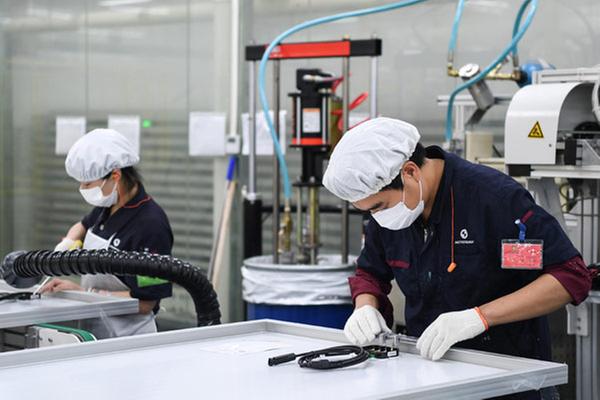 |
| A junction box is assembled at a Sino-German plant in Hangzhou, Zhejiang province, in April. More than 50 percent of the plant's products are sold overseas. [Photo/Xinhua] |
The Belt and Road Initiative promoted by President Xi Jinping foresees the reactivation of a corridor with maritime and terrestrial commercial links between China and Europe, Germany being one of the important poles of this concept.
It has triggered, especially if the concept of the Asian Infrastructure Investment Bank is taken into account, a global reflection on the role of economic links on the Asian-European land mass. It has also reaffirmed to the peoples of this area that economic collaboration from East to West has a long tradition, and over and above that has always been embedded in cultural cooperation.
Few people know that the term Silk Road was coined by Ferdinand von Richthofen in 1877. He was a geographer from the commercially important city of Leipzig, crossed by one of the Salt Roads that have their European center in Halle, a city just 50 kilometers away. Indeed the name Halle relates to a Celtic and Greek language root for the term salt.
From Germany the Silk Road found its way into the English-speaking world and was finally brought to China, where everybody today thinks it is the natural term for the grand periods of China as one of the cultural and economic centers with global links.
Salt Roads and Silk Roads may be on identical routes as in many parts of Germany or in the Mongolian area of Baotou. This has led us to the establishment of an annual conference named Silk Road Meets Salt Road. Scholars from all over the world, especially from China and Germany, meet in the historic Halle Salt Production Museum and reflect on cultural, economic, political and technological issues.
There are many very specific Sino-German aspects that lead us to state that there may be something like a Silk-Road paradigm. We may start with Gottfried Wilhelm von Leibniz (1646-1716), inventor of the digital system, a producer of a mechanical computer, but also, after the catastrophe of the Thirty Years War (1618-1648) in Europe, someone who introduced Chinese philosophy and asked whether Europe needed more thinking in terms of harmony.
This led to the emergence of the physiocratic liberal school of economic thinking in the 16th century. Another important event in the relationship between German and China was the transferring of standardization and patenting systems to China in the early 1960s - leading to an interaction in industry and engineering that by far exceeds the level to be expected with regard to geographic distance.
Applying this joint heritage to modern times, thus entering the fields of economics and technology, both countries seem to be ideal partners, extremely complementary in most fields, competitive in some others, but always both looking to a promising future.
Germany has a powerful techno-industrial base and a sound entrepreneurial foundation, both proving their resilience during the recent economic crisis, especially in contrast to other industrialized countries in Europe, which experienced a meltdown of their manufacturing base.
Some of the best performing investments in China come from industrial Mittelstand, namely the family-based global medium-sized enterprises, and, many Chinese firms have bought themselves into formerly German family firms where successors were unavailable.
China, because of Confucianism, has a family-oriented philosophy supporting family business.
Professor Dr.Dr.h.c. Ulrich Blum holds a chair in Political Economy at Martin-Luther-University Halle-Wittenberg in Germany and is director of the Center of Economics of Materials - CEM, and is visiting professor at University of International Business and Economics (UIBE) in Beijing.










