



Together, China, US can create a symphony









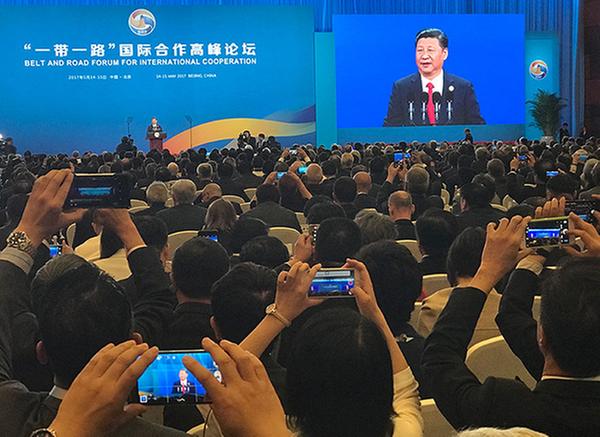 |
| President Xi Jinping delivers a keynote speech at the opening ceremony of the Belt and Road Forum for International Cooperation in the National Convention Center in Beijing, on May 14, 2017. [Photo by Xu Jingxing/chinadaily.com.cn] |
The promotion and implementation of the Belt and Road Initiative (the Silk Road Economic Belt and the 21st Century Maritime Silk Road) could offer the desired answer. At the heart of the initiative is all-round inter-connectivity and cultural integration, which could help reduce, if not end, the injustices stemming from the different development levels, ideologies and political systems of different countries, and facilitate joint efforts to build a global community of shared destiny.
The Belt and Road projects are essentially about building global partnerships and securing peaceful coexistence. They are not about challenging the current world order, as China itself has greatly benefited from it.
The focus areas of the transnational proposal-policymaking, infrastructure, trade, currency, and public minds-each serve carefully designed purposes. Interaction over policymaking will enable the economies along the Belt and Road routes to reach a consensus on development strategy, macroeconomic policy, and major projects.
Infrastructure connectivity, aimed at linking economic zones from Asia to Europe and Africa, will help developing (as well as developed) countries to benefit from participating in the initiative.
Trade exchanges are about co-building an expansive free trade network, accelerating international capacity cooperation, stimulating two-way investment, and enhancing the complementarity among the economies involved.
Free flow of currencies, on the other hand, is expected to create a secure, sustainable financing system that fits the economic reality.
And connecting public minds will serve as a bridge between different cultures and values.
Unlike what some misguided US realists have asserted, China's peaceful rise is happening because it is seeking to further integrate into and optimize globalization, and there is no sign of a so-called Thucydides trap between China as a rising major power and the existing one, that is, the United States. The Belt and Road Initiative also makes a strong case that such a trap can be avoided and the world's largest and second-largest economies can work together not only for mutual benefit but also for the benefit of the rest of the world.
Although the US has stayed away from the Belt and Road projects, its geopolitical and economic dominance means China will have to deal with it while implementing the initiative with other countries. It is thus important to maintain a healthy China-US relationship, especially because the two countries have no direct geopolitical disputes.
Washington's primary concern is whether Beijing, a rising major player, will challenge the US-led world order or help establish a new international system. That is why it does not show much interest in the China-proposed Belt and Road Initiative and the Asian Infrastructure Investment Bank.
Let us not forget that China too has contributed greatly to the establishment of the existing world order as a founding member of the United Nations and a permanent member of the UN Security Council. It has joined more than 100 international organizations and signed more than 300 international treaties and conventions. And being a beneficiary of global governance, China has no reason to challenge it.
The disputes over global governance and the existing world order are essentially about rule-making, which will probably define China-US interactions in the next two to three decades. The wise decision for the two sides would be to work together on new international rules to achieve more inclusive global growth.
The author is a former vice-minister of Overseas Chinese Affairs Office of the State Council, and former vice-minister of the Ministry of Foreign Affairs.
- Putin hails Belt & Road Initiative, calling for Eurasia integration
- China to align Belt & Road initiative with Indonesia's development plan
- Belt and Road Initiative promotes co-op between Auckland, China: official
- CPC publicity chief urges Belt and Road think tank cooperation
- President Xi's Belt and Road speech in numbers





