



Make life convenient while improving living environment









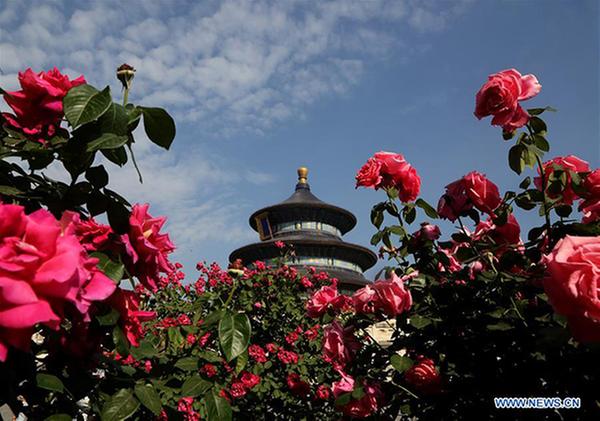 |
| Chinese roses are in full blossom at the Temple of Heaven in Beijing, capital of China, May 16, 2017.[Photo/Xinhua] |
Nearly 27 years have passed, but I clearly remember my first trip to Beijing. It was beautiful, but boring. In Beijing, I met my parents at what then looked like a pretty good hotel in the Liangmaqiao area. To get a taste of Beijing cuisine, however, we had to go to the downtown Dashilan shopping area. But even in Dashilan, where pedestrians were few and traffic light, we couldn't find any decent restaurants serving Beijing food.
So I had lunch at a KFC outlet-my first taste of American fast food.
Born in Chengdu, Sichuan province, known for its vibrant city life, and having studied in Xiamen, Fujian province, one of the five special economic zones set up in the country following the reform and opening-up policy, I quite naturally felt Beijing in those days lacked color.
Beijing is now my second home. I have worked here all my professional life, started my family here, and with pride seen the city's transformation over the years. Restaurants, shops and markets have mushroomed and migrant workers, cars, motorbikes now share the city with shared bicycles. Beijing has become crowded, for sure, but it's more like a metropolis bubbling with life.
Last year, the city authorities launched a drive to close small shops and markets. Which might be absolute necessary to move non-capital functions out of Beijing, especially because the booming of the city's population has been accompanied by the rise of many urban malaises such as soaring housing prices and traffic jams.
According to the city's planning authorities, these moves are aimed at keeping Beijing's population below 23 million by 2020. Most of the senior Beijing residents I talked with support the moves. And their nostalgia for a "cleaner, quieter Beijing" is truly understandable.
However, during a discussion with Beijing vice-mayor Cheng Hong early this month, even some old Beijing residents complained about the inconvenience caused by the closure of markets. Some even said it took them up to three hours to commute to buy vegetables.
According to Cheng, Beijing relocated or upgraded 117 markets last year, of which 45 sold agricultural products. Another 117 markets, 68 of them selling agricultural goods, will be relocated or upgraded this year.
I know dozens of shops and restaurants were closed near my office because they were part of residential buildings and thus could not be used to do business. Iron fences have now come up separating the residential compounds from the pavements. And we appreciate the city authorities' concern for residents' safety and security, yet long for those small eateries that offered us more choices when it came to grabbing a bite.
The popularity of the Sanlitun, known for its bars, and Nanluoguxiang, one of the best-preserved historical areas in downtown Beijing, among tourists shows the magnetic pull small, traditional eateries have.
On a recent weekend, I decided to buy some soil and garden pots for the plants I had ordered online. I visited a small flower market in Haidian district only to discover it was closed. So I drove to Laitai Flower Market in Laitai Flower Street, Chaoyang district. The market was still there, thank god, but most of the small stalls lining the street were gone. I guess the Laitai market is counting its days.
President Xi Jinping has said urban management is a tricky, delicate business. It has to be people-oriented and scientific to achieve sustainable development. This makes urban management a tough and complicated job for a megalopolis and melting pot such as Beijing.
Cheng has promised the relocation of markets will be accompanied by alternative plans to ensure local residents get enough supply of daily necessities.
As a southerner living in Beijing, I hope and believe urban management, and the implementation of Cheng's promise, will make life more convenient for residents while improving the living environment in the capital.
The author is a senior writer with China Daily.
chenliang@chinadaily.com.cn





