



Tsai must rectify policy for Taiwan to prosper









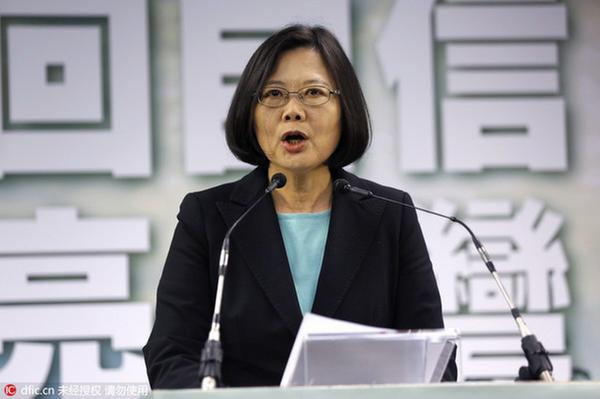 |
| Taiwan's main opposition Democratic Progressive Party, DPP, Chairperson Tsai Ing-wen speaks during a press conference in Taipei, Taiwan,on April 15, 2015. [Photo/IC] |
In the nearly one year that she has been Taiwan leader, Tsai Ing-wen has invited public rage against her reforms. Instead of taking measures to facilitate the economic recovery of the island, which she had promised to do while campaigning for the election last year, the leader of the Democratic Progressive Party has continuously attacked the opposition Kuomintang in the name of political reform.
The first bill the island legislature passed after Tsai's inauguration was about auditing the "improper assets" owned by political parties, which offered a convenient excuse for the DPP to marginalize Kuomintang and seize its "questionable" assets. Her selective "promotion of justice", which criticizes Kuomintang's rule after 1949 yet goes easy on Japan's occupation of Taiwan (1895-1945), has widened the divide on the island.
Tsai's reluctance to uphold the 1992 Consensus, which embodies the one-China principle, has soured cross-Straits relations, for which the island is paying a high price. Her political ambivalence was followed by the suspension of cross-Straits consultation and communication mechanisms, derailed economic cooperation, and a sharp decline in the number of mainland tourists visiting Taiwan.
That, however, failed to wake Tsai up to the latent consequences. The island has been denied permission to participate in this year's World Health Assembly meeting, which will be held in Geneva, Switzerland, on Monday.
Apart from seeking "cultural separatism" by denying the influence of Sun Yat-sen (1866-1925), the founder of Kuomintang and a great revolutionary of modern China, Tsai believes minimizing the economic dependence of Taiwan on the mainland is the right thing to do.
Her "New Southward Policy", which focuses on Southeast Asian markets, has made some progress in diversifying tourist and cultural exchanges, but not enough to change the fact that the Chinese mainland and the Hong Kong Special Administrative Region still account for more than 40 percent of the island's exports. Besides, the withdrawal of the United States from the Trans-Pacific Partnership agreement has dealt another blow to her economic ambitions.
Taiwan did see a double-digit increase in trade exchanges in the first four months of this year and a quarterly growth of 2.56 percent, but that was more because of the robust demand from industrial chains such as Apple. The average wage of Taiwan residents has increased by only a slight margin and its investment environment has not improved much. Tsai's ambition of generating non-nuclear energy as part of her electricity reform, too, faces strong headwinds as renewable energy sources cannot fill the void left by nuclear power plants.
Moreover, most of the industries the Tsai administration has endorsed and funded-from smart engineering to biomedicine-are neither innovative nor major. And the grand infrastructure plan, which involves 800 billion New Taiwan dollars ($27 billion) and spans eight years, has come under fire, because the distribution of resources is largely in favor of regions that support the ruling DPP.
The most controversial of Tsai's reforms is the one regarding working hours, which leaves a loophole that employers can use to force employees to work an extra day on weekends without paying them proper compensation. That, along with the complicated, confusing calculation of overtime pay, has brought down Tsai's approval ratings, which have slid below 30 percent.
The DPP leader's unimpressive performance in her first year in office is not surprising, though, given her desperation to sever ties with the mainland, the largest trading partner of Taiwan, and seek political revenge on the opposition Kuomintang. If Tsai really has the island's best interest in mind, she should change her parochial, "independence-prone" mindset.
The author is a researcher at the Institute of Taiwan Studies, Chinese Academy of Social Sciences.





