



Moon promises change in ROK diplomacy









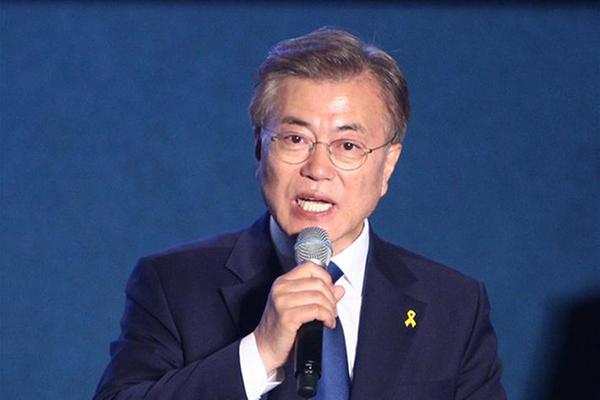 |
| Moon Jae-in of the liberal Minjoo Party speaks during a celebration event in Seoul, South Korea, on May 9, 2017. [Photo/Xinhua] |
Newly elected Republic of Korea President Moon Jae-in faces tough choices on regional security, and political and economic reform. In a phone conversation with Moon one day after his victory, President Xi Jinping emphasized the need for both countries to respect each other's major concerns and interests, as well as maintain a healthy, stable bilateral relationship.
On the deployment of the Terminal High Altitude Area Defense anti-missile system in the ROK, which has hurt bilateral ties, Moon said his government will "proactively" communicate with China while striving to resolve the issue. In fact, the Moon administration has already called for a parliamentary hearing on the deployment of THAAD on ROK soil.
Moon also sent a delegation to the Belt and Road Forum for International Cooperation, which met with Xi on the sidelines of the forum.
Expectations that the Moon administration will adhere to a more balanced diplomacy are high, even though the security dilemma the ROK faces leaves it little choice but to stick to the ROK-US military alliance, which was formed because the United States essentially took over the responsibility of the ROK's national security after the Korean War (1950-53).
Owing to the lack of an independent and comprehensive defense strategy, Seoul may have to stay under Washington's security umbrella, even if it means becoming a part of the US' "rebalancing to Asia" strategy. It also explains why on many occasions Seoul has spoken of Beijing's intervention and Pyongyang's "self-restraint" in the hope that that would help minimize, if not end, the "nuclear threat" from the DPRK.
On the domestic front, the need to promote reforms and restore public trust in political institutions after the impeachment and ouster of former president Park Geun-hye, too, should be taken seriously by Moon. Complaints have often been heard in the ROK about the long absence of efficient communication between the leadership and citizens.
On his campaign trail, Moon promised a less-centralized governing style. His decision to move out of the official presidential residence, or the Blue House, in downtown Seoul where every modern-day ROK president has lived and worked, should be seen as a good sign by those waiting for a change.
To regain public trust he needs to heed the lessons from the scandals the Park administration was involved in, from her seven-hour silence after the sinking of the passenger ferry Sewol in 2014 to the 2015 agreement between the ROK and Japan on settling their differences over Korean "comfort women" (women and girls forced in sexual slavery by the Japanese army before and during World War II).
Reviving an economy mired in rising household debt, high youth unemployment and waning conglomerate-led growth is another daunting task for Moon. Last year saw the dramatic collapse of the ROK's largest shipping company, Hanjin Shipping Co, and Samsung Electronics Co's decision to stop the production, sales and replacement of its "exploding" fire-prone Galaxy Note 7 smartphones. This year, there is a risk that employees of Hyundai Motor Co, the country's largest automaker, could go on a strike. And these developments have prompted the International Monetary Fund to forecast the ROK's growth rate at just 2.7 percent, barely half of the average rate for the Asia-Pacific region.
The veteran politician and former lawyer may have to resort to political reshuffling to make sure his Democratic Party has an overwhelming majority in the national assembly. And the fact that he vowed to reorganize the presidential office after appointing senior secretaries to his office suggests he is moving in that direction.
On the DPRK nuclear issue and the installation of THAAD, the Moon administration would be wise to seek talks with all parties concerned to properly resolve the issues. In this regard, Moon should be lauded for his consideration to send special envoys to Beijing. All these indicate changes can be expected, especially because Moon seems inclined to play a more active diplomatic role in engaging with Pyongyang.
The author is a senior researcher at the Pangoal Institution.





