



Indian fishermen try new nets for healthier oceans









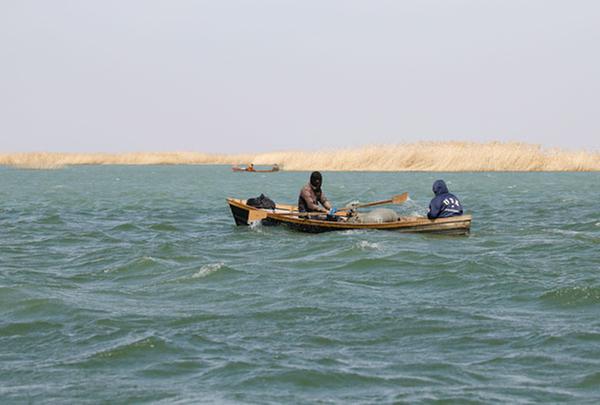 |
| Fishermen sail a boat on the Aral Sea outside the village of Karateren, south-western Kazakhstan, April 15, 2017. [Photo/Agencies] |
It took years for the UN Development Program to convince the fishing communities along India's tropical western coast that the diamond-mesh nets they were using were trapping baby fish, while a square-shaped mesh could allow small fish to escape to maintain a breeding population. But two years after the new nets were fully adopted, fishermen insist they're making a difference.
"This square net is a blessing for us," said John Gabriel Naronha, who runs six trawlers in the area. "When the small fish grows up, the fishermen can really benefit ... we can get good prices for big fish. And the small fish gets a chance to grow."The project, launched in 2011, is one of many being showcased at a major conference on oceans beginning Monday, where the United Nations will plead with nations to help halt a global assault on marine life and ecosystems that is threatening jobs, economies and even human lives.
"The oceans of the planet are in dire need of urgent action," said Marina Walter, deputy director for UNDP in India. That action is even more urgent now that climate change is causing ocean temperatures to rise while waters also become more acidic, causing widespread destruction of coral reefs that sustain a quarter of all marine species.
But conservation efforts work best when they're linked with local livelihoods, Walter said. "You cannot work on biodiversity or life underwater in isolation, without looking at the livelihoods of people, the bread and butter."No one in 80 or so fishing villages of Sindhudurg district expected to have problems fishing, after centuries of their families relying on the sea. Located in one of India's 11 ecologically critical coastline habitats, the area is teeming with life from more than 350 marine species including Indian Ocean dolphins and Olive Ridley turtles. Colorful corals span the shallows, while tangles of mangrove forests protect the land from water erosion.
But that bounty has suffered against the twin assaults of overfishing and pollution, which caused a steady decline local fish stocks and forced fishermen to push further out to sea.
Since switching to new nets, fishermen say fish stocks are recovering, though there is no data collected yet to prove it. Surveys of fish population may be conducted at the end of this year, when the UNDP finishes its six-year project in the area.
The struggles of India's fishermen are hardly unique. About one out of every 10 people in the world relies directly on the ocean to survive. Most of those are among the world's poorest and most vulnerable, meaning they have few substitutes when marine life declines.
And it is declining rapidly, thanks to increased fishing for an expanding global population and unchecked runoff of industrial chemicals, sewage and other pollutants. Already, about 90 percent of wild fisheries around the world are over-exploited or collapsed.
Meanwhile, the UNDP has also helped set up a crab farming project in the Sindudurg area to encourage local preservation of the mangroves and resistance to land developers and those gathering firewood from chopping the saltwater-tolerant trees down.
Now, nurseries for crab seedlings line up along a 2-acre (8,000-square-meter) stretch of backwater pools filled with the mud that crabs like to dig into. It takes up to nine months for the crabs to grow to full size, at which point they are harvested and sold for about $15 per kilogram ($6.80 a pound).
Recently, the group of nine women and one man earned nearly $1,000 in profits from a single harvest.
Local officials are delighted with the low-fuss process and positive results.
"With very little manipulation of the environment, you can grow crabs wherever you have mangroves," said N. Vasudevan, who heads a special unit dedicated to mangrove conservation for the government of India's western state of Maharashtra.
This story corrects number of villages.
AP
- China successfully tests marine natural gas hydrates
- Sales contract dispute between Jiangsu-based Tiansen Petrochemical Co, Ltd, Zhangjiagang-based CNPC & TAFO Transportation Co, Ltd, CNPC & TAFO Marine Bunkers Co, Ltd and Taizhou-based Jiangtai Transportation and Sale Co, Ltd
- Projects harken Fujian's expanding marine economy
- New marine expo sails into Pingtan










