Corporate shoppers take a breather









Overseas M&A's coast on the China-led Belt & Road Initiative, but hit bumps in rising valuations, stricter regulations
After the euphoria over outbound M&A, or mergers and acquisitions, last year, it's time to get back to senses this year and stage a recovery next year-that sums up Chinese companies' current thinking.
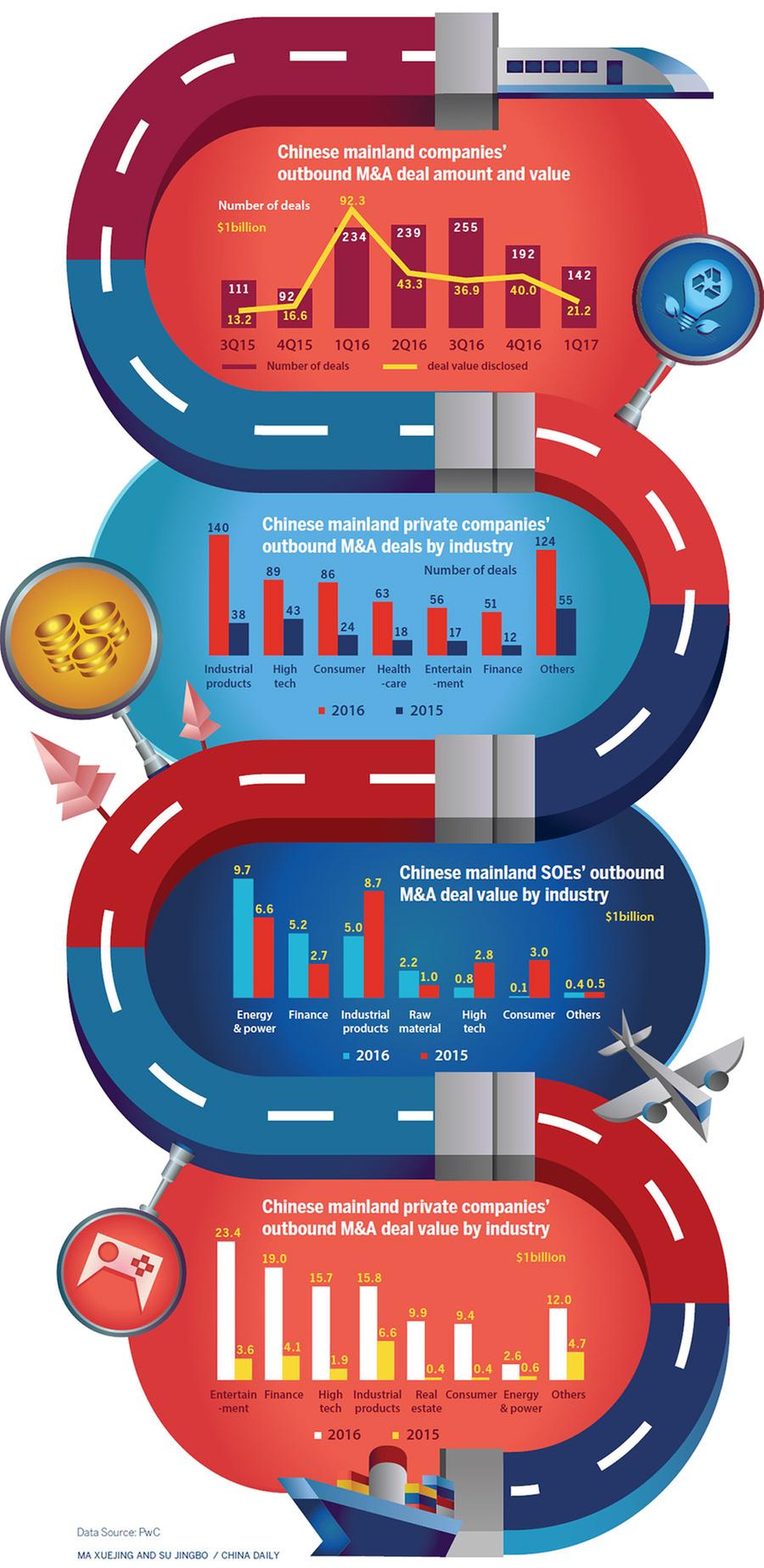
Chinese companies never had it so good in M&A as they did last year. They spent $212.5 billion, almost 3.5 times that of 2015, to merge with, or acquire, companies overseas in 920 deals, up 142.1 percent from 2015, according to accounting firm PricewaterhouseCoopers.
An abundance of capital and cheap debt, pursuit of growth outside a slowing economy and efforts to meet the standards of a more affluent and brand-conscious middle class are still giving momentum to outbound M&A, a report of global law firm Clifford Chance, said.
The first quarter of this year extended the record run of 2016, coasting on opportunities presented by the Belt and Road Initiative. Mainland companies announced 142 outbound M&A's with a combined value of $21.2 billion.
The PwC report said 32 percent of overseas M&A's by Chinese companies in the first quarter of this year were in Asia, a key region for the Belt and Road Initiative.
One of the prominent M&A deals this year involved leading Chinese automaker Zhejiang Geely Holding Group. Geely picked up a 49.9 percent stake in Malaysian carmaker Proton Holdings Bhd from DRB-Hicom Bhd, a Malaysian conglomerate.
Geely will also buy a 51 percent share in Lotus, a British sports carmaker owned by Proton.
Malaysia is one of the many economies participating in the Belt and Road Initiative. Geely and Lotus are expected to sign a final agreement before the end of July, the company said at May-end.
"With Proton and Lotus joining the Geely Group portfolio of brands, we strengthen our global footprint and develop a beachhead in Southeast Asia," said Li Donghui, executive vice-president of Geely.
Guan Qingyou, research director of Minsheng Securities, said, "The Belt and Road Initiative will promote China's merger and acquisition tide" as companies can decrease deal costs and risks with State financial support.
Chen Chao, director of transaction services at PwC China, said, "Cross-border deals with strategic significance, especially industrial upgrading and the Belt and Road-related projects, will dominate the overseas merger and acquisition market this year."
Given the surge in the number of M&A's, Chinese authorities moved to step up supervision in December.
The National Development and Reform Commission, the Ministry of Commerce, the People's Bank of China, and the State Administration of Foreign Exchange declared that they would pay closer attention to overseas investments in hotels, sports clubs, film studios and property.
In January, SAFE released a guideline to tighten review procedures for overseas direct investments.
Meanwhile, Chinese corporate buyers are facing stricter regulatory hurdles and security reviews overseas.
There is another twist in the tale. The volume and value of first-quarter deals dropped 39 percent and 77 percent year-on-year, respectively, from record highs, according to the PwC report.
The report attributed the year-on-year slump in first-quarter M&A's to the slower pace of going abroad by State-owned enterprises and private companies. The deal value by financial investors in the first quarter even plunged 91 percent year-on-year.
"Besides tougher requirements by the regulatory authorities, the global political and economic landscape has been undergoing a new round of rebalancing, with increasing external uncertainties," said Chen of PwC.
"After the blistering growth in 2016, there will be an obvious decrease in overseas acquisition deals this year and the recovery will come in 2018."
Toby Gibb, investment director of European equities at Fidelity International, said the rise of populism has caused many national governments to be much more sensitive to foreign investments, especially in key industries.
This is proving to be a limiting factor for global investors, including those from China, looking for overseas M&A's. So, Europe and the United States will continue to be their key destinations because of their advanced industry, technology and brands, said Wang Peng, a partner at PwC China.
In 2016 and the first quarter of this year, nearly 60 percent of deals secured by mainland companies were in the European and US markets, according to the PwC report.
Hu Bing, co-CEO and president of Russia-China Investment Fund, said as bilateral relations between Russia and China continue to flourish, and cross-border trade is expected to increase significantly in the next couple of years, many Chinese companies and financial institutions are going to Russia to seek M&A's.
But Gibb of Fidelity said Chinese investors would face uncertainties in Europe."If valuations of assets in Europe rise and if the euro rises, they could be limiting factors for M&A, which are still sentiment-driven. We still have Brexit and the Italian election next year, so we don't know how their results would influence M&As."
In terms of deal value, entertainment was the most popular sector among Chinese private enterprises in 2016. It was followed by finance, intelligent manufacturing and the high-tech sector.
Energy and power, finance and industrial products were popular among SOEs last year, PwC said in its report.
Chen said companies engaged in agriculture, machinery equipment, energy and aircraft manufacturing will be key M&A targets for Chinese players this year.
He said in the short term, listed Chinese companies overseas and dollar-dominated private equity funds will have an advantage over investors holding only RMB assets in outbound M&A's.